
通过实验感染载体 Chrysops silacea 来生成 Loa loa 感染性幼虫。
Generation of Loa loa infective larvae by experimental infection of the vector, Chrysops silacea.
机构信息
Parasites and Vector Biology research unit (PAVBRU), Department of Microbiology and Parasitology, University of Buea, Buea, Cameroon.
Research Foundation for Tropical Diseases and the Environment (REFOTDE), Buea, Cameroon.
出版信息
PLoS Negl Trop Dis. 2020 Aug 17;14(8):e0008415. doi: 10.1371/journal.pntd.0008415. eCollection 2020 Aug.
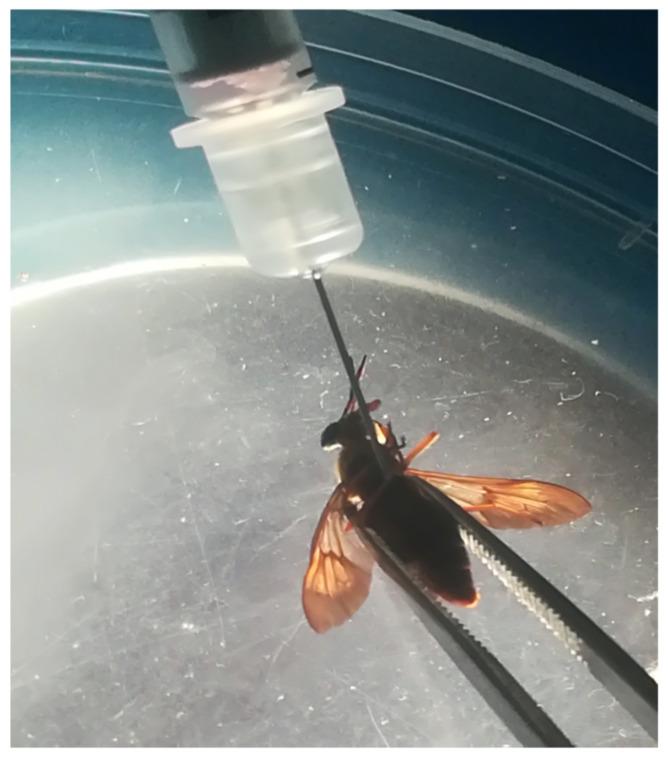
Basic and translational research on loiasis, a filarial nematode infection of medical importance, is impeded by a lack of suitable Loa loa infection models and techniques of obtaining and culturing life cycle stages. We describe the development of a new method for routine production of infective third-stage larvae (L3) of L. loa from the natural intermediate arthropod vector host, Chrysops silacea, following experimental infection with purified microfilariae. At 14-days post-infection of C. silacea, the fly survival rate was 43%. Survival was significantly higher in flies injected with 50 mf (55.2%) than those that received 100 mf (31.0%). However, yield per surviving fly and total yield of L3 was markedly higher in the group of flies inoculated with 100 mf (3474 vs 2462 L3 produced). The abdominal segment hosted the highest percentage recovery of L3 (47.7%) followed by head (34.5%) and thorax (17.9%). L. loa larval survival was higher than 90% after 30 days of in vitro culture. The in vitro moulting success rate to the L4 larval stage was 59.1%. After experimental infection of RAG2-/-IL-2γc-/-mice, the average L. loa juvenile adult worm recovery rate was 10.5% at 62 dpi. More than 87% of the worms were recovered from the muscles and subcutaneous tissues. Worms recovered measured an average 24.3 mm and 11.4 mm in length for females (n = 5) and males (n = 5), respectively. In conclusion, L. loa mf injected into C. silacea intrathoracically develop into infective larvae that remain viable and infective comparable to L3 obtained through natural feeding on the human host. This technique further advances the development of a full laboratory life cycle of L. loa where mf derived from experimentally-infected animals may be utilized to passage life cycle generations via intrathoracic injections of wild-caught vector hosts.
旋毛虫是一种医学重要的丝虫线虫感染,其基础和转化研究受到缺乏合适的旋毛虫感染模型和获取及培养生活史阶段技术的阻碍。我们描述了一种从自然中间宿主 Chrysops silacea 中常规生产感染性第三期幼虫 (L3) 的新方法的发展,该方法是在经纯化微丝蚴实验感染后进行的。在 C. silacea 感染后 14 天,苍蝇的存活率为 43%。与接受 100 mf 的苍蝇相比,注射 50 mf 的苍蝇的存活率明显更高 (55.2%对 31.0%)。然而,接种 100 mf 的苍蝇的每只存活苍蝇的产量和总 L3 产量明显更高 (产生的 3474 个 L3 对 2462 个 L3)。L3 的回收率最高的是腹部节段 (47.7%),其次是头部 (34.5%)和胸部 (17.9%)。在体外培养 30 天后,L. loa 幼虫的存活率高于 90%。L4 幼虫阶段的体外蜕皮成功率为 59.1%。在 RAG2-/-IL-2γc-/-小鼠的实验感染后,62 dpi 时平均回收 L. loa 幼体成虫的回收率为 10.5%。超过 87%的蠕虫从肌肉和皮下组织中回收。回收的蠕虫平均长度为雌性 (n = 5) 24.3 毫米和雄性 (n = 5) 11.4 毫米。总之,注入 C. silacea 胸内的 L. loa mf 发育成感染性幼虫,这些幼虫保持活力和感染力,与通过自然感染人类宿主获得的 L3 相当。这项技术进一步推进了 L. loa 的全实验室生活史的发展,其中可以利用从实验感染动物中获得的 mf 通过胸内注射野生捕获的媒介宿主来传递生活史世代。



 Zotero 插件