
miR-421 的上调预示着预后不良,并促进甲状腺乳头状癌细胞的增殖、迁移和侵袭。
Upregulation of miR-421 predicts poor prognosis and promotes proliferation, migration, and invasion of papillary thyroid cancer cells.
机构信息
Department of Thyroid Surgery, The Affiliated Hospital of Qingdao University, Qingdao, Shandong, China.
出版信息
J Chin Med Assoc. 2020 Nov;83(11):991-996. doi: 10.1097/JCMA.0000000000000426.
BACKGROUND
Papillary thyroid carcinoma (PTC) represents the most frequent subtype of thyroid cancer (TC) with poor prognosis mainly due to the severe invasion and metastasis. As an oncogene, microRNA-421 (miR-421) is involved in the development of various cancers. This study was to investigate the clinical significance of miR-421 in PTC and its effects on the biological function of PTC cells.
METHODS
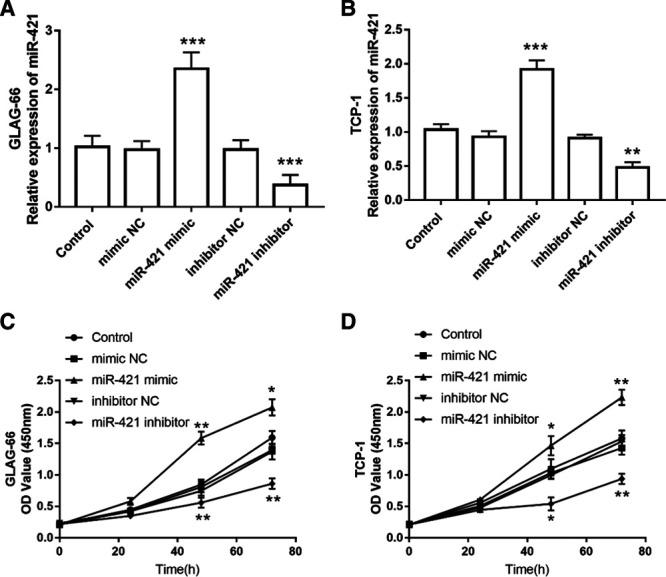
The expression level of miR-421 in all tissues and PTC cell lines was measured by quantitative real-time polymerase chain reaction (qRT-PCR). Subsequently, the relationship between miR-421 expression and the clinicopathological feature was detected by chi-square analysis in 106 patients with PTC. In addition, Kaplan-Meier and multivariate Cox regression analysis were used to detect the survival time and the prognostic value of miR-421. Finally, the regulatory effect of miR-421 on the proliferation, migration, and invasion ability of PTC cells was detected by Cell Counting Kit (CCK-8) and Transwell assay.
RESULTS
Compared with all control groups, the expression of miR-421 was significantly increased in 106 patients tissues and PTC cell lines (p < 0.001). In addition, patients with miR-421 upregulated in PTC showed more positive lymph node metastasis (p = 0.011), positive tumor infiltration (p = 0.031), and TNM stage III/IV (p = 0.019), and when miR-421 expression level was elevated, the survival rate of PTC patients was poor (log-rank test, p = 0.023). Furthermore, miR-421 might be an independent prognostic biomarker for PTC (hazard ratio [HR] = 3.172, 95% CI = 1.071-9.393, p = 0.037). Finally, increased levels of miR-421 can significantly promote cell proliferation, migration, and invasion (p < 0.01).
CONCLUSION
miR-421 is a novel oncogene of PTC and is a valuable prognostic biomarker. Moreover, the upregulation of miR-421 enhances the proliferation, migration, and invasion of PTC cells.
背景
甲状腺癌(TC)中最常见的亚型是甲状腺乳头状癌(PTC),其预后较差,主要是因为其严重的侵袭和转移。作为一种癌基因,miR-421 参与了各种癌症的发展。本研究旨在探讨 miR-421 在 PTC 中的临床意义及其对 PTC 细胞生物学功能的影响。
方法
采用实时定量聚合酶链反应(qRT-PCR)检测所有组织和 PTC 细胞系中 miR-421 的表达水平。然后,通过卡方检验检测 106 例 PTC 患者 miR-421 表达与临床病理特征的关系。此外,通过 Kaplan-Meier 和多因素 Cox 回归分析检测 miR-421 的生存时间和预后价值。最后,通过 CCK-8 和 Transwell 实验检测 miR-421 对 PTC 细胞增殖、迁移和侵袭能力的调控作用。
结果
与所有对照组相比,106 例患者组织和 PTC 细胞系中 miR-421 的表达明显升高(p<0.001)。此外,PTC 中 miR-421 上调的患者表现出更多的阳性淋巴结转移(p=0.011)、阳性肿瘤浸润(p=0.031)和 TNM 分期 III/IV(p=0.019),当 miR-421 表达水平升高时,PTC 患者的生存率较差(对数秩检验,p=0.023)。此外,miR-421 可能是 PTC 的独立预后生物标志物(危险比[HR]=3.172,95%CI=1.071-9.393,p=0.037)。最后,miR-421 水平的升高可显著促进细胞增殖、迁移和侵袭(p<0.01)。
结论
miR-421 是 PTC 的一种新型癌基因,是一种有价值的预后生物标志物。此外,miR-421 的上调增强了 PTC 细胞的增殖、迁移和侵袭能力。


 Zotero 插件