Jones Lindsey E, Hilz Stephanie, Grimmer Matthew R, Mazor Tali, Najac Chloé, Mukherjee Joydeep, McKinney Andrew, Chow Tracy, Pieper Russell O, Ronen Sabrina M, Chang Susan M, Phillips Joanna J, Costello Joseph F
Department of Neurological Surgery, University of California, San Francisco, California, USA.
Biomedical Sciences Graduate Program, University of California, San Francisco, California, USA.
Neurooncol Adv. 2020 Jul 16;2(1):vdaa088. doi: 10.1093/noajnl/vdaa088. eCollection 2020 Jan-Dec.
mutant lower-grade gliomas (LGGs) evolve under the selective pressure of therapy, but well-characterized patient-derived cells (PDCs) modeling evolutionary stages are lacking. -mutant LGGs may develop therapeutic resistance associated with chemotherapy-driven hypermutation and malignant progression. The aim of this study was to establish and characterize PDCs, single-cell-derived PDCs (scPDCs), and xenografts (PDX) of -mutant recurrences representing distinct stages of tumor evolution.
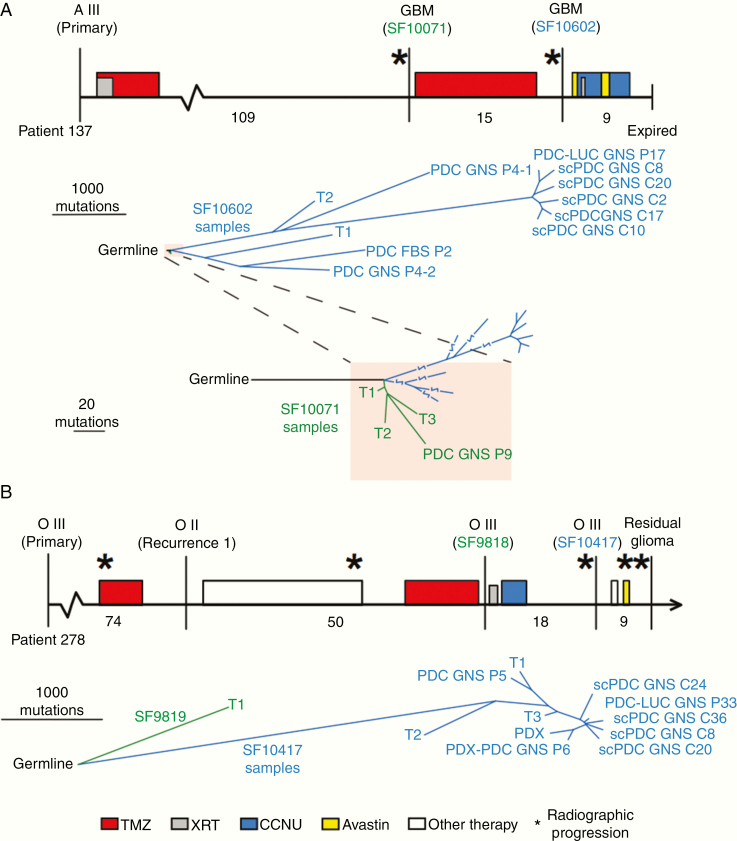
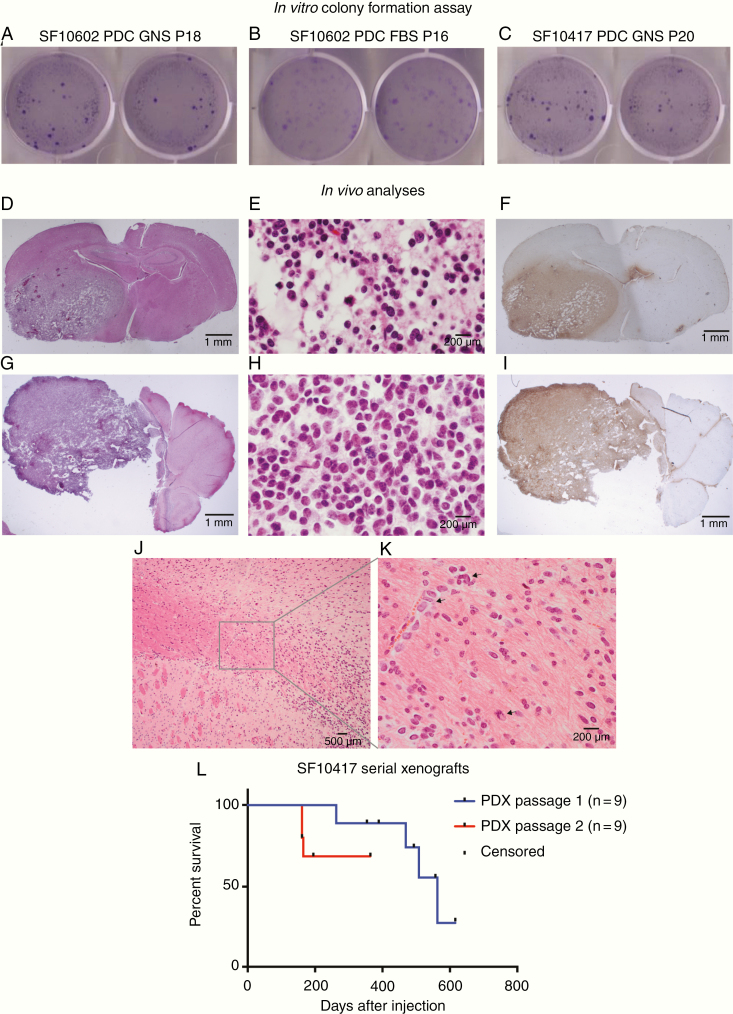
We derived and validated cell cultures from mutant recurrences of astrocytoma and oligodendroglioma. We used exome sequencing and phylogenetic reconstruction to examine the evolutionary stage represented by PDCs, scPDCs, and PDX relative to corresponding spatiotemporal tumor tissue and germline DNA. PDCs were also characterized for growth and tumor immortality phenotypes, and PDX were examined histologically.
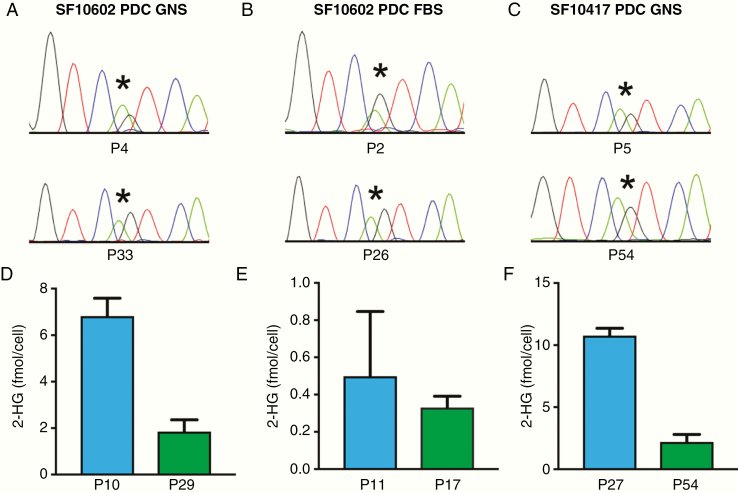
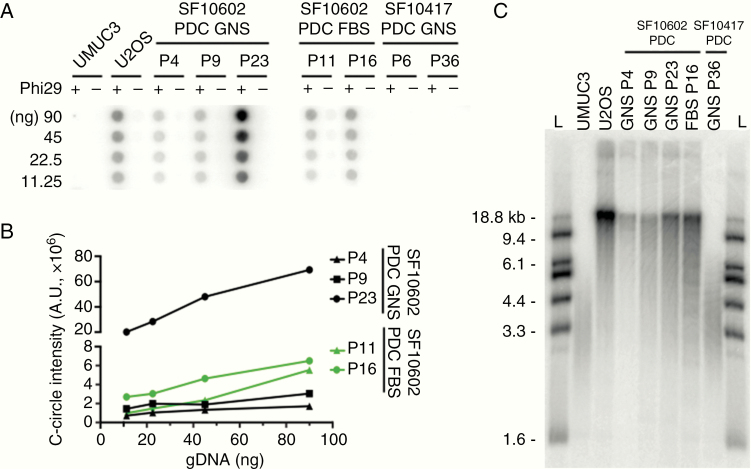
The integrated astrocytoma phylogeny revealed 2 independent founder clonal expansions of hypermutated (HM) cells in tumor tissue that are faithfully represented by independent PDCs. The oligodendroglioma phylogeny showed more than 4000 temozolomide-associated mutations shared among tumor samples, PDCs, scPDCs, and PDX, suggesting a shared monoclonal origin. The PDCs from both subtypes exhibited hallmarks of tumorigenesis, retention of subtype-defining genomic features, production of 2-hydroxyglutarate, and subtype-specific telomere maintenance mechanisms that confer tumor cell immortality. The oligodendroglioma PDCs formed infiltrative intracranial tumors with characteristic histology.
These PDCs, scPDCs, and PDX are unique and versatile community resources that model the heterogeneous clonal origins and functions of recurrent -mutant LGGs. The integrated phylogenies advance our knowledge of the complex evolution and immense mutational load of -mutant HM glioma.
突变型低级别胶质瘤(LGGs)在治疗的选择压力下发生演变,但缺乏能够很好地表征肿瘤进化阶段的患者来源细胞(PDCs)。突变型LGGs可能会产生与化疗驱动的高突变和恶性进展相关的治疗抗性。本研究的目的是建立并表征代表肿瘤进化不同阶段的突变型复发肿瘤的PDCs、单细胞来源的PDCs(scPDCs)和异种移植瘤(PDX)。
我们从星形细胞瘤和少突胶质细胞瘤的突变型复发肿瘤中获取并验证了细胞培养物。我们使用外显子组测序和系统发育重建来检查PDCs、scPDCs和PDX相对于相应的时空肿瘤组织和种系DNA所代表的进化阶段。还对PDCs的生长和肿瘤永生表型进行了表征,并对PDX进行了组织学检查。
整合后的星形细胞瘤系统发育显示,肿瘤组织中高突变(HM)细胞有2个独立的起始克隆扩增,由独立的PDCs忠实地代表。少突胶质细胞瘤系统发育显示,肿瘤样本、PDCs、scPDCs和PDX之间共有4000多个与替莫唑胺相关的突变,表明它们有共同的单克隆起源。来自这两种亚型的PDCs均表现出肿瘤发生的特征、保留了定义亚型的基因组特征、产生了2-羟基戊二酸以及赋予肿瘤细胞永生的亚型特异性端粒维持机制。少突胶质细胞瘤PDCs形成了具有特征性组织学的浸润性颅内肿瘤。
这些PDCs、scPDCs和PDX是独特且通用的群体资源,可模拟复发性突变型LGGs的异质克隆起源和功能。整合后的系统发育推进了我们对突变型HM胶质瘤复杂进化和巨大突变负荷的认识。