Department of Obstetrics and Gynecology, Amsterdam UMC, Academic Medical Center, Amsterdam, The Netherlands.
Department of Infectious Diseases, Amsterdam UMC, Academic Medical Center, Amsterdam, The Netherlands.
Ultrasound Obstet Gynecol. 2021 Mar;57(3):431-439. doi: 10.1002/uog.23126. Epub 2021 Feb 12.
To evaluate the long-term outcomes of children born to women with a short cervix and otherwise low risk for preterm birth, after antenatal exposure to vaginal progesterone vs placebo.
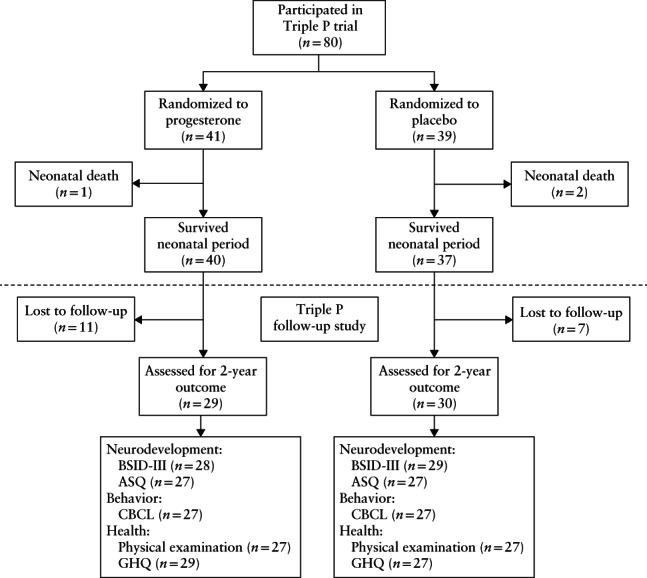
This was a follow-up study of the Triple P trial, which randomized 80 low-risk women with a short cervix (≤ 30 mm) at 18-22 weeks' gestation to progesterone (n = 41) or placebo (n = 39). At 2 years of corrected age, children were invited for a neurodevelopmental assessment, using the Bayley Scales of Infant and Toddler Development, third edition (BSID-III), and a neurological and physical examination by an assessor blinded to the allocated treatment. Parents filled out the Ages and Stages Questionnaire, the Child Behavior Checklist (CBCL) and a general-health questionnaire. The main outcome of interest was mean BSID-III cognitive and motor scores. Additionally, a composite score of mortality and abnormal developmental outcome, including BSID-III ≤-1 SD, CBCL score in the clinical range and/or parental reported physical problems (at least two operations or at least two hospital admissions in the previous 2 years), was evaluated. Our sample size, dictated by the original sample of the Triple P trial, provided 80% power to detect a mean difference (MD) of 15 points (1 SD) between groups for the BSID-III tests.
Of the 80 children born to the randomized women, one in the progesterone group and two in the placebo group died in the neonatal period. Follow-up data were obtained for 59/77 (77%) children and BSID-III outcomes in 57 children (n = 28 in the progesterone group and n = 29 in the placebo group) born at a median gestational age of 38 + 6 weeks (interquartile range (IQR), 37 + 3 to 40 + 1 weeks) with a median birth weight of 3240 g (IQR, 2785-3620 g). In the progesterone vs placebo groups, mean BSID-III cognitive development scores were 101.6 vs 105.0 (MD, -3.4 (95% CI, -9.3 to 2.6); P = 0.29) while mean motor scores were 102.4 vs 107.3 (MD, -4.9 (95% CI, -11.2 to 1.4); P = 0.13). No differences were seen between the two groups in physical (including genital and neurological examination), behavioral and health-related outcomes.
In this sample of children born to low-risk women with a short cervix at screening, no relevant differences in neurodevelopmental, behavioral, health-related and physical outcomes were found between offspring exposed to vaginal progesterone and those exposed to placebo. © 2020 The Authors. Ultrasound in Obstetrics & Gynecology published by John Wiley & Sons Ltd on behalf of International Society of Ultrasound in Obstetrics and Gynecology.
评估在产前接触阴道孕酮与安慰剂后,宫颈较短(≤30mm)且早产风险较低的女性所生儿童的长期结局。
这是 Triple P 试验的随访研究,该研究将 80 名妊娠 18-22 周、宫颈较短(≤30mm)的低风险女性随机分为孕酮组(n=41)和安慰剂组(n=39)。在 2 岁的校正年龄时,邀请儿童接受贝利婴幼儿发育量表第三版(BSID-III)的神经发育评估、由评估者进行神经学和体格检查,评估者对分配的治疗方法不知情。父母填写了年龄和阶段问卷、儿童行为检查表(CBCL)和一般健康问卷。主要观察指标是平均 BSID-III 认知和运动评分。此外,还评估了死亡率和发育异常结果的复合评分,包括 BSID-III ≤-1SD、CBCL 评分处于临床范围和/或父母报告的身体问题(至少两次手术或至少两次住院治疗在过去 2 年)。我们的样本量是根据 Triple P 试验的原始样本确定的,为检测两组间 BSID-III 测试的平均差异(MD)15 分(1SD)提供了 80%的效力。
在随机分配的女性所生的 80 名儿童中,1 名在孕酮组,2 名在安慰剂组新生儿期死亡。对 77%(59/77)的儿童进行了随访数据采集,对 57 名儿童(孕酮组 28 名,安慰剂组 29 名)进行了 BSID-III 结果采集,这些儿童均在中位妊娠 38+6 周(四分位距(IQR),37+3 至 40+1 周)时出生,中位出生体重为 3240g(IQR,2785-3620g)。在孕酮组和安慰剂组中,BSID-III 认知发育评分分别为 101.6 和 105.0(MD,-3.4(95%CI,-9.3 至 2.6);P=0.29),运动评分分别为 102.4 和 107.3(MD,-4.9(95%CI,-11.2 至 1.4);P=0.13)。两组间的体格(包括生殖器和神经检查)、行为和健康相关结局无差异。
在这项筛查时宫颈较短且早产风险较低的低危女性所生儿童的样本中,暴露于阴道孕酮的儿童与暴露于安慰剂的儿童在神经发育、行为、健康相关和体格结局方面没有发现明显差异。