
桑辛酮通过改善肾脏纤维化和炎症来保护肾小球系膜细胞功能障碍对抗血管紧张素 II。
Sauchinone Protects Renal Mesangial Cell Dysfunction against Angiotensin II by Improving Renal Fibrosis and Inflammation.
机构信息
Hanbang Cardio-Renal Syndrome Research Center, Wonkwang University, 460, Iksan-daero, Iksan, Jeonbuk 54538, Korea.
College of Oriental Medicine and Professional Graduate School of Oriental Medicine, Wonkwang University, 460, Iksan-daero, Iksan, Jeonbuk 54538, Korea.
出版信息
Int J Mol Sci. 2020 Sep 23;21(19):7003. doi: 10.3390/ijms21197003.
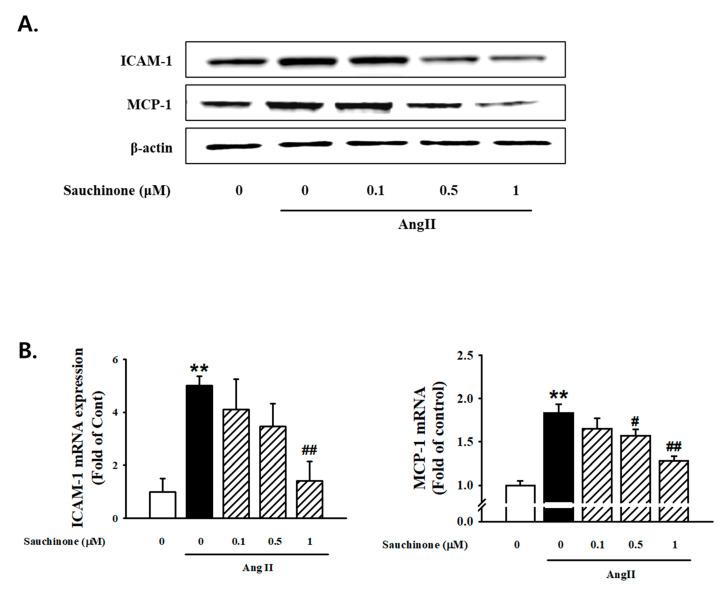
Abnormal and excessive growth of mesangial cells is important in the pathophysiologic processes of diabetes-associated interstitial fibrosis and glomerulosclerosis, leading to diabetic nephropathy, which eventually turns into end-stage renal disease. Sauchinone, a biologically-active lignan isolated from aerial parts of , has anti-inflammatory and anti-viral activities effects on various cell types. However, there are no studies reporting the effects of sauchinone on diabetic nephropathy. The present study aims to investigate the role of sauchinone in mesangial cell proliferation and fibrosis induced by angiotensin II, as well as the underlying mechanisms of these processes. Human renal mesangial cells were induced by angiotensin II (AngII, 10 μM) in the presence or absence of sauchinone (0.1-1 μM) and incubated for 48 h. In this study, we found that AngII induced mesangial cell proliferation, while treatment with sauchinone inhibited the cell proliferation in a dose-dependent manner. Pre-treatment with sauchinone induced down-regulation of cyclins/CDKs and up-regulation of CDK inhibitor, p21, and p27 expression. In addition, AngII-enhanced expression of fibrosis biomarkers such as fibronectin, collagen IV, and connective tissue growth factor (CTGF), which was markedly attenuated by sauchinone. Sauchinone also decreased AngII-induced TGF-β1 and Smad-2, Smad-3, and Smad-4 expression. This study further revealed that sauchinone ameliorated AngII-induced mesangial inflammation through disturbing activation of inflammatory factors, and NLRP3 inflammasome, which is composed of the NLRP3 protein, procaspase-1, and apoptosis-associated speck-like protein containing a CARD (ASC). Moreover, pretreatment of sauchinone inhibited NF-κB translocation and ROS production in AngII-exposed mesangial cells. These data suggest that sauchinone has a protective effect on renal proliferation, fibrosis and inflammation. Therefore, sauchinone might be a potential pharmacological agent in prevention of AngII-induced renal damage leading to diabetic nephropathy.
系膜细胞的异常和过度生长在糖尿病相关的间质纤维化和肾小球硬化的病理生理过程中很重要,导致糖尿病肾病,最终发展为终末期肾病。sauchinone 是一种从 的地上部分分离得到的生物活性木脂素,对各种细胞类型具有抗炎和抗病毒作用。然而,目前还没有研究报道 sauchinone 对糖尿病肾病的影响。本研究旨在探讨 sauchinone 对血管紧张素 II 诱导的系膜细胞增殖和纤维化的作用及其机制。将人肾系膜细胞用血管紧张素 II(AngII,10μM)诱导,并在存在或不存在 sauchinone(0.1-1μM)的情况下孵育 48h。在这项研究中,我们发现 AngII 诱导系膜细胞增殖,而 sauchinone 以剂量依赖性方式抑制细胞增殖。sauchinone 预处理诱导细胞周期蛋白/CDK 下调和 CDK 抑制剂 p21 和 p27 表达上调。此外,AngII 增强了纤维化生物标志物如纤连蛋白、IV 型胶原和结缔组织生长因子(CTGF)的表达,而 sauchinone 明显减弱了这些表达。sauchinone 还降低了 AngII 诱导的 TGF-β1 和 Smad-2、Smad-3 和 Smad-4 的表达。本研究进一步表明,sauchinone 通过干扰炎症因子和 NLRP3 炎性体的激活来改善 AngII 诱导的系膜炎症,NLRP3 炎性体由 NLRP3 蛋白、原半胱天冬酶-1 和含有 CARD(ASC)的凋亡相关斑点样蛋白组成。此外,sauchinone 预处理抑制了 AngII 暴露的系膜细胞中 NF-κB 的易位和 ROS 的产生。这些数据表明 sauchinone 对肾脏增殖、纤维化和炎症具有保护作用。因此,sauchinone 可能是预防 AngII 诱导的肾脏损伤导致糖尿病肾病的潜在药理学药物。



 Zotero 插件