Bodt Louise Hart, Rollins Lee Ann, Zichello Julia M
Educational Laboratory for Comparative Genomics and Human Origins American Museum of Natural History New York NY USA.
Cold Spring Harbor Laboratory DNA Learning Center Cold Spring Harbor NY USA.
Ecol Evol. 2020 Aug 27;10(18):10186-10195. doi: 10.1002/ece3.6679. eCollection 2020 Sep.
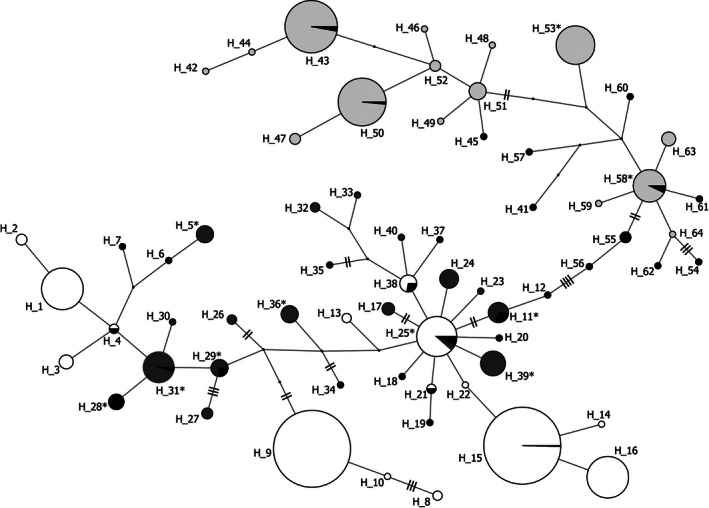
European starlings () represent one of the most widespread and problematic avian invasive species in the world. Understanding their unique population history and current population dynamics can contribute to conservation efforts and clarify evolutionary processes over short timescales. European starlings were introduced to Central Park, New York in 1890, and from a founding group of about 100 birds, they have expanded across North America with a current population of approximately 200 million. There were also multiple introductions in Australia in the mid-19th century and at least one introduction in South Africa in the late 19th century. Independent introductions on these three continents provide a robust system to investigate invasion genetics. In this study, we compare mitochondrial diversity in European starlings from North America, Australia, and South Africa, and a portion of the native range in the United Kingdom. Of the three invasive ranges, the North American population shows the highest haplotype diversity and evidence of both sudden demographic and spatial expansion. Comparatively, the Australian population shows the lowest haplotype diversity, but also shows evidence for sudden demographic and spatial expansion. South Africa is intermediate to the other invasive populations in genetic diversity but does not show evidence of demographic expansion. In previous studies, population genetic structure was found in Australia, but not in South Africa. Here we find no evidence of population structure in North America. Although all invasive populations share haplotypes with the native range, only one haplotype is shared between invasive populations. This suggests these three invasive populations represent independent subsamples of the native range. The structure of the haplotype network implies that the native-range sampling does not comprehensively characterize the genetic diversity there. This study represents the most geographically widespread analysis of European starling population genetics to date.
欧洲椋鸟()是世界上分布最广、问题最多的鸟类入侵物种之一。了解它们独特的种群历史和当前的种群动态有助于保护工作,并阐明短时间尺度上的进化过程。1890年欧洲椋鸟被引入纽约中央公园,从最初约100只鸟的群体开始,它们已在北美扩张,目前种群数量约为2亿只。19世纪中叶在澳大利亚也有多次引入,19世纪末在南非至少有一次引入。在这三大洲的独立引入为研究入侵遗传学提供了一个强大的系统。在本研究中,我们比较了来自北美、澳大利亚和南非的欧洲椋鸟以及英国部分原生范围内的线粒体多样性。在这三个入侵区域中,北美种群显示出最高的单倍型多样性,并有突然的种群数量和空间扩张的证据。相比之下,澳大利亚种群显示出最低的单倍型多样性,但也有突然的种群数量和空间扩张的证据。南非在遗传多样性方面介于其他入侵种群之间,但没有显示出种群数量扩张的证据。在先前的研究中,在澳大利亚发现了种群遗传结构,但在南非没有发现。在这里,我们在北美没有发现种群结构的证据。尽管所有入侵种群都与原生范围共享单倍型,但入侵种群之间只共享一个单倍型。这表明这三个入侵种群代表了原生范围的独立子样本。单倍型网络的结构意味着原生范围的采样并没有全面表征那里的遗传多样性。这项研究是迄今为止对欧洲椋鸟种群遗传学在地理上分布最广的分析。