Kawabe Mayuko, Yamamoto Izumi, Yamakawa Takafumi, Katsumata Haruki, Isaka Nao, Katsuma Ai, Nakada Yasuyuki, Kobayashi Akimitsu, Koike Kentaro, Ueda Hiroyuki, Tanno Yudo, Koike Yusuke, Miki Jun, Yamada Hiroki, Kimura Takahiro, Ohkido Ichiro, Tsuboi Nobuo, Yamamoto Hiroyasu, Kojima Hiromi, Yokoo Takashi
Division of Nephrology and Hypertension, Department of Internal Medicine, The Jikei University School of Medicine, Tokyo, Japan.
Department of Otorhinolaryngology, The Jikei University School of Medicine, Tokyo, Japan.
Front Immunol. 2020 Sep 3;11:2068. doi: 10.3389/fimmu.2020.02068. eCollection 2020.
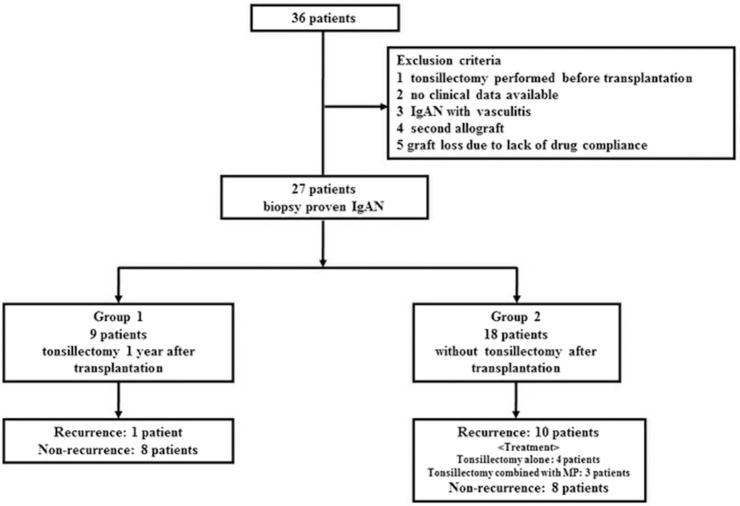
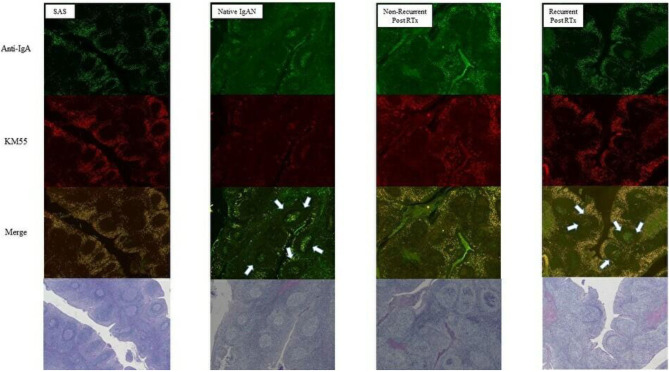
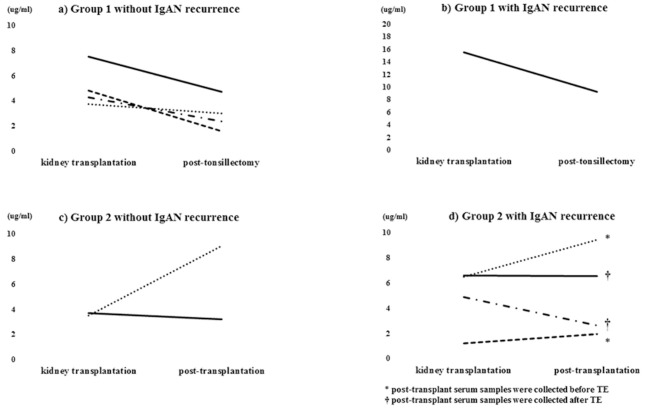
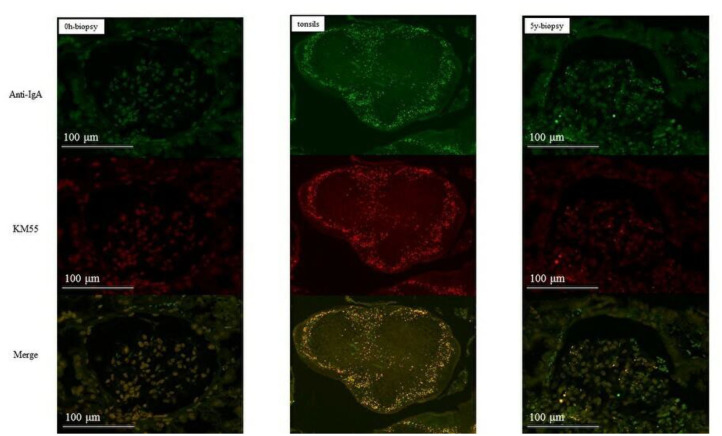
Recurrence of IgA nephropathy (IgAN) in the transplanted kidney is associated with graft survival, but no specific treatment is available. Tonsillectomy (TE) reportedly arrests the progression of IgAN in the native kidney. Thus, we conducted a single-center retrospective cohort study to evaluate the effect of TE prior to IgAN recurrence. Of the 36 patients with biopsy-proven IgAN who underwent kidney transplantation, 27 were included in this study. Nine patients underwent TE at 1 year after kidney transplantation (group 1), and the remaining 18 did not undergo TE (group 2). The rate of histological IgAN recurrence was significantly lower in group 1 than in group 2 (11.1 vs. 55.6%, log-rank = 0.046). In addition, half of the recurrent patients in group 2 exhibited active lesions, compared to none in group 1. Serum Gd-IgA1 levels decreased after TE in group 1, whereas they remained stable or increased slightly in group 2. In the recurrent cases, IgA and Gd-IgA1 were found in the germinal center in addition to the mantle zone of tonsils. Finally, mesangial IgA and Gd-IgA1 immunoreactivity was reduced after TE in some cases. Our data suggest that TE at 1 year after kidney transplantation might be associated with the reduced rate of histological IgAN recurrence. TE arrested or reduced serum Gd-IgA1 and mesangial Gd-IgA1 immunoreactivity. Therefore, we generated a hypothesis that serum Gd-IgA1 derived from the tonsils may play a pivotal role in the pathogenesis of IgAN. Based on these findings, we need to conduct verification in a prospective randomized controlled trial.
移植肾中IgA肾病(IgAN)的复发与移植肾存活相关,但目前尚无特效治疗方法。据报道,扁桃体切除术(TE)可阻止IgAN在原肾中的进展。因此,我们开展了一项单中心回顾性队列研究,以评估IgAN复发前进行TE的效果。在36例经活检证实为IgAN并接受肾移植的患者中,27例纳入本研究。9例患者在肾移植后1年接受了TE(第1组),其余18例未接受TE(第2组)。第1组组织学上IgAN复发率显著低于第2组(11.1%对55.6%,对数秩检验P = 0.046)。此外,第2组中一半的复发患者表现为活动性病变,而第1组中无此情况。第1组TE后血清Gd-IgA1水平下降,而第2组中其保持稳定或略有升高。在复发病例中,除扁桃体套区外,生发中心也发现了IgA和Gd-IgA1。最后,部分病例TE后系膜IgA和Gd-IgA1免疫反应性降低。我们的数据表明,肾移植后1年进行TE可能与组织学上IgAN复发率降低有关。TE可阻止或降低血清Gd-IgA1及系膜Gd-IgA1免疫反应性。因此,我们提出一个假设,即来自扁桃体的血清Gd-IgA1可能在IgAN发病机制中起关键作用。基于这些发现,我们需要在前瞻性随机对照试验中进行验证。