Adams B A, Whipple K X, Forte A M, Heimsath A M, Hodges K V
School of Earth Sciences, University of Bristol, Bristol, UK.
School of Earth and Space Exploration, Arizona State University, Tempe, AZ, USA.
Sci Adv. 2020 Oct 16;6(42). doi: 10.1126/sciadv.aaz3166. Print 2020 Oct.
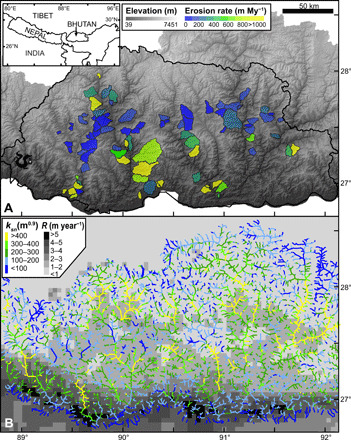
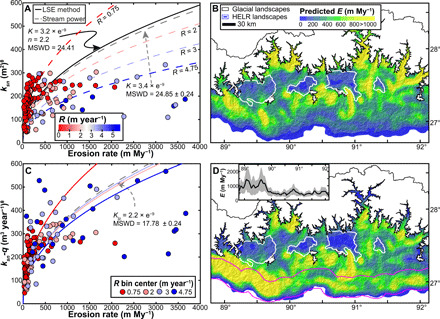
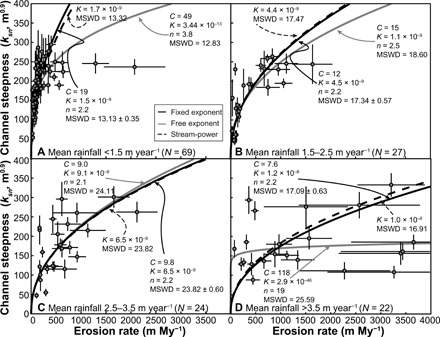
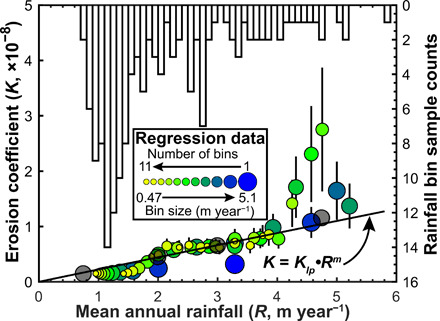
The ongoing debate about the nature of coupling between climate and tectonics in mountain ranges derives, in part, from an imperfect understanding of how topography, climate, erosion, and rock uplift are interrelated. Here, we demonstrate that erosion rate is nonlinearly related to fluvial relief with a proportionality set by mean annual rainfall. These relationships can be quantified for tectonically active landscapes, and calculations based on them enable estimation of erosion where observations are lacking. Tests of the predictive power of this relationship in the Himalaya, where erosion is well constrained, affirm the value of our approach. Our model allows estimation of erosion rates in fluvial landscapes using readily available datasets, and the underlying relationship between erosion and rainfall offers the promise of a deeper understanding of how climate and tectonic evolution affect erosion and topography in space and time and of the potential influence of climate on tectonics.
关于山脉中气候与构造耦合性质的持续争论,部分源于对地形、气候、侵蚀和岩石隆升之间相互关系的不完美理解。在此,我们证明侵蚀速率与河流地形起伏呈非线性关系,其比例关系由年平均降雨量确定。这些关系可针对构造活动活跃的地貌进行量化,基于它们的计算能够在缺乏观测数据的情况下估算侵蚀量。在喜马拉雅地区对这种关系预测能力的测试中,由于该地区侵蚀情况有充分限制,证实了我们方法的价值。我们的模型允许使用现成的数据集估算河流地貌中的侵蚀速率,并且侵蚀与降雨之间的潜在关系有望让我们更深入地理解气候和构造演化如何在时空上影响侵蚀和地形,以及气候对构造的潜在影响。