Department of Internal Medicine, Allegheny Health Network, Pittsburgh, PA, USA.
Department of Internal Medicine, Allegheny Health Network, Pittsburgh, PA, USA.
Hematol Oncol Stem Cell Ther. 2021 Sep;14(3):218-230. doi: 10.1016/j.hemonc.2020.09.005. Epub 2020 Oct 10.
Disparities driven by socioeconomic factors have been shown to impact outcomes for cancer patients. We sought to explore this relationship among patients with multiple myeloma (MM) who were not considered for hematopoietic stem cell transplant in the first-line setting and how it varied over time.
We queried the National Cancer Database for patients diagnosed with MM between 2004 and 2016 and included only those who received systemic therapy as the first-line treatment. Enrollment rates for therapy were calculated as receipt of systemic therapy as the incident event of interest (numerator) over time to initiation of therapy (denominator) and used to calculate incident rate ratios that were further analyzed using Poisson regression analysis. A multivariate Cox proportional hazards model was constructed for survival analysis, and differences were reported as hazard ratios (HRs).
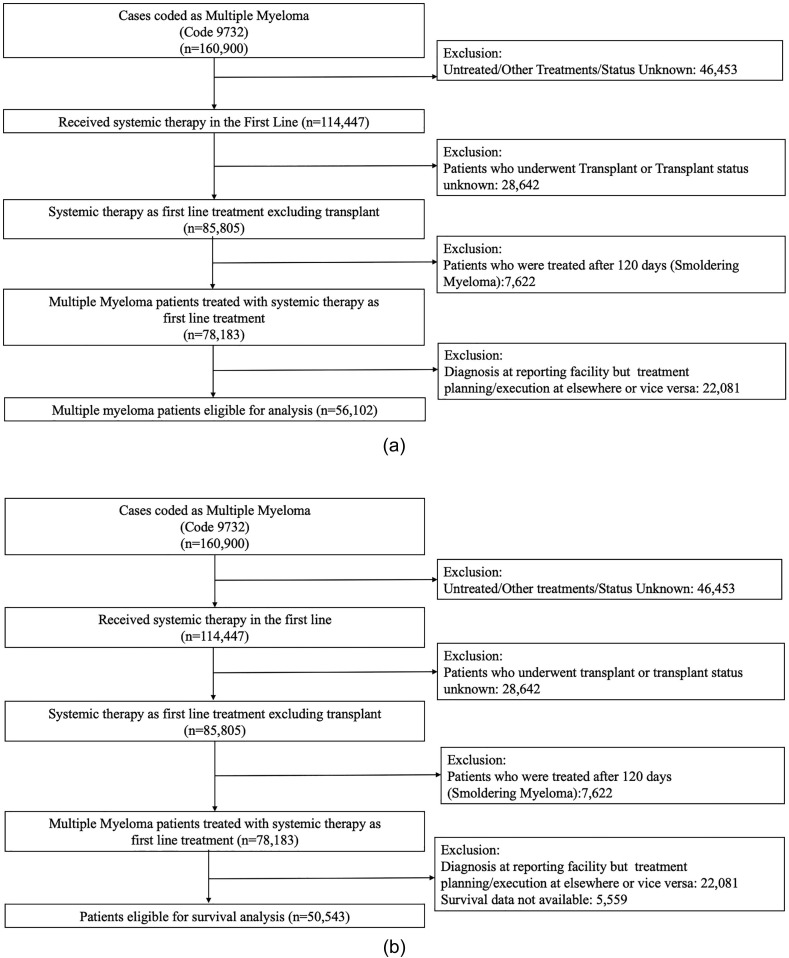
We identified 56,102 patients for enrollment analysis and 50,543 patients for survival analysis. Therapy enrollment in a multivariate model was significantly impacted by race and sex (p < .005). Advanced age, earlier year of diagnosis, lack of insurance or Medicaid, and higher comorbidity were associated with poor survival (HR > 1), whereas female sex, non-Hispanic black race, higher income, and treatment at an academic center were associated with improved survival (HR < 1).
Disparities in treatment of MM exist and are caused by a complex interplay of multiple factors, with socioeconomic factor playing a significant role. Studies exploring such determinants may help in equitable distribution of resources to overcome such differences.
社会经济因素导致的差异已被证明会影响癌症患者的治疗效果。我们旨在探讨未在一线治疗中考虑造血干细胞移植的多发性骨髓瘤(MM)患者中存在的这种关系,以及这种关系随时间的变化情况。
我们在国家癌症数据库中检索了 2004 年至 2016 年间诊断为 MM 的患者,并仅纳入接受系统治疗作为一线治疗的患者。治疗的登记率计算为作为感兴趣的首发事件(分子)的系统治疗的接受率,除以治疗开始时间(分母),并用于计算进一步使用泊松回归分析进行分析的发病风险比。构建了多变量 Cox 比例风险模型进行生存分析,差异以风险比(HR)报告。
我们共纳入了 56102 例患者进行登记分析,50543 例患者进行生存分析。多变量模型中治疗登记率受到种族和性别显著影响(p<.005)。高龄、较早的诊断年份、缺乏保险或医疗补助以及较高的合并症与较差的生存相关(HR>1),而女性、非西班牙裔黑人种族、较高的收入以及在学术中心接受治疗与较好的生存相关(HR<1)。
MM 的治疗存在差异,这些差异是由多种因素的复杂相互作用引起的,社会经济因素起着重要作用。研究这些决定因素可能有助于公平分配资源以克服这些差异。