Waters Michael R, Stafford Thomas W, Carlson David L
Department of Anthropology, Texas A&M University, College Station, TX 77843-4352, USA.
Center for the Study of the First Americans, Texas A&M University, College Station, TX 77843-4352, USA.
Sci Adv. 2020 Oct 21;6(43). doi: 10.1126/sciadv.aaz0455. Print 2020 Oct.
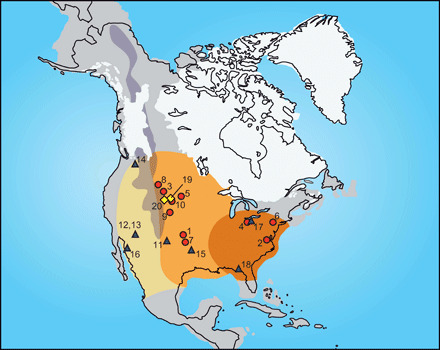
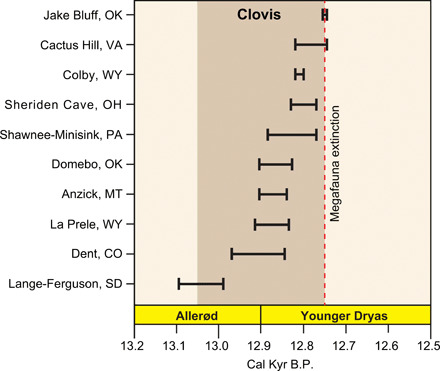
Thirty-two radiocarbon ages on bone, charcoal, and carbonized plant remains from 10 Clovis sites range from 11,110 ± 40 to 10,820 ± 10 C years before the present (yr B.P.). These radiocarbon ages provide a maximum calibrated (cal) age range for Clovis of ~13,050 to ~12,750 cal yr B.P. This radiocarbon record suggests that Clovis first appeared at the end of the Allerød and is one of at least three contemporary archaeological complexes in the Western Hemisphere during the terminal Pleistocene. Stemmed projectile points in western North America are coeval and even older than Clovis, and the Fishtail point complex is well established in the southern cone of South America by ~12,900 cal yr B.P. Clovis disappeared ~12,750 cal yr B.P. at the beginning of the Younger Dryas, coincident with the extinction of the remaining North American megafauna (Proboscideans) and the appearance of multiple North American regional archaeological complexes.
来自10个克洛维斯遗址的骨骼、木炭和碳化植物残骸的32个放射性碳年代测定结果显示,其年代范围在距今11110±40至10820±10碳年之间(公元前)。这些放射性碳年代为克洛维斯文化提供了一个最大校正(cal)年龄范围,约为公元前13050年至约公元前12750年。这一放射性碳记录表明,克洛维斯文化最早出现在阿勒罗德期末期,是末次更新世晚期西半球至少三个同时期考古复合体之一。北美西部的带柄投射尖器与克洛维斯文化同时期,甚至比它还要古老,而鱼尾尖器复合体在公元前约12900年时已在南美洲南部地区确立。克洛维斯文化在公元前约12750年的新仙女木期开始时消失,这与北美剩余大型动物(长鼻目动物)的灭绝以及多个北美地区考古复合体的出现同时发生。