
对猕猴基因组进行单细胞链测序揭示了灵长类进化过程中多个嵌套的倒位和断裂点的重复使用。
Single-cell strand sequencing of a macaque genome reveals multiple nested inversions and breakpoint reuse during primate evolution.
机构信息
Dipartimento di Biologia, Università degli Studi di Bari "Aldo Moro," Bari 70125, Italy.
European Molecular Biology Laboratory (EMBL), Genome Biology Unit, 69117 Heidelberg, Germany.
出版信息
Genome Res. 2020 Nov;30(11):1680-1693. doi: 10.1101/gr.265322.120. Epub 2020 Oct 22.
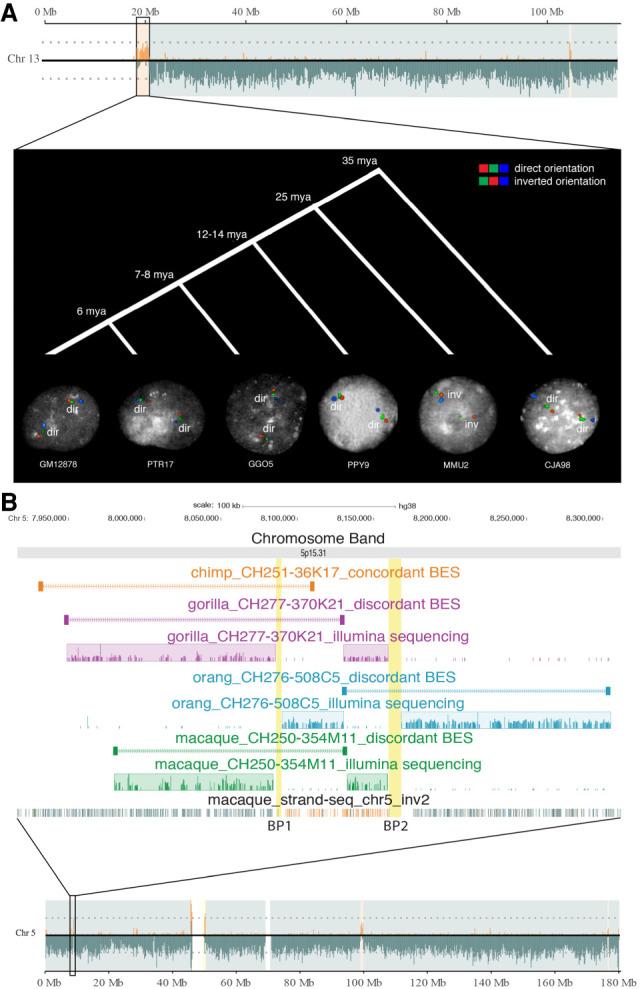
Rhesus macaque is an Old World monkey that shared a common ancestor with human ∼25 Myr ago and is an important animal model for human disease studies. A deep understanding of its genetics is therefore required for both biomedical and evolutionary studies. Among structural variants, inversions represent a driving force in speciation and play an important role in disease predisposition. Here we generated a genome-wide map of inversions between human and macaque, combining single-cell strand sequencing with cytogenetics. We identified 375 total inversions between 859 bp and 92 Mbp, increasing by eightfold the number of previously reported inversions. Among these, 19 inversions flanked by segmental duplications overlap with recurrent copy number variants associated with neurocognitive disorders. Evolutionary analyses show that in 17 out of 19 cases, the Hominidae orientation of these disease-associated regions is always derived. This suggests that duplicated sequences likely played a fundamental role in generating inversions in humans and great apes, creating architectures that nowadays predispose these regions to disease-associated genetic instability. Finally, we identified 861 genes mapping at 156 inversions breakpoints, with some showing evidence of differential expression in human and macaque cell lines, thus highlighting candidates that might have contributed to the evolution of species-specific features. This study depicts the most accurate fine-scale map of inversions between human and macaque using a two-pronged integrative approach, such as single-cell strand sequencing and cytogenetics, and represents a valuable resource toward understanding of the biology and evolution of primate species.
恒河猴是一种旧大陆猴,与人类在约 2500 万年前拥有共同的祖先,是人类疾病研究的重要动物模型。因此,无论是在生物医学还是进化研究中,都需要深入了解其遗传学。在结构变异中,倒位是物种形成的驱动力之一,在疾病易感性中起着重要作用。在这里,我们结合单细胞链测序和细胞遗传学,生成了人类和猕猴之间全基因组倒位图谱。我们确定了 375 个总倒位,大小在 859bp 到 92 Mbp 之间,使以前报道的倒位数量增加了 8 倍。其中,19 个侧翼为片段重复的倒位与与神经认知障碍相关的反复拷贝数变异重叠。进化分析表明,在这 19 个倒位中,有 17 个与神经认知障碍相关的区域在人类和大猿中总是呈现同源结构,这表明重复序列可能在人类和大猿中产生倒位方面发挥了重要作用,创造了如今使这些区域易患与疾病相关的遗传不稳定性的结构。最后,我们确定了 156 个倒位断点处的 861 个基因映射,其中一些在人类和猕猴细胞系中显示出差异表达的证据,从而突出了可能为物种特异性特征进化做出贡献的候选基因。本研究使用单细胞链测序和细胞遗传学的双管齐下的综合方法,描绘了人类和猕猴之间最精确的精细尺度倒位图谱,为理解灵长类物种的生物学和进化提供了有价值的资源。



 Zotero 插件