Cardiovascular Prevention and Rehabilitation Program, Toronto Rehabilitation Institute, University Health Network, Toronto, Canada.
Cardiovascular Prevention and Rehabilitation Program, Toronto Rehabilitation Institute, University Health Network, Toronto, Canada; School of Kinesiology and Health Science, York University, Toronto, Canada.
Patient Educ Couns. 2021 May;104(5):1140-1148. doi: 10.1016/j.pec.2020.10.008. Epub 2020 Oct 13.
To translate, cross-culturally adapt and validate a comprehensive evidence- and theoretically-based CR education intervention in Latin America.
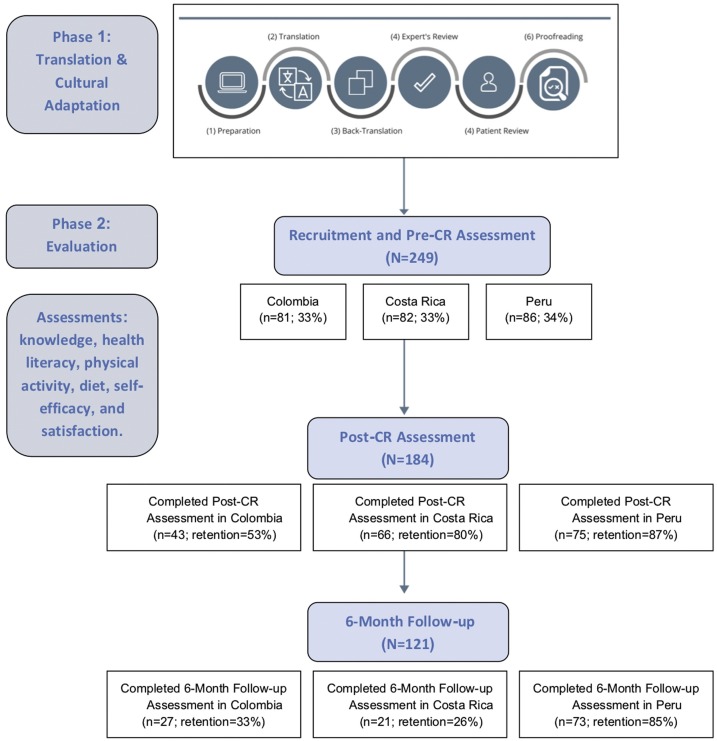
First, best practices in translation and cross-cultural adaptation were applied through 6 steps. Then, the Spanish version was delivered to CR participants from programs in Colombia, Costa Rica and Peru for validation, such that the evaluation was pre-post, uncontrolled, pragmatic, observational, and prospective in design. Participants completed surveys assessing knowledge, health literacy, self-efficacy, and health behaviours. All outcomes were assessed pre-, and post-CR, as well as 6 months after CR completion.
After translation of the patient guide from English to Spanish, 5 of the 9 booklets were culturally adapted. Two-hundred and forty-nine patients consented to participate, of which 184 (74 %) completed post-CR, and 121 (48 %) completed final assessments. There was a significant improvement in disease-related knowledge pre- to post-CR, as well as in health literacy, self-efficacy, and health behaviours (all p < 0.05). These gains were sustained 6 months post-program. With adjustment, CR attendance (i.e., exposure to the education) was associated with greater post-CR knowledge (ß = 0.026; p = 0.01).
A patient education intervention for CR patients in Latin America has been validated, and wider implementation is warranted.
Application of this first-ever validated CR education program for Spanish-speaking settings may result in secondary prevention.
将一个基于循证和理论的综合 CR 教育干预措施从英文翻译、跨文化调适并在拉丁美洲进行验证。
首先,通过 6 个步骤应用翻译和跨文化调适的最佳实践。然后,将西班牙语版本提供给来自哥伦比亚、哥斯达黎加和秘鲁的项目中的 CR 参与者进行验证,从而使评估具有前瞻性、非对照、实用、观察性和前瞻性设计。参与者完成了评估知识、健康素养、自我效能和健康行为的调查。所有结果均在 CR 之前、之后以及 CR 完成后 6 个月进行评估。
将患者指南从英文翻译成西班牙语后,9 本手册中的 5 本进行了文化调适。有 249 名患者同意参与,其中 184 名(74%)完成了 CR 后评估,121 名(48%)完成了最终评估。在 CR 前后,疾病相关知识以及健康素养、自我效能和健康行为均有显著改善(均 p<0.05)。这些改善在项目结束后 6 个月仍持续存在。调整后,CR 参与(即接受教育)与 CR 后知识增加相关(β=0.026;p=0.01)。
针对拉丁美洲 CR 患者的患者教育干预措施已得到验证,需要更广泛的实施。
在西班牙语环境中应用首个经过验证的 CR 教育项目可能会带来二级预防效果。