Institute of Biodiversity, Animal Health and Comparative Medicine, College of Medical, Veterinary and Life Sciences, University of Glasgow, Glasgow G12 8QQ, UK.
MARBEC, Université de Montpellier, CNRS, Ifremer, IRD, 9190 Montpellier, France.
J Exp Biol. 2020 Nov 12;223(Pt 21):jeb222133. doi: 10.1242/jeb.222133.
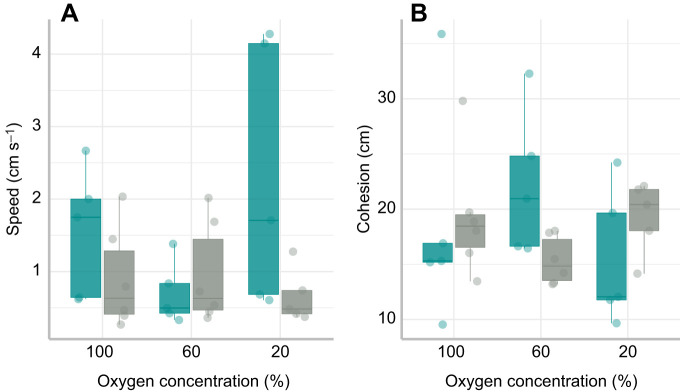
In some fishes, the ability to breathe air has evolved to overcome constraints in hypoxic environments but comes at a cost of increased predation. To reduce this risk, some species perform group air breathing. Temperature may also affect the frequency of air breathing in fishes, but this topic has received relatively little research attention. This study examined how acclimation temperature and acute exposure to hypoxia affected the air-breathing behaviour of a social catfish, the bronze corydoras , and aimed to determine whether individual oxygen demand influenced the behaviour of entire groups. Groups of seven fish were observed in an arena to measure air-breathing frequency of individuals and consequent group air-breathing behaviour, under three oxygen concentrations (100%, 60% and 20% air saturation) and two acclimation temperatures (25 and 30°C). Intermittent flow respirometry was used to estimate oxygen demand of individuals. Increasingly severe hypoxia increased air breathing at the individual and group levels. Although there were minimal differences in air-breathing frequency among individuals in response to an increase in temperature, the effect of temperature that did exist manifested as an increase in group air-breathing frequency at 30°C. Groups that were more socially cohesive during routine activity took more breaths but, in most cases, air breathing among individuals was not temporally clustered. There was no association between an individual's oxygen demand and its air-breathing frequency in a group. For , although air-breathing frequency is influenced by hypoxia, behavioural variation among groups could explain the small overall effect of temperature on group air-breathing frequency.
在一些鱼类中,呼吸空气的能力已经进化到可以克服缺氧环境的限制,但这也带来了被捕食的风险增加。为了降低这种风险,一些鱼类会进行群体呼吸空气。温度也可能影响鱼类呼吸空气的频率,但这个话题受到的研究关注相对较少。本研究探讨了驯化温度和急性缺氧暴露如何影响一种社交性鲶鱼——青铜鼠鱼的呼吸空气行为,并旨在确定个体的氧气需求是否会影响整个群体的行为。将 7 条鱼一组置于一个竞技场中,在三种氧气浓度(100%、60%和 20%空气饱和度)和两种驯化温度(25 和 30°C)下,观察个体的呼吸空气频率以及随之而来的群体呼吸空气行为。间歇性流动呼吸计用于估计个体的氧气需求。随着缺氧程度的加剧,个体和群体的呼吸空气频率都增加了。尽管个体对温度升高的呼吸空气频率差异很小,但确实存在的温度效应表现为 30°C 时群体呼吸空气频率的增加。在日常活动中更具社交凝聚力的群体呼吸次数更多,但在大多数情况下,个体之间的呼吸空气并没有时间上的聚类。个体的氧气需求与其在群体中的呼吸空气频率之间没有关联。虽然呼吸空气频率受缺氧影响,但群体之间的行为变化可以解释温度对群体呼吸空气频率的总体影响较小的原因。