
与你的(人工)手交谈:交际手势作为具身化的一种隐性测量方式。
Talking with Your (Artificial) Hands: Communicative Hand Gestures as an Implicit Measure of Embodiment.
作者信息
Maimon-Mor Roni O, Obasi Emeka, Lu Jenny, Odeh Nour, Kirker Stephen, MacSweeney Mairéad, Goldin-Meadow Susan, Makin Tamar R
机构信息
Institute of Cognitive Neuroscience, University College London, 17 Queen Square, London WC1N 3AZ, UK.
WIN Centre, Nuffield Department of Clinical Neuroscience, University of Oxford, Oxford OX3 9DU, UK.
出版信息
iScience. 2020 Oct 6;23(11):101650. doi: 10.1016/j.isci.2020.101650. eCollection 2020 Nov 20.
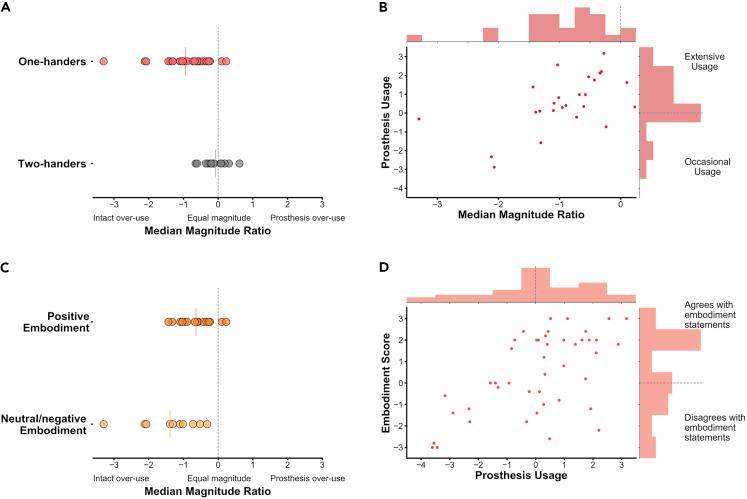
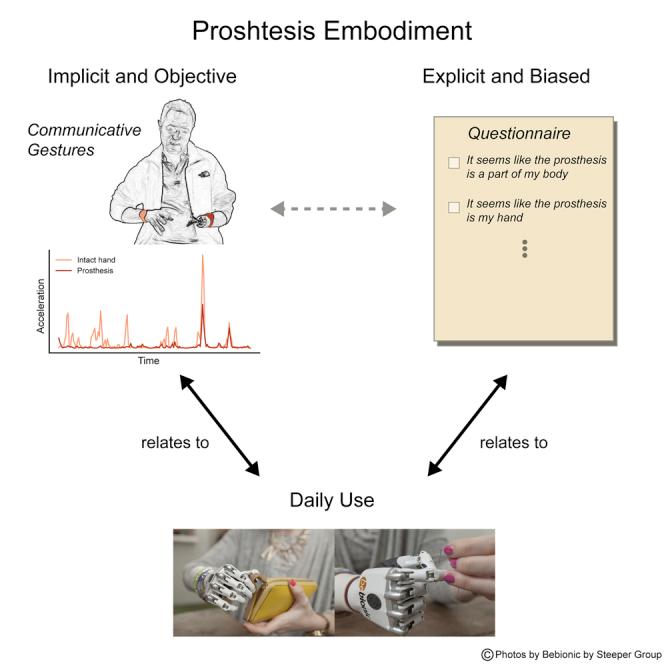
When people talk, they move their hands to enhance meaning. Using accelerometry, we measured whether people spontaneously use their artificial limbs (prostheses) to gesture, and whether this behavior relates to everyday prosthesis use and perceived embodiment. Perhaps surprisingly, one- and two-handed participants did not differ in the number of gestures they produced in gesture-facilitating tasks. However, they did differ in their gesture profile. One-handers performed more, and bigger, gesture movements with their intact hand relative to their prosthesis. Importantly, one-handers who gestured more similarly to their two-handed counterparts also used their prosthesis more in everyday life. Although collectively one-handers only marginally agreed that their prosthesis feels like a body part, one-handers who reported they embody their prosthesis also showed greater prosthesis use for communication and daily function. Our findings provide the first empirical link between everyday prosthesis use habits and perceived embodiment and a novel means for implicitly indexing embodiment.
人们交谈时会用手部动作来强化语义。我们运用加速度测量法,探究人们是否会自发地使用假肢进行手势表达,以及这种行为是否与假肢的日常使用及感知到的身体融入感有关。或许令人惊讶的是,单臂和双臂参与者在有助于手势表达的任务中所做出的手势数量并无差异。然而,他们的手势特征却有所不同。与使用假肢的手相比,单臂者用健全的手做出的手势动作更多、幅度更大。重要的是,在手势上与双臂者更相似的单臂者在日常生活中也更多地使用假肢。尽管总体上单臂者只是勉强认同他们的假肢感觉像身体的一部分,但那些表示将假肢视为身体一部分的单臂者在交流和日常功能中也更多地使用假肢。我们的研究结果首次在假肢的日常使用习惯与感知到的身体融入感之间建立了实证联系,并提供了一种隐含地衡量身体融入感的新方法。

 Zotero 插件