
使用左炔诺孕酮家族孕激素避孕的女性体内循环的促性腺激素糖型
Gonadotropin Glycoforms Circulating in Women Using Progestins of the Levonorgestrel Family for Contraception.
作者信息
Eriksson Karin, Wide Leif
机构信息
Department of Clinical Chemistry, University Hospital, Uppsala, Sweden.
出版信息
J Endocr Soc. 2020 Aug 28;4(11):bvaa128. doi: 10.1210/jendso/bvaa128. eCollection 2020 Nov 1.
CONTEXT
The progestins of the levonorgestrel family are 13-ethylgonane progestins, commonly used for contraception in women. One contraceptive effect of these progestins is inhibition of ovulation, which may be a result of changes in gonadotropin glycosylation patterns. Gonadotropin glycoforms differ in number of glycans and bioactivity: more bioactive low-N-glycosylated glycoforms, diglycosylated luteinizing hormone (LHdi) and triglycosylated follicle-stimulating hormone (FSHtri), and less bioactive fully N-glycosylated glycoforms, LHtri and FSHtetra.
OBJECTIVE
Characterize the glycosylation patterns on the circulating gonadotropin glycoforms in women using 13-ethylgonane progestins for contraception.
DESIGN SUBJECTS MAIN OUTCOME MEASURES
Serum samples, collected from 92 healthy women using 13-ethylgonane progestins for contraception, were included. Forty women used progestin-only continuously and 52 used progestins combined with ethinylestradiol (EE) for 3 weeks followed by a hormone-free week. Concentration, sulfonation, and sialylation of each glycoform were determined and compared with follicular phase values of normal menstrual cycles.
RESULTS
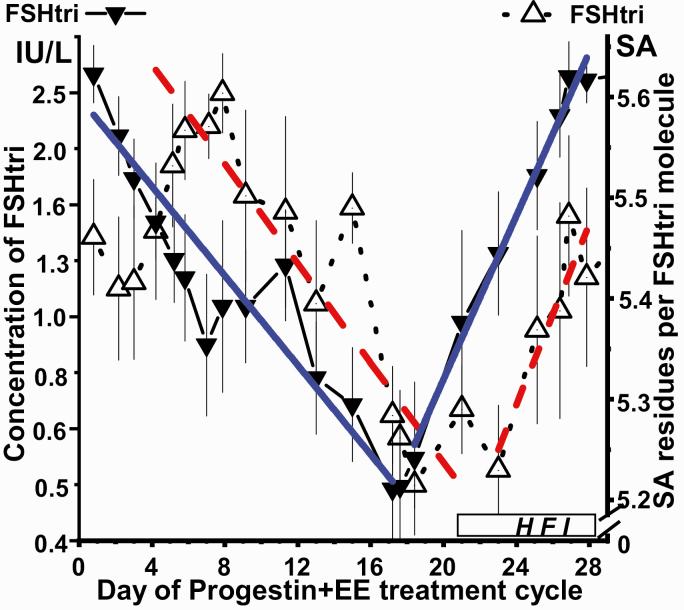
The progestin-only group had significantly increased serum levels, decreased sulfonation, and increased sialylation of LHdi. The LHdi/FSHtri ratio was increased. The progestin+EE group had significantly decreased gonadotropin glycoform concentrations and decreased sialylation of FSHtri. The progestin+EE effect on sialylation of FSHtri occurred later during the treatment cycle in contrast to the effect on FSHtri concentration.
CONCLUSIONS
The 2 different progestin treatments induced different effects on the glycan synthesis and concentrations of more bioactive low-glycosylated gonadotropins. Progestin-only treatment increased sialylation and decreased sulfonation of LHdi molecules, contributing to sustained higher levels of bioactive LHdi molecules. Progestin+EE treatment decreased sialylation of FSHtri, contributing to a shorter half-life and decreased levels of bioactive FSHtri.
背景
左炔诺孕酮家族的孕激素是13-乙基孕烷类孕激素,常用于女性避孕。这些孕激素的一种避孕作用是抑制排卵,这可能是促性腺激素糖基化模式变化的结果。促性腺激素糖型在聚糖数量和生物活性方面存在差异:生物活性较高的低N-糖基化糖型、双糖基化促黄体生成素(LHdi)和三糖基化促卵泡生成素(FSHtri),以及生物活性较低的完全N-糖基化糖型、LHtri和FSHtetra。
目的
描述使用13-乙基孕烷类孕激素避孕的女性循环促性腺激素糖型的糖基化模式。
设计 受试者 主要观察指标:纳入从92名使用13-乙基孕烷类孕激素避孕的健康女性收集的血清样本。40名女性持续仅使用孕激素,52名女性将孕激素与炔雌醇(EE)联合使用3周,随后为无激素周。测定每种糖型的浓度、磺化和唾液酸化,并与正常月经周期的卵泡期值进行比较。
结果
仅使用孕激素组的LHdi血清水平显著升高、磺化降低且唾液酸化增加。LHdi/FSHtri比值升高。孕激素+EE组的促性腺激素糖型浓度显著降低,FSHtri的唾液酸化降低。与对FSHtri浓度的影响相比,孕激素+EE对FSHtri唾液酸化的影响在治疗周期后期出现。
结论
两种不同的孕激素治疗对聚糖合成和生物活性较高的低糖基化促性腺激素浓度产生不同影响。仅使用孕激素治疗增加了LHdi分子的唾液酸化并降低了磺化,导致生物活性LHdi分子持续处于较高水平。孕激素+EE治疗降低了FSHtri的唾液酸化,导致生物活性FSHtri的半衰期缩短和水平降低。
 Zotero 插件