
阿富汗五岁以下儿童腹泻的决定因素:2015年阿富汗人口与健康调查的二次分析
Determinants of diarrhea in children under the age of five in Afghanistan: a secondary analysis of the Afghanistan Demographic and Health Survey 2015.
作者信息
Wasiq Ahmad Nasir, Saw Yu Mon, Jawid Sultani, Kariya Tetsuyoshi, Yamamoto Eiko, Hamajima Nobuyuki
机构信息
Department of Healthcare Administration, Nagoya University Graduate School of Medicine, Nagoya, Japan.
Ministry of Public Health, Kabul, Afghanistan.
出版信息
Nagoya J Med Sci. 2020 Aug;82(3):545-556. doi: 10.18999/nagjms.82.3.545.
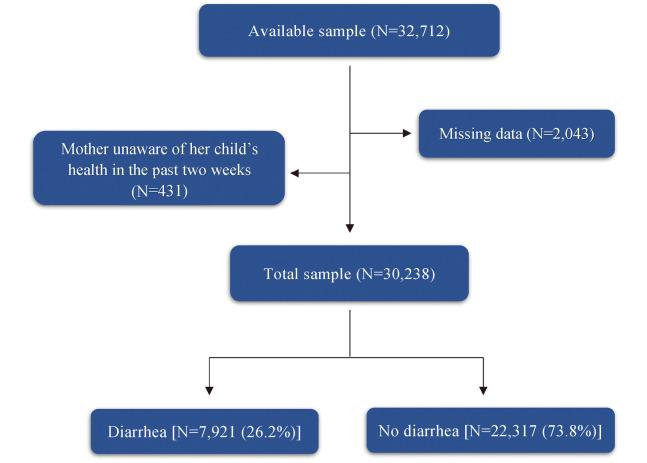
Diarrhea is the second leading cause of under-five mortality and globally accounts for 526,000 child deaths every year. Afghanistan, with 33,000 child deaths in 2012, was ranked 8 among nations, with the highest under-five deaths being from pneumonia and diarrhea. This study aimed to identify the determinants of diarrhea in children under the age of five in Afghanistan. A secondary data analysis of the Afghanistan Demographic and Health Survey (AfDHS) 2015 was focused on diarrhea in children under the age of five. The dataset of the AfDHS 2015 was used for the analysis. The subjects for this study were 30,238 under-five children. A logistic regression model was applied to examine the determinants of childhood diarrhea. This study found that 7,921 (26.2%) out of 30,238 under-five children had diarrhea within the two weeks preceding the survey. Higher maternal education accompanied a lower risk of childhood diarrhea with an adjusted odds ratio (AOR) of 0.70 (<0.01) than did no education. Flush toilets (AOR=0.84, <0.01) and traditional dry vaults (AOR=0.83, <0.001) were less likely associated with diarrhea compared with pit latrines. Tube wells, public taps, and unprotected wells and springs were sources of drinking water with a higher risk of diarrhea than piped water. This study identified that the type of toilet facility, source of drinking water, age of the child, and maternal education were important determinants of under-five diarrhea. Intervention programs concerning improved sanitation facilities, sources of drinking water, and raising women's level of education and health awareness are important.
腹泻是五岁以下儿童死亡的第二大主要原因,全球每年有52.6万儿童死于腹泻。阿富汗在2012年有3.3万儿童死亡,在各国中排名第8,五岁以下儿童死亡人数最多的原因是肺炎和腹泻。本研究旨在确定阿富汗五岁以下儿童腹泻的决定因素。对2015年阿富汗人口与健康调查(AfDHS)进行的二次数据分析聚焦于五岁以下儿童的腹泻情况。使用了2015年AfDHS的数据集进行分析。本研究的对象是30238名五岁以下儿童。应用逻辑回归模型来检验儿童腹泻的决定因素。本研究发现,在30238名五岁以下儿童中,有7921名(26.2%)在调查前两周内患有腹泻。与未受过教育的母亲相比,母亲受教育程度较高的儿童患腹泻的风险较低,调整后的优势比(AOR)为0.70(<0.01)。与坑式厕所相比,冲水马桶(AOR = 0.84,<0.01)和传统干式厕所(AOR = 0.83,<0.001)与腹泻的关联较小。与管道供水相比,管井、公共水龙头以及未受保护的水井和泉水作为饮用水源时,导致腹泻的风险更高。本研究确定,厕所设施类型、饮用水源、儿童年龄和母亲受教育程度是五岁以下儿童腹泻的重要决定因素。有关改善卫生设施、饮用水源以及提高妇女教育水平和健康意识的干预项目很重要。
 Zotero 插件