Liu Chunyu, Wang Fei, Wang Bin, Wu Ting, Wang Yue, Huo Wenbo, Zhang Shuxia, Su Ying, Liu Jinming, Liu Yumeng, Yu Jinghua
Institute of Virology and AIDS Research, The First Hospital of Jilin University, Jilin University, Changchun, Jilin 130021, P.R. China.
Acupunture Department, The Affiliated Hospital of Changchun University of Chinese Medicine, Changchun, Jilin 130000, P.R. China.
Oncol Lett. 2020 Dec;20(6):358. doi: 10.3892/ol.2020.12222. Epub 2020 Oct 14.
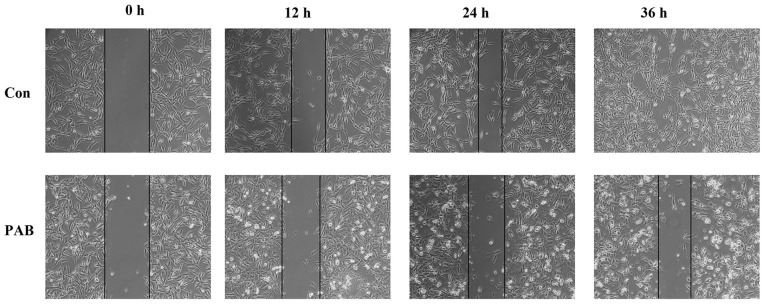
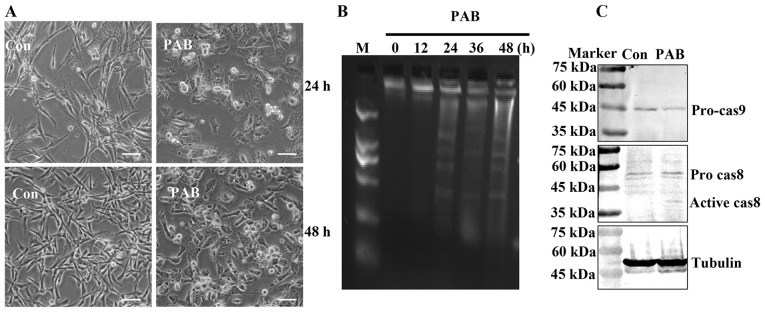
Pseudolaric acid B (PAB) is a diterpene-type acid isolated from the root and trunk bark of Gordon of the family that has been demonstrated to induce apoptosis in various cell lines and autophagy in certain cell lines including murine fibrosarcoma L929, human thyroid squamous cell carcinoma SW579 and human lung fibroblast MRC5 cells. However, in human rhabdomyosarcoma RD cells, which are derived from the most common soft tissue sarcoma in children and represent a high-grade neoplasm of a skeletal myoblast type, it is not clear whether PAB induces apoptosis or autophagy. The identification of the exact mechanism of PAB is important for studying its antitumor effects and its potential application in the treatment of human rhabdomyosarcoma. To confirm the inhibitory ability of PAB on RD cells, the inhibitory ratio of PAB was analyzed, and the results of MTT assay demonstrated that PAB inhibited RD cell proliferation. Meanwhile aggregation of the microtubule fibers was found in PAB-treated RD cells compared with that in control-treated cells, which was consistent with previous studies. In addition, PAB inhibited RD cell migration, induced apoptosis and cell cycle arrest at the G2/M phase. These results suggested that the mechanism of PAB-mediated growth inhibition in RD was similar to that reported in the human breast cancer cell line MCF-7 and the neuroglioma cell line A172; however, it was different from that reported in the L929, MRC5 and SW579 cell lines. Additional experiments demonstrated that PAB regulated the activation of caspase-8 and caspase-9 to induce apoptosis and caused an upregulation of phosphorylated H2A histone family member X and cyclin B1 expression in order to induce cell cycle arrest. Therefore, PAB may be considered a potential treatment agent for human rhabdomyosarcoma.
土槿皮酸B(PAB)是从该科植物土槿的根皮和干皮中分离得到的二萜类酸,已证明其可诱导多种细胞系凋亡,并在某些细胞系中诱导自噬,包括小鼠纤维肉瘤L929、人甲状腺鳞状细胞癌SW579和人肺成纤维细胞MRC5细胞。然而,在人横纹肌肉瘤RD细胞中,其来源于儿童最常见的软组织肉瘤,代表骨骼肌母细胞类型的高级别肿瘤,目前尚不清楚PAB是否诱导凋亡或自噬。明确PAB的确切作用机制对于研究其抗肿瘤作用及其在人横纹肌肉瘤治疗中的潜在应用具有重要意义。为了证实PAB对RD细胞的抑制能力,分析了PAB的抑制率,MTT实验结果表明PAB抑制RD细胞增殖。同时,与对照处理的细胞相比,在PAB处理的RD细胞中发现微管纤维聚集,这与先前的研究一致。此外,PAB抑制RD细胞迁移,诱导凋亡并使细胞周期停滞在G2/M期。这些结果表明,PAB介导的RD细胞生长抑制机制与人类乳腺癌细胞系MCF-7和神经胶质瘤细胞系A172中报道的机制相似;然而,与L929、MRC5和SW579细胞系中报道的机制不同。进一步的实验表明,PAB调节半胱天冬酶-8和半胱天冬酶-9的激活以诱导凋亡,并导致磷酸化组蛋白H2A家族成员X和细胞周期蛋白B1表达上调,从而诱导细胞周期停滞。因此,PAB可被认为是治疗人横纹肌肉瘤的潜在药物。