
极端质体RNA编辑可能会混淆系统发育重建:以石松类植物为例的研究
Extreme plastid RNA editing may confound phylogenetic reconstruction: A case study of (lycophytes).
作者信息
Du Xin-Yu, Lu Jin-Mei, Li De-Zhu
机构信息
Germplasm Bank of Wild Species, Kunming Institute of Botany, Chinese Academy of Sciences, 132 Lanhei Road, Kunming, Yunnan 650201, China.
Kunming College of Life Science, University of Chinese Academy of Sciences, 19 Qingsong Road, Kunming, Yunnan 650201, China.
出版信息
Plant Divers. 2020 Jul 16;42(5):356-361. doi: 10.1016/j.pld.2020.06.009. eCollection 2020 Oct.
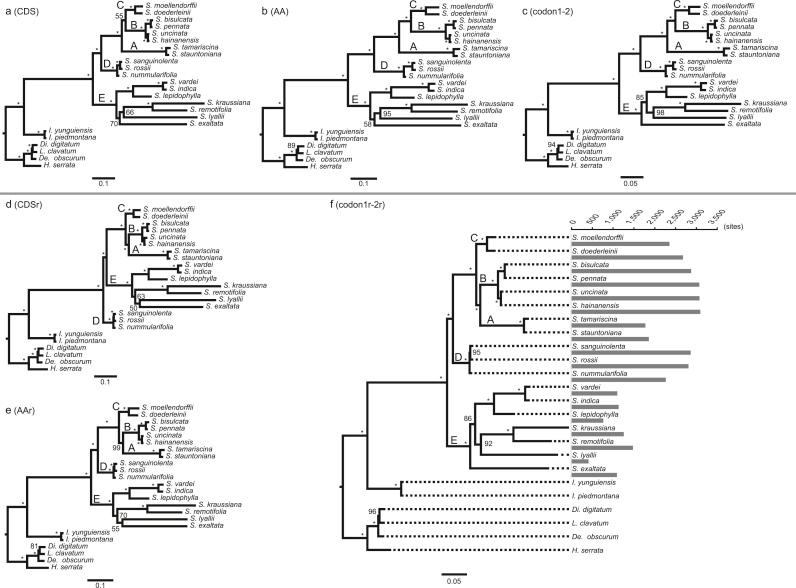
Cytidine-to-uridine (C-to-U) RNA editing is common in coding regions of organellar genomes throughout land plants. In most cases RNA editing alters translated amino acids or creates new start codons, potentially confounds phylogenetic reconstructions. In this study, we used the spike moss genus (lycophytes), which has the highest frequency of RNA editing, as a model to test the effects of extreme RNA editing on phylogenetic reconstruction. We predicted the C-to-U RNA editing sites in coding regions of 18 plastomes, and reconstructed the phylogenetic relationships within based on three data set pairs consisted of plastome or RNA-edited coding sequences, first and second codon positions, and translated amino acid sequences, respectively. We predicted between 400 and 3100 RNA editing sites of 18 plastomes. The numbers of RNA editing sites in plastomes were highly correlated with the GC content of first and second codon positions, but not correlated with the GC content of plastomes as a whole. Contrast phylogenetic analyses showed that there were substantial differences (e.g., the placement of clade B in ) between the phylogenies generated by the plastome and RNA-edited data sets. This empirical study provides evidence that extreme C-to-U RNA editing in the coding regions of organellar genomes alters the sequences used for phylogenetic reconstruction, and might even confound phylogenetic reconstruction. Therefore, RNA editing sites should be corrected when plastid or mitochondrial genes are used for phylogenetic studies, particularly in those lineages with abundant organellar RNA editing sites, such as hornworts, quillworts, spike mosses, and some seed plants.
胞嘧啶到尿嘧啶(C-to-U)的RNA编辑在整个陆地植物细胞器基因组的编码区域中很常见。在大多数情况下,RNA编辑会改变翻译后的氨基酸或产生新的起始密码子,这可能会混淆系统发育重建。在本研究中,我们以RNA编辑频率最高的卷柏属(石松类植物)为模型,来测试极端RNA编辑对系统发育重建的影响。我们预测了18个质体基因组编码区域中的C-to-U RNA编辑位点,并分别基于由质体基因组或RNA编辑后的编码序列、第一和第二密码子位置以及翻译后的氨基酸序列组成的三个数据集对,重建了卷柏属内的系统发育关系。我们预测了18个质体基因组中400到3100个RNA编辑位点。质体基因组中RNA编辑位点的数量与第一和第二密码子位置的GC含量高度相关,但与整个质体基因组的GC含量无关。对比系统发育分析表明,由质体基因组和RNA编辑数据集生成的系统发育树之间存在显著差异(例如,进化枝B在卷柏属中的位置)。这项实证研究提供了证据,表明细胞器基因组编码区域中的极端C-to-U RNA编辑会改变用于系统发育重建的序列,甚至可能混淆系统发育重建。因此,当使用质体或线粒体基因进行系统发育研究时,尤其是在那些细胞器RNA编辑位点丰富的谱系中,如角苔、水韭、卷柏和一些种子植物,RNA编辑位点应该被校正。
 Zotero 插件