Jacob Jake S, Lee Michelle E, Chew Erin Y, Thrift Aaron P, Sealock Robert J
Section of Gastroenterology and Hepatology, Department of Medicine, Baylor College of Medicine, Houston, TX, USA.
Department of Internal Medicine, Johns Hopkins Hospital, Baltimore, MD, USA.
Clin Endosc. 2021 Mar;54(2):269-274. doi: 10.5946/ce.2020.100. Epub 2020 Nov 6.
BACKGROUND/AIMS: The American Society for Gastrointestinal Endoscopy (ASGE) revised its guidelines for risk stratification of patients with suspected choledocholithiasis. This study aimed to assess the diagnostic performance of the revision and to compare it to the previous guidelines.
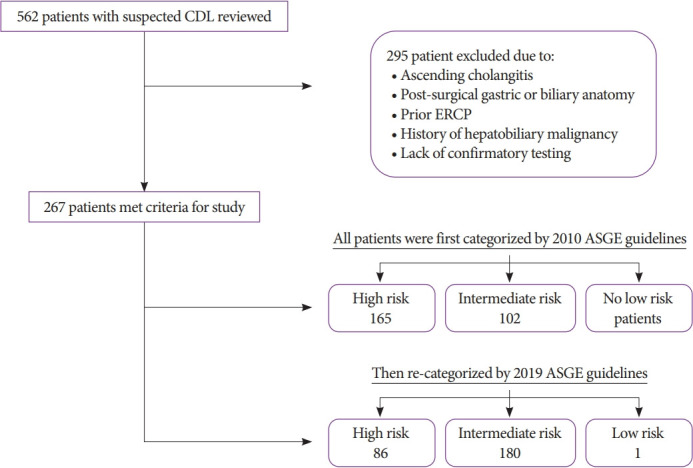
We conducted a retrospective cohort study of 267 patients with suspected choledocholithiasis. We identified high-risk patients according to the original and revised guidelines and examined the diagnostic accuracy of both guidelines. We measured the association between individual criteria and choledocholithiasis.
Under the original guidelines, 165 (62%) patients met the criteria for high risk, of whom 79% had confirmed choledocholithiasis. The categorization had a sensitivity and specificity of 68% and 55%, respectively, for the detection of choledocholithiasis. Under the revised guidelines, 86 (32%) patients met the criteria for high risk, of whom 83% had choledocholithiasis. The revised categorization had a lower sensitivity and higher specificity of 37% and 80%, respectively. The positive predictive value of the high-risk categorization increased with the revision, reflecting a potential decrease in diagnostic endoscopic retrograde cholangiopancreatograpies (ERCPs). Stone visualized on imaging had the greatest specificity for choledocholithiasis. Gallstone pancreatitis was not associated with the risk for choledocholithiasis.
The 2019 revision of the ASGE guidelines decreases the utilization of ERCP as a diagnostic modality and offers an improved risk stratification tool.
背景/目的:美国胃肠内镜学会(ASGE)修订了疑似胆总管结石患者的风险分层指南。本研究旨在评估该修订版的诊断性能,并将其与先前的指南进行比较。
我们对267例疑似胆总管结石患者进行了一项回顾性队列研究。我们根据原始指南和修订指南确定了高危患者,并检查了这两种指南的诊断准确性。我们测量了各个标准与胆总管结石之间的关联。
根据原始指南,165例(62%)患者符合高危标准,其中79%确诊为胆总管结石。该分类对胆总管结石检测的敏感性和特异性分别为68%和55%。根据修订指南,86例(32%)患者符合高危标准,其中83%患有胆总管结石。修订后的分类敏感性较低,为37%,特异性较高,为80%。高危分类的阳性预测值随着修订而增加,这反映出诊断性内镜逆行胰胆管造影术(ERCP)可能减少。影像学上可见结石对胆总管结石具有最高的特异性。胆石性胰腺炎与胆总管结石风险无关。
ASGE指南2019年修订版降低了ERCP作为诊断方式的使用率,并提供了一种改进的风险分层工具。