Metabolic Diseases Branch, National Institute of Diabetes and Digestive and Kidney Diseases, Bethesda, Maryland.
Mouse Metabolism Core Laboratory, National Institute of Diabetes and Digestive and Kidney Diseases, Bethesda, Maryland.
Am J Physiol Endocrinol Metab. 2021 Feb 1;320(2):E270-E280. doi: 10.1152/ajpendo.00059.2020. Epub 2020 Nov 9.
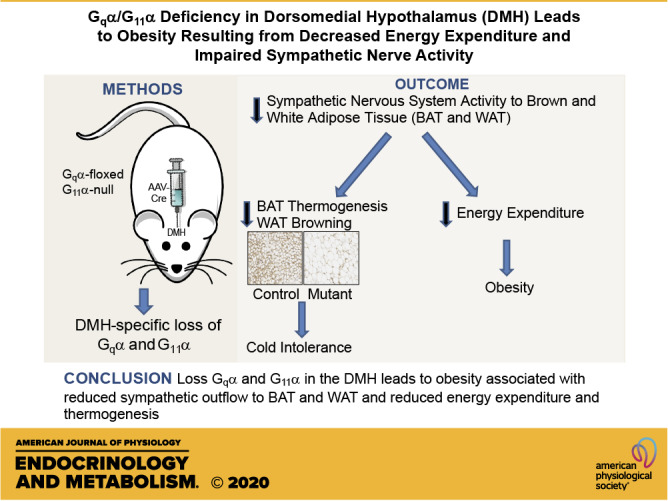
The G-protein subunits Gα and Gα (Gα) couple receptors to phospholipase C, leading to increased intracellular calcium. In this study we investigated the consequences of G/α deficiency in the dorsomedial hypothalamus (DMH), a critical site for the control of energy homeostasis. Mice with DMH-specific deletion of Gα (DMHGq/11KO) were generated by stereotaxic injection of adeno-associated virus (AAV)-Cre-green fluorescent protein (GFP) into the DMH of Gα:Gα mice. Compared with control mice that received DMH injection of AAV-GFP, DMHGq/11KO mice developed obesity associated with reduced energy expenditure without significant changes in food intake or physical activity. DMHGq/11KO mice showed no defects in the ability of the melanocortin agonist melanotan II to acutely stimulate energy expenditure or to inhibit food intake. At room temperature (22°C), DMHGq/11KO mice showed reduced sympathetic nervous system activity in brown adipose tissue (BAT) and heart, accompanied with decreased basal BAT uncoupling protein 1 () gene expression and lower heart rates. These mice were cold intolerant when acutely exposed to cold (6°C for 5 h) and had decreased cold-stimulated BAT gene expression. DMHGq/11KO mice also failed to adapt to gradually declining ambient temperatures and to develop adipocyte browning in inguinal white adipose tissue although their BAT was proportionally stimulated. Consistent with impaired cold-induced thermogenesis, the onset of obesity in DMHGq/11KO mice was significantly delayed when housed under thermoneutral conditions (30°C). Thus our results show that Gα and Gα in the DMH are required for the control of energy homeostasis by stimulating energy expenditure and thermoregulation. This paper demonstrates that signaling within the dorsomedial hypothalamus via the G proteins Gα and Gα, which couple cell surface receptors to the stimulation of phospholipase C, is critical for regulation of energy expenditure, thermoregulation by brown adipose tissue and the induction of white adipose tissue browning.
G 蛋白亚基 Gα 和 Gα(Gα) 将受体偶联到磷脂酶 C,导致细胞内钙离子增加。在这项研究中,我们研究了背内侧下丘脑 (DMH) 中 G/α 缺乏的后果,DMH 是控制能量平衡的关键部位。通过立体定向注射腺相关病毒 (AAV)-Cre-绿色荧光蛋白 (GFP) 到 Gα:Gα 小鼠的 DMH 中,生成了 DMH 特异性缺失 Gα 的小鼠 (DMHGq/11KO)。与接受 DMH 注射 AAV-GFP 的对照小鼠相比,DMHGq/11KO 小鼠发展为肥胖症,伴有能量消耗减少,而食物摄入或体力活动没有明显变化。DMHGq/11KO 小鼠在急性刺激能量消耗或抑制食物摄入方面,对黑皮质素激动剂黑素坦 II 的能力没有缺陷。在室温 (22°C) 下,DMHGq/11KO 小鼠棕色脂肪组织 (BAT) 和心脏中的交感神经系统活动减少,伴随着基础 BAT 解偶联蛋白 1()基因表达降低和心率降低。这些小鼠在急性暴露于寒冷 (6°C 5 小时) 时不耐寒,并且冷刺激 BAT 基因表达降低。DMHGq/11KO 小鼠也不能适应逐渐下降的环境温度,并且尽管其 BAT 被成比例地刺激,但不能在腹股沟白色脂肪组织中发展脂肪细胞褐变。与受损的冷诱导产热一致,当在热中性条件 (30°C) 下饲养时,DMHGq/11KO 小鼠肥胖的发作明显延迟。因此,我们的结果表明,DMH 中的 Gα 和 Gα 通过刺激能量消耗和体温调节来控制能量平衡是必需的。本文表明,通过将细胞表面受体偶联到磷脂酶 C 的刺激,G 蛋白 Gα 和 Gα 在内侧下丘脑的信号转导对于能量消耗、棕色脂肪组织的体温调节以及白色脂肪组织褐变的诱导至关重要。