HIV Unit, Geneva University Hospitals, Geneva, Switzerland
Faculty of Medicine, University of Geneva, Geneva, Switzerland.
BMJ Open. 2020 Nov 12;10(11):e040110. doi: 10.1136/bmjopen-2020-040110.
Lopinavir/ritonavir (LPV/r) has been proposed as repurposed drugs for pre-exposure and postexposure prophylaxis as well as therapy of COVID-19. Coronavirus postexposure prophylaxis (COPEP) trial aims at assessing their efficacy as postexposure ring-prophylaxis among adults exposed to SARS-CoV-2.
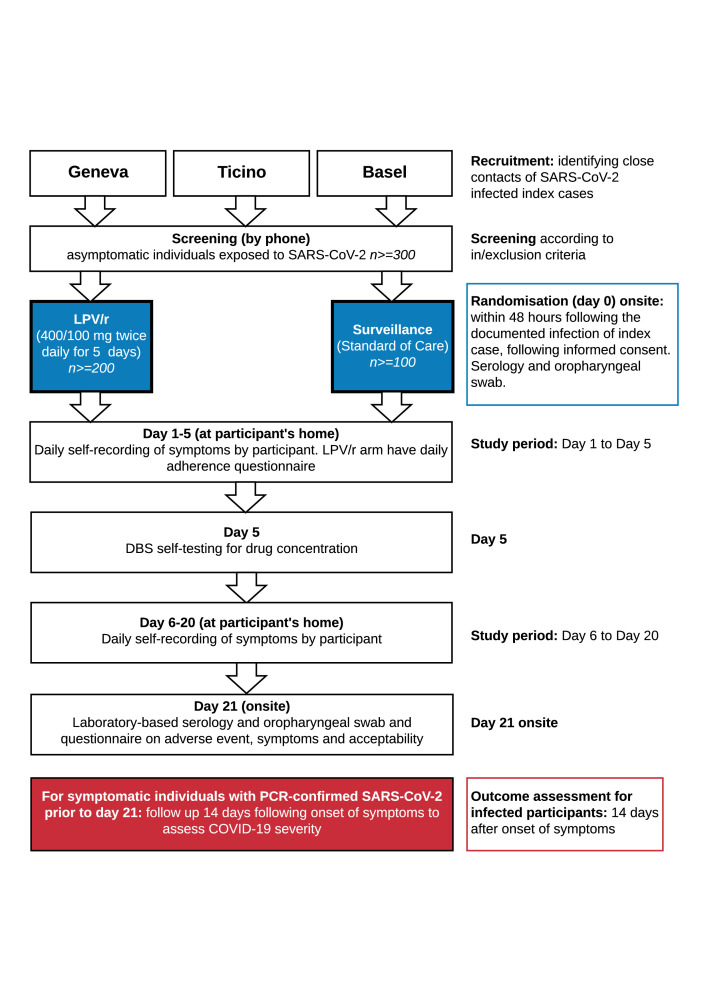
COPEP is a two-arm open-label cluster-randomised trial conducted in three cantons of Switzerland. Asymptomatic contacts (≥16 years) of individuals diagnosed with COVID-19 will be randomised (2:1) to either LPV/r (400 mg/100 mg two times per day) for 5 days, or a standard of care arm (no treatment). Asymptomatic individuals may be either SARS-CoV-2 positive or negative. Contacts living in the single household will form a cluster and will be randomised into the same arm. All participants will be followed-up for 21 days and undergo daily monitoring for COVID-19 symptoms. The primary endpoint is 21-day incidence of laboratory-confirmed COVID-19 with ≥1 compatible symptom, analysed in an intention-to-treat (ITT) analysis. The secondary endpoints include the 21-day incidence of COVID-19 as well as SARS-CoV-2 infection in a modified ITT analysis, excluding participants who had a positive SARS-CoV-2 RT-PCR from oropharyngeal swab and/or a positive SARS-CoV-2 IgG serology at baseline. Assuming a 21-day incidence for COVID-19 of 20% among contacts without postexposure chemoprophylaxis, to detect a relative risk reduction of 60% (ie, translating in an absolute reduction from 20% to 8%), with a power of 80%, an alpha of 5%. Accounting for design effect of cluster design of circa 1.1, we plan to enrol 200 participants to the LPV/r arm and 100 to the standard of care arm, 300 participants in total.
Ethics approval has been granted by the Commission Cantonale d'Ethique de la Recherche, Ethikkommission Nordwest- und Zentralschweiz and Comitato Etico Cantonale (ref 2020-00864) and Swissmedic (2020DR3056). Results from this trial will be disseminated via journal articles and presentations at national and international conferences.
Clinicaltrials.gov Registry (NCT04364022); Swiss National Clinical Trial Portal Registry (SNCTP 000003732).
CCER 2020-0864.
洛匹那韦/利托那韦(LPV/r)已被提议作为新冠肺炎的暴露前和暴露后预防以及治疗的重新利用药物。冠状病毒暴露后预防(COPEP)试验旨在评估其作为成年人接触 SARS-CoV-2 后的环预防药物的疗效。
COPEP 是一项在瑞士三个州进行的两臂开放性标签聚类随机试验。接触者(≥16 岁)接触确诊为 COVID-19 的个体,将被随机(2:1)分配至 LPV/r(每天两次,400mg/100mg)治疗 5 天,或标准治疗组(不治疗)。无症状的接触者可能 SARS-CoV-2 阳性或阴性。居住在单个家庭中的接触者将形成一个集群,并被随机分配到同一组。所有参与者将随访 21 天,并进行每日 COVID-19 症状监测。主要终点是 21 天内实验室确诊的 COVID-19 发病率,≥1 个符合症状的分析在意向治疗(ITT)分析中。次要终点包括修改后的 ITT 分析中 COVID-19 的 21 天发病率以及 SARS-CoV-2 感染率,排除基线时咽拭子 SARS-CoV-2 RT-PCR 阳性或 SARS-CoV-2 IgG 血清学阳性的参与者。假设接触者无暴露后化学预防的 COVID-19 21 天发病率为 20%,则检测到 60%的相对风险降低(即,从 20%绝对降低到 8%),效能为 80%,α 值为 5%。考虑到聚类设计的设计效应约为 1.1,我们计划招募 200 名 LPV/r 组和 100 名标准护理组的参与者,总共 300 名参与者。
委员会伦理委员会、西北和中瑞士伦理委员会和瑞士联邦药物管理局(参考号 2020-00864)和瑞士联邦药物管理局已批准该研究的伦理,并将通过期刊文章和在国家和国际会议上的演讲传播该试验的结果。
Clinicaltrials.gov 注册(NCT04364022);瑞士国家临床试验门户注册(SNCTP 000003732)。
CCER 2020-00864。