
巴西南部涎腺癌:107 例预后研究。
Salivary gland cancer in Southern Brazil: a prognostic study of 107 cases.
机构信息
Faculdade de Odontologia Universidade Federal do Rio Grande do Sul Rua Ramiro Barcelos, 2492, sala 503 CEP: 90035-003 - Santana, Porto Alegre RS, Brazil
出版信息
Med Oral Patol Oral Cir Bucal. 2021 May 1;26(3):e393-e403. doi: 10.4317/medoral.24248.
BACKGROUND
Salivary gland cancers (SGC) represent an uncommon group of heterogeneous tumors. We performed a retrospective survey of SGC diagnosed in a reference center for treatment of malignant tumors from the south of Brazil aiming to determine the prognostic value of demographic, clinic and pathologic features.
MATERIAL AND METHODS
Cases diagnosed as SGC between 2006 and 2016 were retrospectively collected. Medical records were examined to extract demographic, clinic, pathologic and follow-up information.
RESULTS
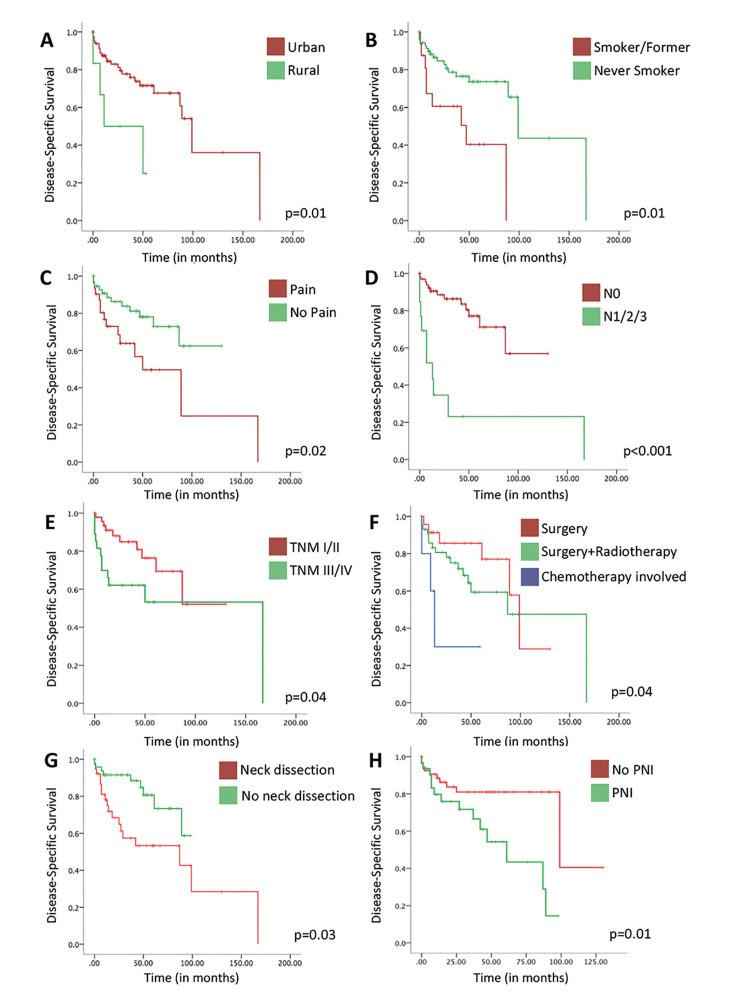
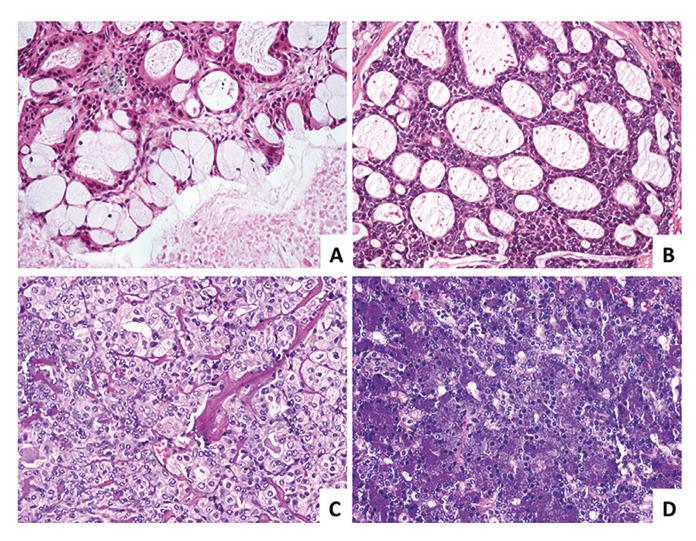
One-hundred and seven cases of SGC were identified. The most common SGC were mucoepidermoid carcinoma (MEC) (n = 39) followed by adenoid cystic carcinoma (AdCC) (n = 29). Among AdCCs, 55.2% of cases were classified as cribriform, 27.6% as tubular and 17.2% as solid. The tubular subtype had the highest percentage of cases with perineural invasion (p=0.01). Among MEC, 61.5% of cases were classified as low grade, 15.4% as intermediate grade and 19.9% as high grade. Low grade MEC had the lowest percentage of cases with perineural invasion (p=0.04). The 5-year survival for loco-regional control, disease-free survival (DFS) and disease-specific survival were 75%, 70% and 84%, respectively. The following features were associated with poor DFS: advanced age (p=0.03), rural residency (p=0.01), being a smoker or former smoker (p=0.01), pain (p=0.03), nodal metastasis (p<0.001), need for chemotherapy (p=0.02), neck dissection (p=0.04), perineural invasion (p=0.01), and being diagnosed with AdCC compared to MEC (p=0.02).
CONCLUSIONS
The clinco-demographic and pathologic features identified as prognostic factors reveal the profile of patients at increased risk of recurrence and who would benefit from closer follow-up.
背景
唾液腺癌(SGC)是一组罕见的异质性肿瘤。我们对巴西南部一家恶性肿瘤治疗中心诊断的 SGC 进行了回顾性调查,旨在确定人口统计学、临床和病理特征的预后价值。
材料和方法
回顾性收集了 2006 年至 2016 年期间诊断为 SGC 的病例。检查病历以提取人口统计学、临床、病理和随访信息。
结果
共发现 107 例 SGC。最常见的 SGC 是黏液表皮样癌(MEC)(n=39),其次是腺样囊性癌(AdCC)(n=29)。在 AdCC 中,55.2%的病例为筛状,27.6%为管状,17.2%为实体。管状亚型有神经周围侵犯的病例比例最高(p=0.01)。在 MEC 中,61.5%的病例为低级别,15.4%为中级别,19.9%为高级别。低级别 MEC 神经周围侵犯的病例比例最低(p=0.04)。局部区域控制、无病生存(DFS)和疾病特异性生存的 5 年生存率分别为 75%、70%和 84%。DFS 不良的相关特征包括:年龄较大(p=0.03)、农村居住(p=0.01)、吸烟或曾经吸烟(p=0.01)、疼痛(p=0.03)、淋巴结转移(p<0.001)、需要化疗(p=0.02)、颈清扫术(p=0.04)、神经周围侵犯(p=0.01),以及与 MEC 相比诊断为 AdCC(p=0.02)。
结论
确定为预后因素的临床-人口统计学和病理特征揭示了复发风险增加的患者特征,这些患者将受益于更密切的随访。

 Zotero 插件