Institute of Biomedical and Clinical Sciences, Medical School, College of Medicine and Health, University of Exeter, Hatherly Laboratories, Exeter EX4 4PS, UK.
Int J Mol Sci. 2020 Nov 30;21(23):9142. doi: 10.3390/ijms21239142.
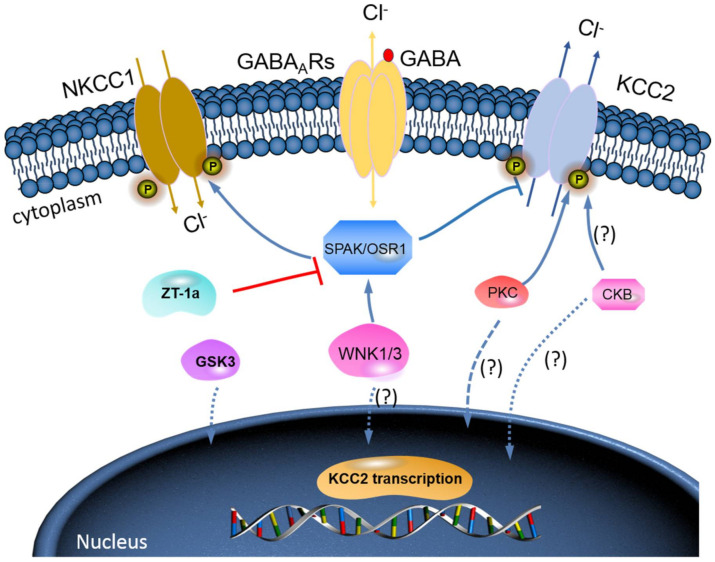
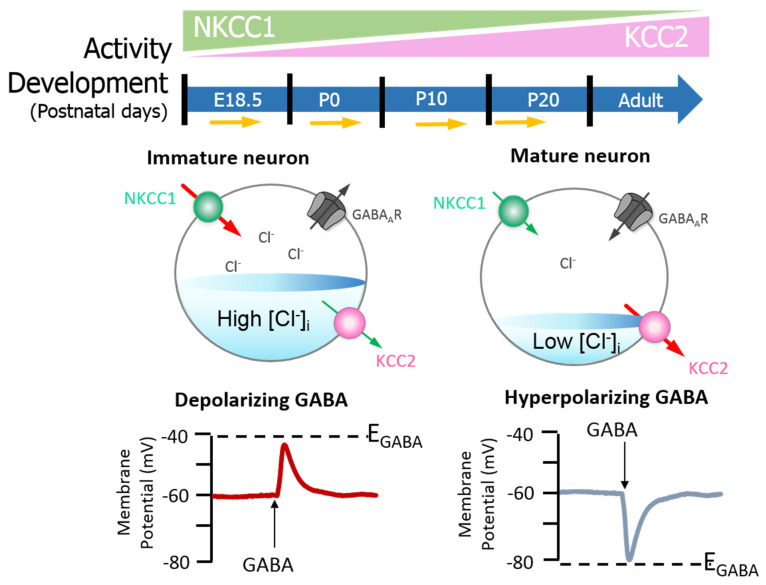
Intracellular chloride levels in the brain are regulated primarily through the opposing effects of two cation-chloride co-transporters (CCCs), namely K-Cl co-transporter-2 (KCC2) and Na-K-Cl co-transporter-1 (NKCC1). These CCCs are differentially expressed throughout the course of development, thereby determining the excitatory-to-inhibitory γ-aminobutyric acid (GABA) switch. GABAergic excitation (depolarisation) is important in controlling the healthy development of the nervous system; as the brain matures, GABAergic inhibition (hyperpolarisation) prevails. This developmental switch in excitability is important, as uncontrolled regulation of neuronal excitability can have implications for health. Huntington's disease (HD) is an example of a genetic disorder whereby the expression levels of KCC2 are abnormal due to mutant protein interactions. Although HD is primarily considered a motor disease, many other clinical manifestations exist; these often present in advance of any movement abnormalities. Cognitive change, in addition to sleep disorders, is prevalent in the HD population; the effect of uncontrolled KCC2 function on cognition and sleep has also been explored. Several mechanisms by which KCC2 expression is reduced have been proposed recently, thereby suggesting extensive investigation of KCC2 as a possible therapeutic target for the development of pharmacological compounds that can effectively treat HD co-morbidities. Hence, this review summarizes the role of KCC2 in the healthy and HD brain, and highlights recent advances that attest to KCC2 as a strong research and therapeutic target candidate.
脑内细胞内氯离子水平主要通过两种阳离子-氯离子共转运体(CCCs)的拮抗作用来调节,即 K-Cl 共转运体-2(KCC2)和 Na-K-Cl 共转运体-1(NKCC1)。这些 CCCs 在整个发育过程中表达不同,从而决定了兴奋性 GABA(γ-氨基丁酸)向抑制性 GABA 的转换。GABA 能兴奋(去极化)对于控制神经系统的健康发育很重要;随着大脑的成熟,GABA 能抑制(超极化)占主导地位。这种兴奋性的发育性转换很重要,因为神经元兴奋性的失控调节可能对健康有影响。亨廷顿病(HD)是一种遗传疾病的例子,由于突变蛋白相互作用,KCC2 的表达水平异常。尽管 HD 主要被认为是一种运动疾病,但存在许多其他临床表现;这些通常在任何运动异常之前出现。认知改变,除了睡眠障碍,在 HD 人群中很常见;失控的 KCC2 功能对认知和睡眠的影响也得到了探索。最近提出了几种 KCC2 表达降低的机制,从而表明对 KCC2 作为一种可能的治疗靶点进行广泛研究,以开发可有效治疗 HD 合并症的药物化合物。因此,本综述总结了 KCC2 在健康和 HD 大脑中的作用,并强调了最近的进展,证明 KCC2 是一个强有力的研究和治疗靶点候选者。