
氨甲环酸对谷氨酸转运体EAAT3活性的影响。
Effects of tranexamic acid on the activity of glutamate transporter EAAT3.
作者信息
Shin Hyun-Jung, Lee Soo-Young, Na Hyo-Seok, Koo Bon-Wook, Ryu Jung-Hee, Do Sang-Hwan
机构信息
Department of Anesthesiology and Pain Medicine, Seoul National University Bundang Hospital, Seongnam, Korea.
2Department of Anesthesiology and Pain Medicine, ThanQ Seoul Thyroid-Head & Neck Surgery Center, Seoul, Korea.
出版信息
Anesth Pain Med (Seoul). 2020 Jul 31;15(3):291-296. doi: 10.17085/apm.20004.
BACKGROUND
Tranexamic acid (TXA) is the most widely used hemostatic agent in surgical patients. However, when used in a high dose, it could cause a seizure in the postoperative period. The exact effector mechanism behind the seizure triggering remains unknown. Therefore, the authors investigated the effects of TXA on the activity of glutamate transporter type 3 (excitatory amino acid transporter 3; EAAT3), which is the main neuronal glutamate transporter type.
METHODS
EAAT3 was expressed in oocytes through mRNA injection. Oocytes were incubated with diluted tranexamic acid for 72 h. Two-electrode voltage clamping was used to measure membrane currents before, during, and after applying 30 µM L-glutamate. Responses were quantified by integrating the current traces and reported in microcoulombs (µC). Results were presented as mean ± SEM.
RESULTS
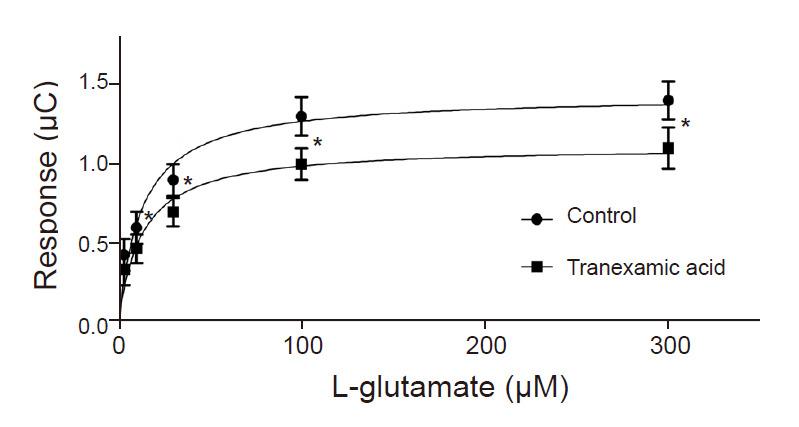
TXA (30 to 1,000 µM) significantly decreased EAAT3 activity. Our kinetic study showed that V was significantly decreased in the TXA group compared with the control group (1.1 ± 0.1 vs. 1.4 ± 0.1 µC, n = 18-23, P = 0.043), but the K did not significantly change (12.7 ± 3.9 µM for TXA vs. 12.8 ± 3.8 for control, n = 18-23, P = 0.986).
CONCLUSIONS
Our results suggest that TXA attenuates EAAT3 activity, which may explain its proconvulsant effect.
背景
氨甲环酸(TXA)是外科手术患者中使用最广泛的止血剂。然而,高剂量使用时,它可能在术后引发癫痫发作。癫痫发作触发背后的确切效应机制尚不清楚。因此,作者研究了TXA对3型谷氨酸转运体(兴奋性氨基酸转运体3;EAAT3)活性的影响,EAAT3是主要的神经元谷氨酸转运体类型。
方法
通过mRNA注射在卵母细胞中表达EAAT3。将卵母细胞与稀释的氨甲环酸孵育72小时。在施加30μM L-谷氨酸之前、期间和之后,使用双电极电压钳测量膜电流。通过对电流轨迹进行积分来量化反应,并以微库仑(μC)报告。结果以平均值±标准误表示。
结果
TXA(30至1000μM)显著降低EAAT3活性。我们的动力学研究表明,与对照组相比,TXA组的V显著降低(1.1±0.1对1.4±0.1μC,n = 18 - 23,P = 0.043),但K没有显著变化(TXA组为12.7±3.9μM,对照组为12.8±3.8,n = 18 - 23,P = 0.986)。
结论
我们的结果表明,TXA减弱EAAT3活性,这可能解释了其促惊厥作用。


 Zotero 插件