Emerg Infect Dis. 2021 Jan;27(1):26-35. doi: 10.3201/eid2701.190782.
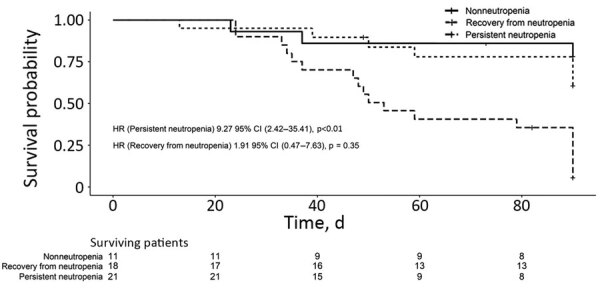
Invasive fusariosis (IF) is associated with severe neutropenia in patients with concurrent hematologic conditions. We conducted a retrospective observational study to characterize the epidemiology of IF in 18 Spanish hospitals during 2000-2015. In that time, the frequency of IF in nonneutropenic patients increased from 0.08 cases per 100,000 admissions in 2000-2009 to 0.22 cases per 100,000 admissions in 2010-2015. Nonneutropenic IF patients often had nonhematologic conditions, such as chronic cardiac or lung disease, rheumatoid arthritis, history of solid organ transplantation, or localized fusariosis. The 90-day death rate among nonneutropenic patients (28.6%) and patients with resolved neutropenia (38.1%) was similar. However, the death rate among patients with persistent neutropenia (91.3%) was significantly higher. We used a multivariate Cox regression analysis to characterize risk factors for death: persistent neutropenia was the only risk factor for death, regardless of antifungal therapy.
侵袭性镰刀菌病(IF)与同时存在血液学疾病的患者的严重中性粒细胞减少症有关。我们进行了一项回顾性观察研究,以描述 2000-2015 年间 18 家西班牙医院中 IF 的流行病学特征。在此期间,非中性粒细胞减少症患者中 IF 的频率从 2000-2009 年的每 10 万例住院患者 0.08 例增加到 2010-2015 年的每 10 万例住院患者 0.22 例。非中性粒细胞减少症 IF 患者常有非血液学疾病,如慢性心脏或肺部疾病、类风湿性关节炎、实体器官移植史或局部镰刀菌病。非中性粒细胞减少症患者(28.6%)和中性粒细胞减少症缓解患者(38.1%)的 90 天死亡率相似。然而,持续中性粒细胞减少症患者(91.3%)的死亡率显著更高。我们使用多变量 Cox 回归分析来描述死亡的危险因素:持续中性粒细胞减少症是死亡的唯一危险因素,无论是否接受抗真菌治疗。