
粘弹性吉塞库斯流体材料参数对等温熔体纺丝过程中细流拉伸性能及拉伸共振不稳定性的影响
Effect of Material Parameter of Viscoelastic Giesekus Fluids on Extensional Properties in Spinline and Draw Resonance Instability in Isothermal Melt Spinning Process.
作者信息
Park Geunyeop, Yun Jangho, Lee Changhoon, Jung Hyun Wook
机构信息
Department of Chemical and Biological Engineering, Korea University, Seoul 02841, Korea.
Hyundai Oilbank, Central Technology Research Institute, Yongin 16891, Korea.
出版信息
Polymers (Basel). 2020 Dec 31;13(1):139. doi: 10.3390/polym13010139.
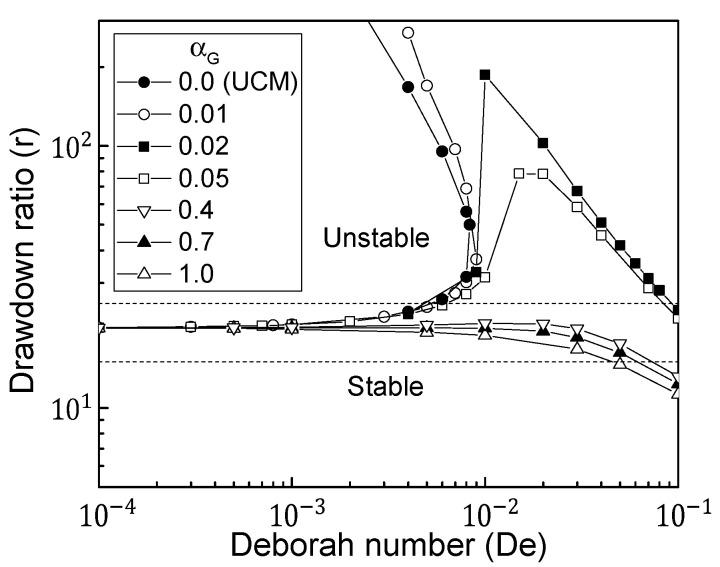
The draw resonance instability of viscoelastic Giesekus fluids was studied by correlating the spinline extensional features and transit times of several kinematic waves in an isothermal melt spinning process. The critical drawdown ratios were critically dependent on the Deborah number (, the ratio of material relaxation time to process time) and a single material parameter (αG) of the Giesekus fluid. In the intermediate range of αG, the stability status changed distinctively with increasing , i.e., the spinning system was initially stabilized and subsequently destabilized, as increases. In this αG regime, the level of velocity and extensional-thickening rheological property in the spinline became gradually enhanced at low and weakened at high . The draw resonance onsets for different values of αG were determined precisely using a simple indicator composed of several kinematic waves traveling the entire spinline and period of oscillation. The change in transit times of kinematic waves for varying adequately reflected the effect of αG on the change in stability.
通过关联等温熔体纺丝过程中几种运动波的纺丝线拉伸特性和传播时间,研究了粘弹性吉塞库斯流体的拉伸共振不稳定性。临界拉伸比主要取决于德博拉数(材料松弛时间与加工时间之比)和吉塞库斯流体的单一材料参数(αG)。在αG的中间范围内,随着德博拉数增加,稳定性状态发生显著变化,即纺丝系统最初稳定,随后失稳。在这个αG范围内,纺丝线中的速度水平和拉伸增稠流变特性在低德博拉数时逐渐增强,在高德博拉数时减弱。使用由沿整个纺丝线传播的几种运动波和振荡周期组成的简单指标,精确确定了不同αG值下的拉伸共振起始点。运动波传播时间随德博拉数的变化充分反映了αG对稳定性变化的影响。




 Zotero 插件