Li Nansong, Zhu Hanhao, Wang Xiaohan, Xiao Rui, Xue Yangyang, Zheng Guangxue
Acoustic Science and Technology Laboratory, Harbin Engineering University, Harbin 150001, China.
Key Laboratory of Marine Information Acquisition and Security (Harbin Engineering University), Ministry of Industry and Information Technology, Harbin 150001, China.
Sensors (Basel). 2020 Dec 30;21(1):192. doi: 10.3390/s21010192.
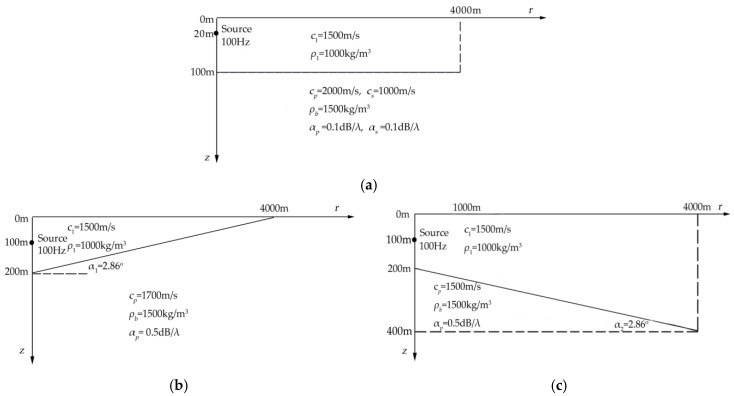
This work is concerned with the characteristics of very low frequency sound propagation (VLF, ≤100 Hz) in the shallow marine environment. Under these conditions, the classical hypothesis of considering the sea bottom as a fluid environment is no longer appropriate, and the sound propagation characteristics at the sea bottom should be also considered. Hence, based on the finite element method (FEM), and setting the sea bottom as an elastic medium, a proposed model which unifies the sea water and sea bottom is established, and the propagation characteristics in full waveguides of shallow water can be synchronously discussed. Using this model, the effects of the sea bottom topography and the various geoacoustic parameters on VLF sound propagation and its corresponding mechanisms are investigated through numerical examples and acoustic theory. The simulation results demonstrate the adaptability of the proposed model to complex shallow water waveguides and the accuracy of the calculated acoustic field. For the sea bottom topography, the greater the inclination angle of an up-sloping sea bottom, the stronger the leak of acoustic energy to the sea bottom, and the more rapid the attenuation of the acoustic energy in sea water. The effect of a down-sloping sea bottom on acoustic energy is the opposite. Moreover, the greater the pressure wave (P-wave) speed in the sea bottom, the more acoustic energy remains in the water rather than leaking into the bottom; the influence laws of the density and the shear wave (S-wave) speed in the sea bottom are opposite.
这项工作关注的是极低频声音传播(VLF,≤100赫兹)在浅海环境中的特性。在这些条件下,将海底视为流体环境的经典假设不再适用,还应考虑海底的声音传播特性。因此,基于有限元方法(FEM),并将海底设定为弹性介质,建立了一个统一海水和海底的模型,可同步讨论浅水中全波导的传播特性。利用该模型,通过数值示例和声理论研究了海底地形和各种地球声学参数对极低频声音传播的影响及其相应机制。模拟结果证明了所提模型对复杂浅水波导的适应性以及计算声场的准确性。对于海底地形,上坡海底的倾斜角度越大,声能向海底的泄漏越强,海水中声能的衰减越快。下坡海底对声能的影响则相反。此外,海底中的压力波(P波)速度越大,留在水中而非泄漏到海底的声能就越多;海底密度和剪切波(S波)速度的影响规律则相反。