Hundertmark Wiley J, Lee Marissa, Smith Ian A, Bang Ashley H Y, Chen Vivien, Gately Conor K, Templer Pamela H, Hutyra Lucy R
Department of Earth and Environment, Boston University, Boston, MA, 02215, USA.
Department of Earth, Environmental, and Planetary Sciences, Brown University, Providence, RI, 02912, USA.
Carbon Balance Manag. 2021 Jan 7;16(1):1. doi: 10.1186/s13021-020-00160-5.
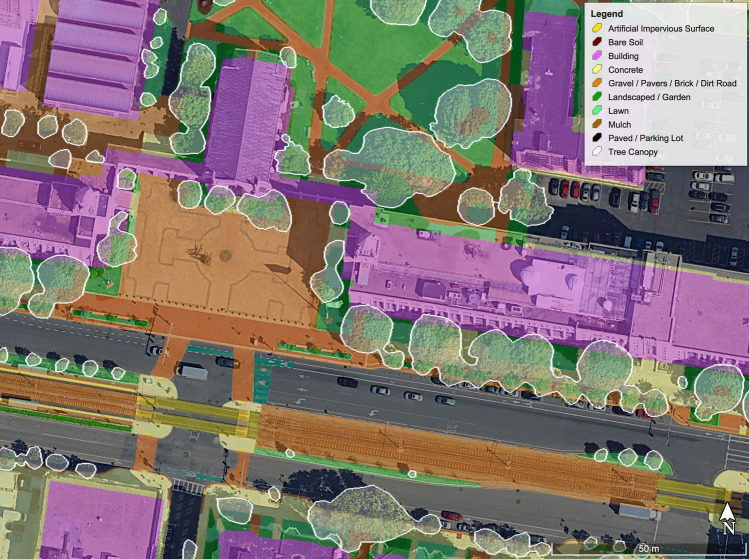
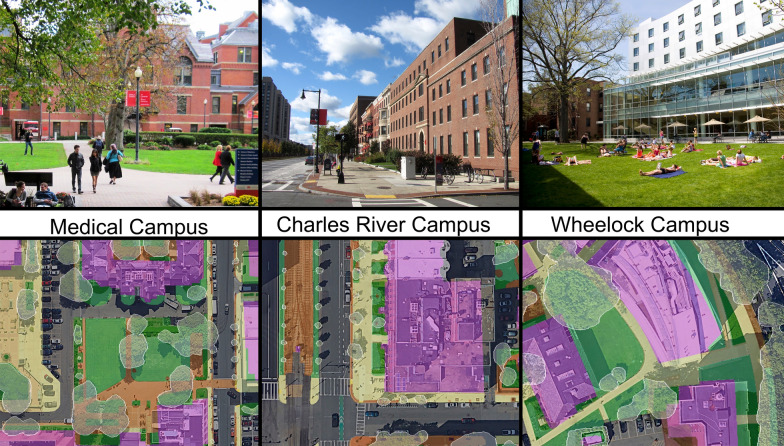
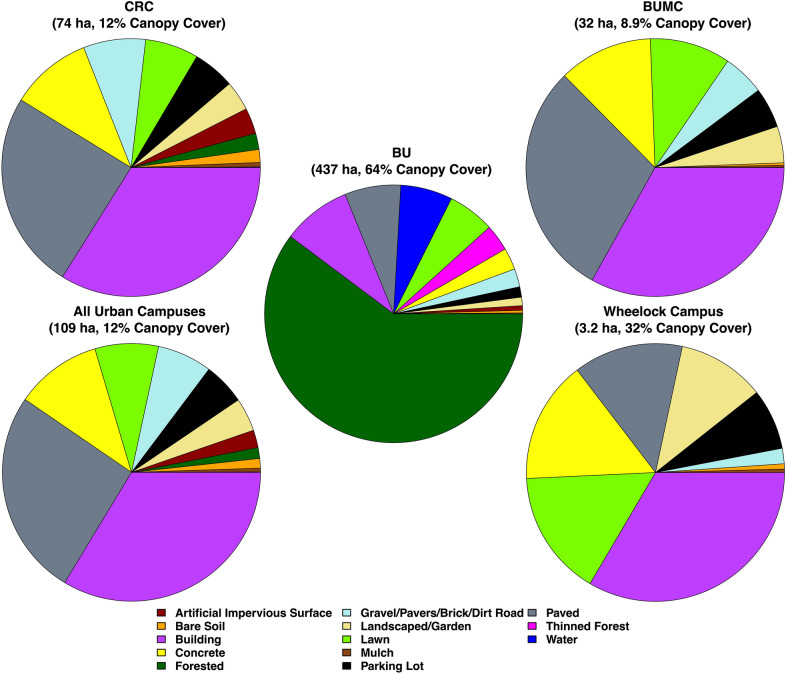
With a lack of United States federal policy to address climate change, cities, the private sector, and universities have shouldered much of the work to reduce carbon dioxide (CO) and other greenhouse gas emissions. This study aims to determine how landcover characteristics influence the amount of carbon (C) sequestered and respired via biological processes, evaluating the role of land management on the overall C budget of an urban university. Boston University published a comprehensive Climate Action Plan in 2017 with the goal of achieving C neutrality by 2040. In this study, we digitized and discretized each of Boston University's three urban campuses into landcover types, with C sequestration and respiration rates measured and scaled to provide a University-wide estimate of biogenic C fluxes within the broader context of total University emissions.
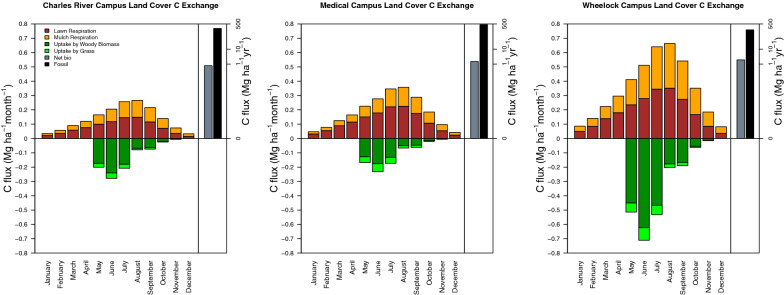
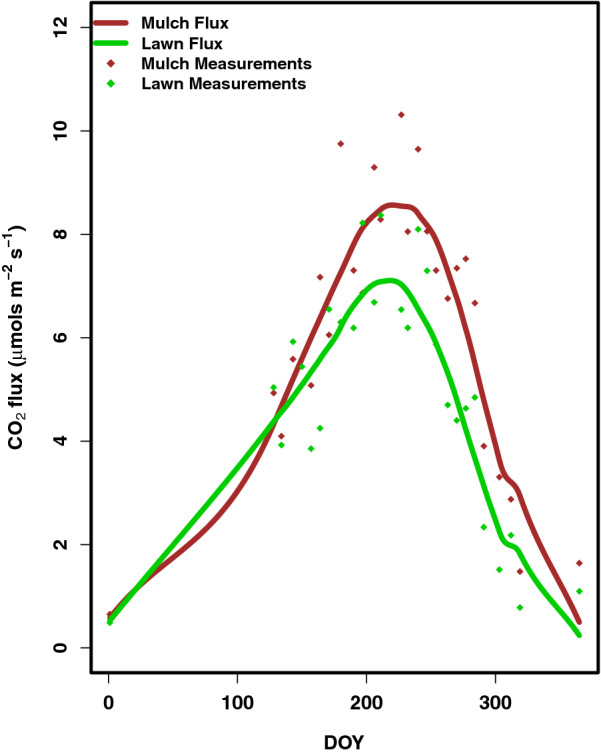
Each of Boston University's three highly urban campuses were net sources of biogenic C to the atmosphere. While trees were estimated to sequester 0.6 ± 0.2 kg C m canopy cover year, mulch and lawn areas in 2018 emitted C at rates of 1.7 ± 0.4 kg C m year and 1.4 ± 0.4 kg C m year, respectively. C uptake by tree canopy cover, which can spatially overlap lawn and mulched landcovers, was not large enough to offset biogenic emissions. The proportion of biogenic emissions to Scope 1 anthropogenic emissions on each campus varied from 0.5% to 2%, and depended primarily on the total anthropogenic emissions on each campus.
Our study quantifies the role of urban landcover in local C budgets, offering insights on how landscaping management strategies-such as decreasing mulch application rates and expanding tree canopy extent-can assist universities in minimizing biogenic C emissions and even potentially creating a small biogenic C sink. Although biogenic C fluxes represent a small fraction of overall anthropogenic emissions on urban university campuses, these biogenic fluxes are under active management by the university and should be included in climate action plans.
由于美国缺乏应对气候变化的联邦政策,城市、私营部门和大学承担了大部分减少二氧化碳(CO)和其他温室气体排放的工作。本研究旨在确定土地覆盖特征如何影响通过生物过程固存和呼吸的碳(C)量,评估土地管理在城市大学整体碳预算中的作用。波士顿大学于2017年发布了一项全面的气候行动计划,目标是到2040年实现碳中和。在本研究中,我们将波士顿大学的三个城市校区中的每一个数字化并离散为土地覆盖类型,测量并按比例缩放碳固存和呼吸速率,以在大学总排放的更广泛背景下提供全大学范围内生物源碳通量的估计。
波士顿大学的三个高度城市化校区均为大气中生物源碳的净排放源。虽然估计树木每年每平方米树冠覆盖面积固存0.6±0.2千克碳,但2018年覆盖物和草坪区域的碳排放速率分别为每年每平方米1.7±0.4千克碳和1.4±0.4千克碳。树冠覆盖吸收的碳,其在空间上可能与草坪和覆盖物覆盖的土地重叠,不足以抵消生物源排放。每个校区生物源排放占第1类人为排放的比例在0.5%至2%之间,主要取决于每个校区的总人为排放量。
我们的研究量化了城市土地覆盖在当地碳预算中的作用,为景观管理策略(如降低覆盖物施用率和扩大树冠范围)如何帮助大学减少生物源碳排放甚至潜在地创造一个小型生物源碳汇提供了见解。虽然生物源碳通量在城市大学校园的整体人为排放中占比很小,但这些生物源通量由大学积极管理,应纳入气候行动计划。