
新型冠状病毒肺炎与急性肾损伤的关联:一项多中心队列研究,疾病严重程度无关。
The Association of COVID-19 With Acute Kidney Injury Independent of Severity of Illness: A Multicenter Cohort Study.
作者信息
Moledina Dennis G, Simonov Michael, Yamamoto Yu, Alausa Jameel, Arora Tanima, Biswas Aditya, Cantley Lloyd G, Ghazi Lama, Greenberg Jason H, Hinchcliff Monique, Huang Chenxi, Mansour Sherry G, Martin Melissa, Peixoto Aldo, Schulz Wade, Subair Labeebah, Testani Jeffrey M, Ugwuowo Ugochukwu, Young Patrick, Wilson F Perry
机构信息
Section of Nephrology, Department of Internal Medicine, Yale School of Medicine, New Haven, CT; Clinical and Translational Research Accelerator, Department of Internal Medicine, Yale School of Medicine, New Haven, CT.
Clinical and Translational Research Accelerator, Department of Internal Medicine, Yale School of Medicine, New Haven, CT; Section of General Internal Medicine, Department of Internal Medicine, Yale School of Medicine, New Haven, CT.
出版信息
Am J Kidney Dis. 2021 Apr;77(4):490-499.e1. doi: 10.1053/j.ajkd.2020.12.007. Epub 2021 Jan 8.
RATIONALE & OBJECTIVE: Although coronavirus disease 2019 (COVID-19) has been associated with acute kidney injury (AKI), it is unclear whether this association is independent of traditional risk factors such as hypotension, nephrotoxin exposure, and inflammation. We tested the independent association of COVID-19 with AKI.
STUDY DESIGN
Multicenter, observational, cohort study.
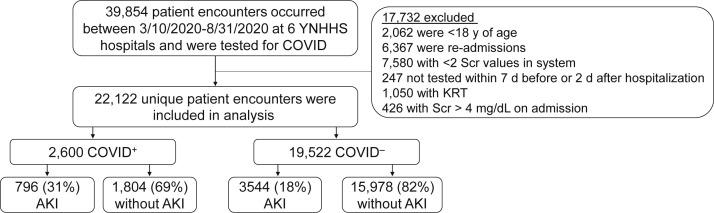
SETTING & PARTICIPANTS: Patients admitted to 1 of 6 hospitals within the Yale New Haven Health System between March 10, 2020, and August 31, 2020, with results for severe acute respiratory syndrome coronavirus 2 (SARS-CoV-2) testing via polymerase chain reaction of a nasopharyngeal sample.
EXPOSURE
Positive test for SARS-CoV-2.
OUTCOME
AKI by KDIGO (Kidney Disease: Improving Global Outcomes) criteria.
ANALYTICAL APPROACH
Evaluated the association of COVID-19 with AKI after controlling for time-invariant factors at admission (eg, demographic characteristics, comorbidities) and time-varying factors updated continuously during hospitalization (eg, vital signs, medications, laboratory results, respiratory failure) using time-updated Cox proportional hazard models.
RESULTS
Of the 22,122 patients hospitalized, 2,600 tested positive and 19,522 tested negative for SARS-CoV-2. Compared with patients who tested negative, patients with COVID-19 had more AKI (30.6% vs 18.2%; absolute risk difference, 12.5% [95% CI, 10.6%-14.3%]) and dialysis-requiring AKI (8.5% vs 3.6%) and lower rates of recovery from AKI (58% vs 69.8%). Compared with patients without COVID-19, patients with COVID-19 had higher inflammatory marker levels (C-reactive protein, ferritin) and greater use of vasopressors and diuretic agents. Compared with patients without COVID-19, patients with COVID-19 had a higher rate of AKI in univariable analysis (hazard ratio, 1.84 [95% CI, 1.73-1.95]). In a fully adjusted model controlling for demographic variables, comorbidities, vital signs, medications, and laboratory results, COVID-19 remained associated with a high rate of AKI (adjusted hazard ratio, 1.40 [95% CI, 1.29-1.53]).
LIMITATIONS
Possibility of residual confounding.
CONCLUSIONS
COVID-19 is associated with high rates of AKI not fully explained by adjustment for known risk factors. This suggests the presence of mechanisms of AKI not accounted for in this analysis, which may include a direct effect of COVID-19 on the kidney or other unmeasured mediators. Future studies should evaluate the possible unique pathways by which COVID-19 may cause AKI.
原理与目的
尽管2019冠状病毒病(COVID-19)与急性肾损伤(AKI)有关,但尚不清楚这种关联是否独立于传统风险因素,如低血压、肾毒素暴露和炎症。我们测试了COVID-19与AKI的独立关联。
研究设计
多中心、观察性队列研究。
设置与参与者
2020年3月10日至2020年8月31日期间入住耶鲁纽黑文医疗系统内6家医院之一的患者,通过鼻咽样本聚合酶链反应检测严重急性呼吸综合征冠状病毒2(SARS-CoV-2)的结果。
暴露因素
SARS-CoV-2检测呈阳性。
结局指标
根据改善全球肾脏病预后组织(KDIGO)标准诊断的AKI。
分析方法
使用时间更新的Cox比例风险模型,在控制入院时的时间不变因素(如人口统计学特征、合并症)和住院期间持续更新的时间变化因素(如生命体征、药物、实验室检查结果、呼吸衰竭)后,评估COVID-19与AKI的关联。
结果
在22122例住院患者中,2600例SARS-CoV-2检测呈阳性,19522例检测呈阴性。与检测阴性的患者相比,COVID-19患者发生AKI的比例更高(30.6%对18.2%;绝对风险差异为12.5%[95%CI,10.6%-14.3%]),需要透析的AKI比例更高(8.5%对3.6%),AKI恢复率更低(58%对69.8%)。与无COVID-19的患者相比,COVID-19患者的炎症标志物水平(C反应蛋白、铁蛋白)更高,血管升压药和利尿剂的使用更多。在单变量分析中,与无COVID-19的患者相比,COVID-19患者发生AKI的比例更高(风险比,1.84[95%CI,1.73-1.95])。在控制人口统计学变量、合并症、生命体征、药物和实验室检查结果的完全调整模型中,COVID-19仍与高AKI发生率相关(调整后风险比,1.40[95%CI,1.29-1.53])。
局限性
存在残余混杂因素的可能性。
结论
COVID-19与高AKI发生率相关,已知风险因素调整后仍无法完全解释。这表明本分析中未考虑到AKI的机制存在,可能包括COVID-19对肾脏的直接影响或其他未测量的介质。未来的研究应评估COVID-19可能导致AKI的独特途径。



 Zotero 插件