Partelli Stefano, Ramage John K, Massironi Sara, Zerbi Alessandro, Kim Hong Beom, Niccoli Patricia, Panzuto Francesco, Landoni Luca, Tomazic Ales, Ibrahim Toni, Kaltsas Gregory, Bertani Emilio, Sauvanet Alain, Segelov Eva, Caplin Martyn, Coppa Jorgelina, Armstrong Thomas, Weickert Martin O, Butturini Giovanni, Staettner Stefan, Boesch Florian, Cives Mauro, Moulton Carol Anne, He Jin, Selberherr Andreas, Twito Orit, Castaldi Antonio, De Angelis Claudio Giovanni, Gaujoux Sebastien, Almeamar Hussein, Frilling Andrea, Vigia Emanuel, Wilson Colin, Muffatti Francesca, Srirajaskanthan Raj, Invernizzi Pietro, Lania Andrea, Kwon Wooil, Ewald Jacques, Rinzivillo Maria, Nessi Chiara, Smid Lojze M, Gardini Andrea, Tsoli Marina, Picardi Edgardo E, Hentic Olivia, Croagh Daniel, Toumpanakis Christos, Citterio Davide, Ramsey Emma, Mosterman Barbara, Regi Paolo, Gasteiger Silvia, Rossi Roberta E, Smiroldo Valeria, Jang Jin-Young, Falconi Massimo
Pancreatic Surgery Unit, Pancreas Translational & Clinical Research Center, IRCCS San Raffaele Scientific Institute, Milan, Italy.
Kings Health Partners NET Center, Kings College Hospital London, London, United Kingdom.
Front Med (Lausanne). 2020 Dec 23;7:598438. doi: 10.3389/fmed.2020.598438. eCollection 2020.
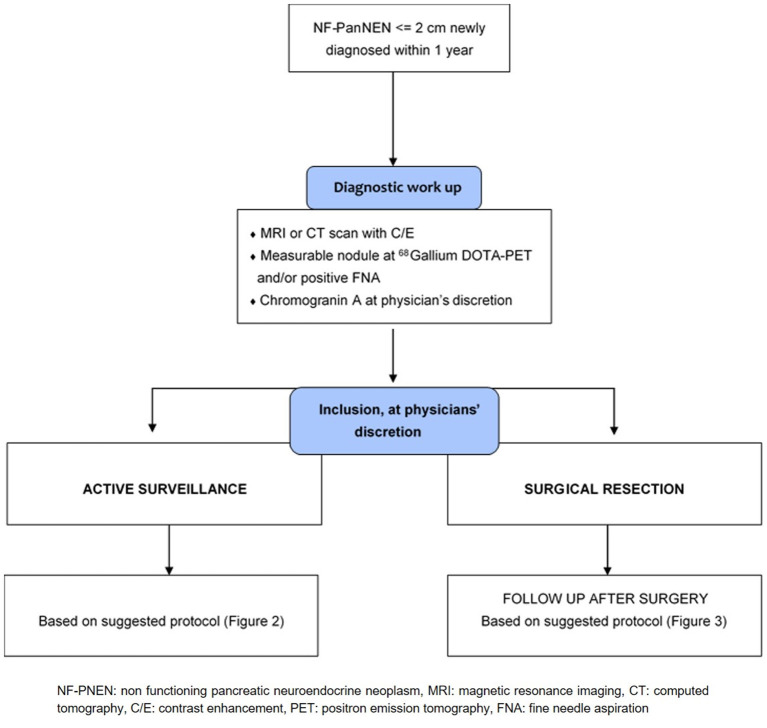
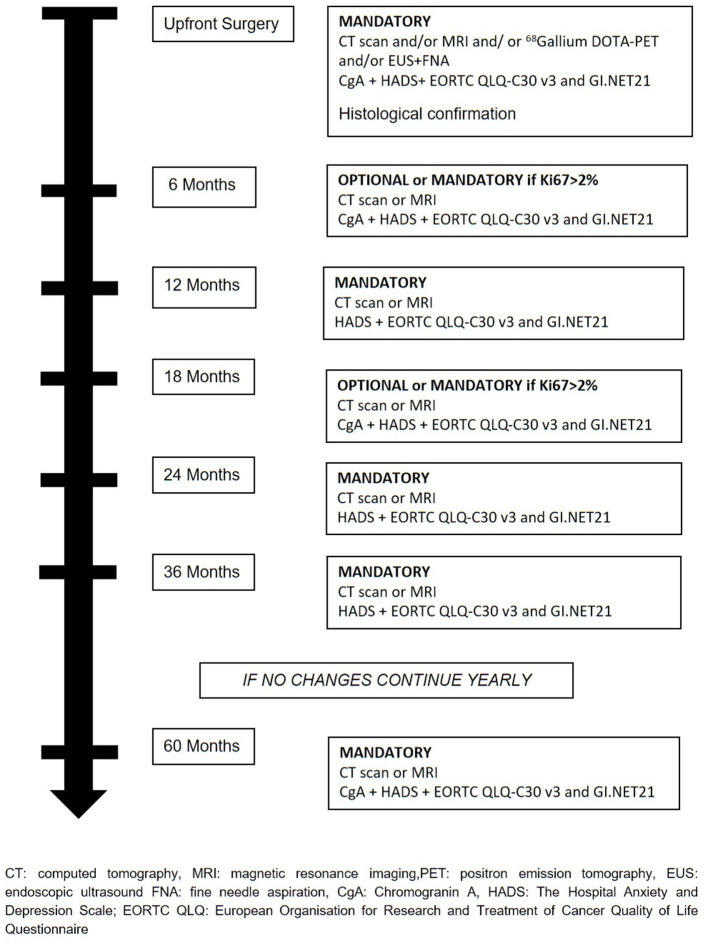
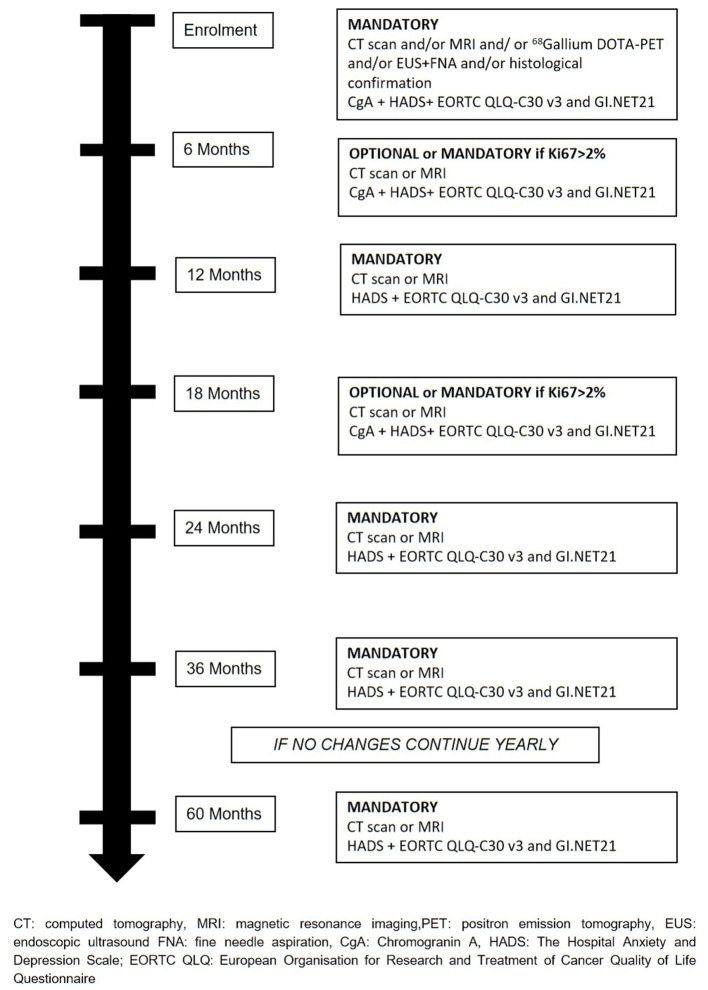
The optimal treatment for small, asymptomatic, nonfunctioning pancreatic neuroendocrine neoplasms (NF-PanNEN) is still controversial. European Neuroendocrine Tumor Society (ENETS) guidelines recommend a watchful strategy for asymptomatic NF-PanNEN <2 cm of diameter. Several retrospective series demonstrated that a non-operative management is safe and feasible, but no prospective studies are available. Aim of the ASPEN study is to evaluate the optimal management of asymptomatic NF-PanNEN ≤2 cm comparing active surveillance and surgery. ASPEN is a prospective international observational multicentric cohort study supported by ENETS. The study is registered in ClinicalTrials.gov with the identification code NCT03084770. Based on the incidence of NF-PanNEN the number of expected patients to be enrolled in the ASPEN study is 1,000 during the study period (2017-2022). Primary endpoint is disease/progression-free survival, defined as the time from study enrolment to the first evidence of progression (active surveillance group) or recurrence of disease (surgery group) or death from disease. Inclusion criteria are: age >18 years, the presence of asymptomatic sporadic NF-PanNEN ≤2 cm proven by a positive fine-needle aspiration (FNA) or by the presence of a measurable nodule on high-quality imaging techniques that is positive at Gallium DOTATOC-PET scan. The ASPEN study is designed to investigate if an active surveillance of asymptomatic NF-PanNEN ≤2 cm is safe as compared to surgical approach.
对于小型、无症状、无功能的胰腺神经内分泌肿瘤(NF-PanNEN),最佳治疗方法仍存在争议。欧洲神经内分泌肿瘤学会(ENETS)指南建议,对于直径<2 cm的无症状NF-PanNEN采取观察策略。多项回顾性系列研究表明,非手术治疗是安全可行的,但尚无前瞻性研究。ASPEN研究的目的是比较主动监测和手术治疗,评估直径≤2 cm的无症状NF-PanNEN的最佳治疗方法。ASPEN是一项由ENETS支持的前瞻性国际观察性多中心队列研究。该研究已在ClinicalTrials.gov注册,识别码为NCT03084770。根据NF-PanNEN的发病率,预计在研究期间(2017 - 2022年)有1000名患者纳入ASPEN研究。主要终点是疾病无进展生存期,定义为从研究入组到出现进展的首个证据(主动监测组)或疾病复发(手术组)或死于疾病的时间。纳入标准为:年龄>18岁,经细针穿刺活检(FNA)阳性或高质量成像技术显示可测量结节且镓[68Ga] DOTATOC-PET扫描呈阳性,证实存在无症状散发性NF-PanNEN≤2 cm。ASPEN研究旨在调查与手术方法相比,对直径≤2 cm的无症状NF-PanNEN进行主动监测是否安全。