• 文献检索
  • 文档翻译
  • 深度研究
  • 学术资讯
  • Suppr Zotero 插件Zotero 插件
  • 邀请有礼
  • 套餐&价格
  • 历史记录
应用&插件
Suppr Zotero 插件Zotero 插件浏览器插件Mac 客户端Windows 客户端微信小程序
定价
高级版会员购买积分包购买API积分包
服务
文献检索文档翻译深度研究API 文档MCP 服务
关于我们
关于 Suppr公司介绍联系我们用户协议隐私条款
关注我们

Suppr 超能文献

核心技术专利:CN118964589B侵权必究
粤ICP备2023148730 号-1Suppr @ 2026

文献检索

告别复杂PubMed语法,用中文像聊天一样搜索,搜遍4000万医学文献。AI智能推荐,让科研检索更轻松。

立即免费搜索

文件翻译

保留排版,准确专业,支持PDF/Word/PPT等文件格式,支持 12+语言互译。

免费翻译文档

深度研究

AI帮你快速写综述,25分钟生成高质量综述,智能提取关键信息,辅助科研写作。

立即免费体验

亚马逊森林中的食用水果植物物种主要依赖蜜蜂和甲虫作为传粉媒介。

Edible Fruit Plant Species in the Amazon Forest Rely Mostly on Bees and Beetles as Pollinators.

机构信息

Instituto Tecnológico Vale. Rua Boaventura da Silva 955. Belém, Pará, Brazil.

Centro de Ciências Naturais e Tecnologia, Universidade do Estado do Pará. Rua do Una 156. Belém, Pará, Brazil.

出版信息

J Econ Entomol. 2021 Apr 13;114(2):710-722. doi: 10.1093/jee/toaa284.

DOI:10.1093/jee/toaa284
PMID:33440000
原文链接:https://pmc.ncbi.nlm.nih.gov/articles/PMC8042744/
Abstract

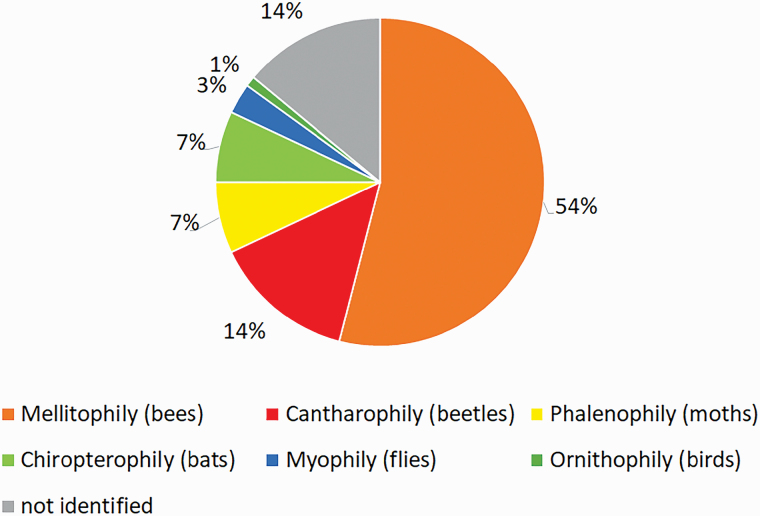
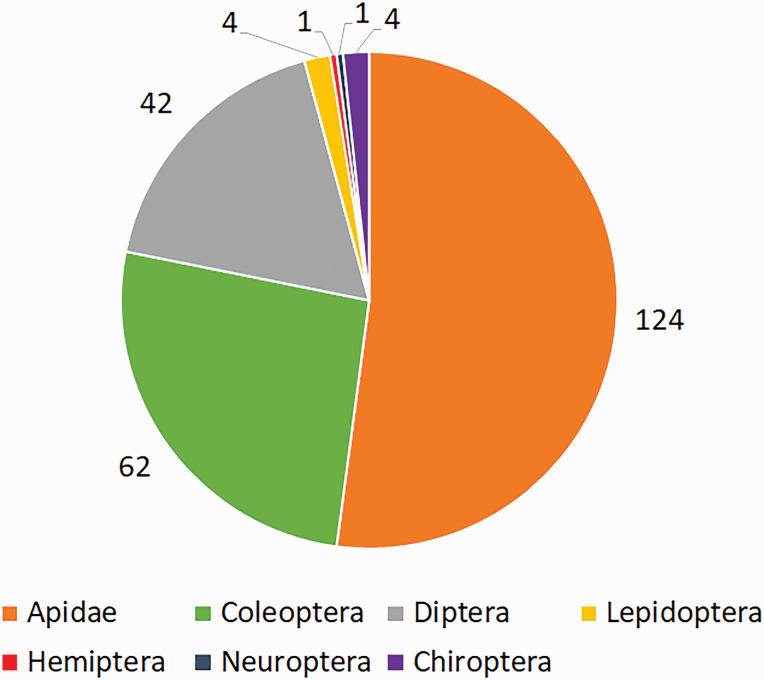
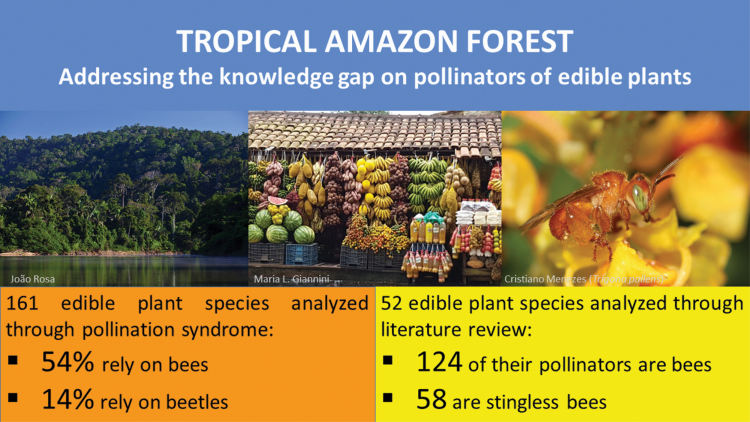
Edible fruit plants of tropical forests are important for the subsistence of traditional communities. Understanding the most important pollinators related to fruit and seed production of these plants is a necessary step to protect their pollination service and assure the food security of these communities. However, there are many important knowledge gaps related to floral biology and pollination in megadiverse tropical rainforests, such as the Amazon Forest, due mainly to the high number of plant species. Our study aims to indicate the main pollinators of edible plants (mainly fruits) of the Amazon forest. For this, we adopted a threefold strategy: we built a list of edible plant species, determined the pollination syndrome of each species, and performed a review on the scientific literature searching for their pollinator/visitors. The list of plant species was determined from two specialized publications on Amazon fruit plants, totaling 188 species. The pollination syndrome was determined for 161 species. The syndromes most frequently found among the analyzed species were melittophily (bee pollination), which was found in 101 of the analyzed plant species (54%) and cantharophily (beetle pollination; 26 species; 14%). We also found 238 pollinator/visitor taxa quoted for 52 (28%) plant species in previous publications, with 124 taxa belonging to Apidae family (bees; 52%), mainly from Meliponini tribe (58 taxa; 47%). Knowledge about pollinators is an important step to help on preserving their ecosystem services and maintaining the productivity of fruit trees in the Amazon.

摘要

热带森林的可食用水果植物对于传统社区的生存至关重要。了解与这些植物的果实和种子生产相关的最重要的传粉者,是保护其传粉服务并确保这些社区粮食安全的必要步骤。然而,由于植物物种数量众多,在像亚马逊雨林这样的生物多样性热点地区,存在许多与花卉生物学和传粉相关的重要知识空白。我们的研究旨在确定亚马逊森林中可食用植物(主要是水果)的主要传粉者。为此,我们采用了三重策略:我们构建了一个可食用植物物种清单,确定了每个物种的传粉综合征,并对有关其传粉者/访客的科学文献进行了综述。植物物种清单来自两份关于亚马逊水果植物的专业出版物,共确定了 188 个物种。对 161 个物种确定了传粉综合征。在分析的物种中最常见的综合征是蜜蜂传粉(melittophily),在分析的 101 种植物物种(54%)中发现了这种综合征,其次是甲虫传粉(cantharophily;26 种;14%)。我们还在之前的出版物中为 52 种(28%)植物物种找到了 238 种传粉者/访客类群,其中 124 种属于 Apidae 科(蜜蜂;52%),主要来自 Meliponini 部落(58 种;47%)。关于传粉者的知识是帮助保护其生态系统服务和维持亚马逊地区果树生产力的重要步骤。
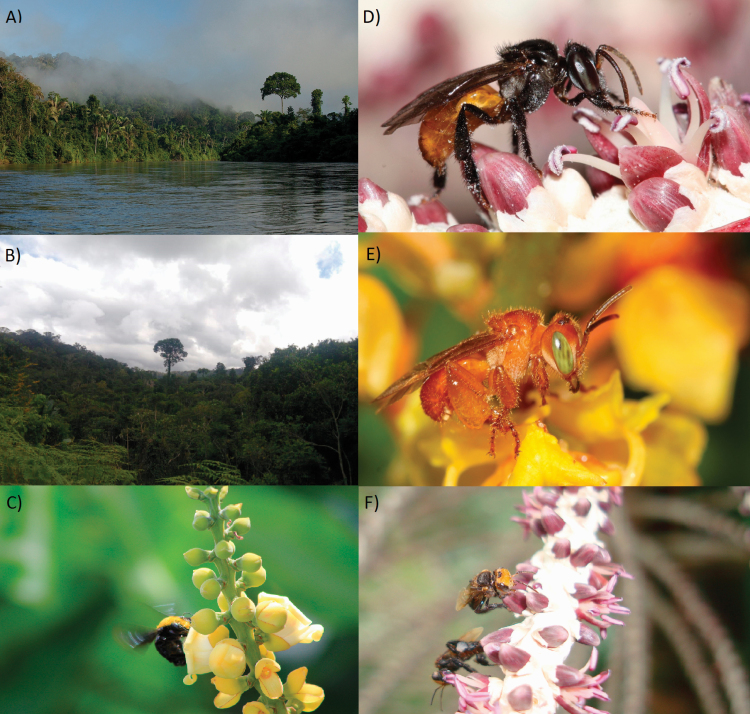
https://cdn.ncbi.nlm.nih.gov/pmc/blobs/b363/8042744/9f22e83313e2/toaa284f0003.jpg
https://cdn.ncbi.nlm.nih.gov/pmc/blobs/b363/8042744/5bf3265d2ea2/toaa284f0004.jpg
https://cdn.ncbi.nlm.nih.gov/pmc/blobs/b363/8042744/edb3f4ad4852/toaa284f0001.jpg
https://cdn.ncbi.nlm.nih.gov/pmc/blobs/b363/8042744/deea7c950aff/toaa284f0002.jpg
https://cdn.ncbi.nlm.nih.gov/pmc/blobs/b363/8042744/9f22e83313e2/toaa284f0003.jpg
https://cdn.ncbi.nlm.nih.gov/pmc/blobs/b363/8042744/5bf3265d2ea2/toaa284f0004.jpg
https://cdn.ncbi.nlm.nih.gov/pmc/blobs/b363/8042744/edb3f4ad4852/toaa284f0001.jpg
https://cdn.ncbi.nlm.nih.gov/pmc/blobs/b363/8042744/deea7c950aff/toaa284f0002.jpg
https://cdn.ncbi.nlm.nih.gov/pmc/blobs/b363/8042744/9f22e83313e2/toaa284f0003.jpg

相似文献

1
Edible Fruit Plant Species in the Amazon Forest Rely Mostly on Bees and Beetles as Pollinators.亚马逊森林中的食用水果植物物种主要依赖蜜蜂和甲虫作为传粉媒介。
J Econ Entomol. 2021 Apr 13;114(2):710-722. doi: 10.1093/jee/toaa284.
2
Pollination services to crops of watermelon (Citrullus lanatus) and green tomato (Physalis ixocarpa) in the coastal region of Jalisco, Mexico.授粉服务对墨西哥哈利斯科州沿海地区西瓜(Citrullus lanatus)和绿番茄(Physalis ixocarpa)作物的影响。
PLoS One. 2024 Jul 23;19(7):e0301402. doi: 10.1371/journal.pone.0301402. eCollection 2024.
3
Bee communities and pollination services in adjacent crop fields following flower removal in an invasive forest shrub.移除入侵森林灌木后相邻作物地中的蜜蜂群落和传粉服务。
Ecol Appl. 2020 Jun;30(4):e02078. doi: 10.1002/eap.2078. Epub 2020 Feb 26.
4
Pollinator richness, pollination networks, and diet adjustment along local and landscape gradients of resource diversity.传粉者丰富度、传粉网络以及在资源多样性的局部和景观梯度上的饮食调整。
Ecol Appl. 2022 Sep;32(6):e2634. doi: 10.1002/eap.2634. Epub 2022 Jun 26.
5
Bee pollinator functional responses and functional effects in restored tropical forests.恢复热带森林中的蜜蜂传粉者功能反应和功能效应。
Ecol Appl. 2020 Apr;30(3):e02054. doi: 10.1002/eap.2054. Epub 2020 Jan 8.
6
Buzz-Pollination in a Tropical Montane Cloud Forest: Compositional Similarity and Plant-Pollinator Interactions.热带山地云雾林中的蜂媒传粉:组成相似性和植物-传粉者相互作用。
Neotrop Entomol. 2021 Aug;50(4):524-536. doi: 10.1007/s13744-021-00867-1. Epub 2021 Apr 20.
7
Forests are critically important to global pollinator diversity and enhance pollination in adjacent crops.森林对全球传粉者的多样性至关重要,并能增强邻近作物的授粉效果。
Biol Rev Camb Philos Soc. 2023 Aug;98(4):1118-1141. doi: 10.1111/brv.12947. Epub 2023 Mar 6.
8
Bee community shifts with landscape context in a tropical countryside.热带乡村地区的蜜蜂群落随景观环境而变化。
Ecol Appl. 2007 Mar;17(2):418-30. doi: 10.1890/06-0029.
9
Foraging traits modulate stingless bee community disassembly under forest loss.觅食习性调节森林丧失下无刺蜂群落解体。
J Anim Ecol. 2017 Oct;86(6):1404-1416. doi: 10.1111/1365-2656.12747. Epub 2017 Sep 28.
10
Dominance of non-wetland-dependent pollinators in a plant community in a small natural wetland in Shimane, Japan.在日本岛根县一个小型自然湿地的植物群落中,非湿地依赖传粉者占主导地位。
J Plant Res. 2024 Mar;137(2):191-201. doi: 10.1007/s10265-023-01518-9. Epub 2024 Jan 11.

引用本文的文献

1
Pot-pollen DNA barcoding as a tool to determine the diversity of plant species visited by Ecuadorian stingless bees.壶花粉DNA条形码作为一种工具用于确定厄瓜多尔无刺蜂所访植物物种的多样性。
PLoS One. 2025 May 14;20(5):e0323306. doi: 10.1371/journal.pone.0323306. eCollection 2025.
2
Spatial Modeling of Insect Pollination Services in Fragmented Landscapes.破碎景观中昆虫授粉服务的空间建模
Insects. 2024 Aug 30;15(9):662. doi: 10.3390/insects15090662.
3
Pangenomes as a Resource to Accelerate Breeding of Under-Utilised Crop Species.

本文引用的文献

1
The Value of Crop Production and Pollination Services in the Eastern Amazon.《亚马逊东部地区作物生产和传粉服务的价值》
Neotrop Entomol. 2020 Aug;49(4):545-556. doi: 10.1007/s13744-020-00791-w. Epub 2020 Jun 15.
2
Assessing nature's contributions to people.评估自然对人类的贡献。
Science. 2018 Jan 19;359(6373):270-272. doi: 10.1126/science.aap8826.
3
Foraging traits modulate stingless bee community disassembly under forest loss.觅食习性调节森林丧失下无刺蜂群落解体。
泛基因组作为加速利用不足作物品种培育的资源。
Int J Mol Sci. 2022 Feb 28;23(5):2671. doi: 10.3390/ijms23052671.
4
Viruses Infecting Trees and Herbs That Produce Edible Fleshy Fruits with a Prominent Value in the Global Market: An Evolutionary Perspective.感染树木和草本植物的病毒,这些植物产生在全球市场具有显著价值的可食用肉质果实:进化视角。
Plants (Basel). 2022 Jan 13;11(2):203. doi: 10.3390/plants11020203.
J Anim Ecol. 2017 Oct;86(6):1404-1416. doi: 10.1111/1365-2656.12747. Epub 2017 Sep 28.
4
Projected climate change threatens pollinators and crop production in Brazil.预计的气候变化威胁着巴西的传粉者和农作物生产。
PLoS One. 2017 Aug 9;12(8):e0182274. doi: 10.1371/journal.pone.0182274. eCollection 2017.
5
Flowering phenology, growth forms, and pollination syndromes in tropical dry forest species: Influence of phylogeny and abiotic factors.热带干旱森林物种的开花物候、生长形式和传粉综合征:系统发育和非生物因素的影响
Am J Bot. 2017 Jan;104(1):39-49. doi: 10.3732/ajb.1600305. Epub 2016 Dec 28.
6
Safeguarding pollinators and their values to human well-being.保护传粉者及其对人类福祉的价值。
Nature. 2016 Dec 8;540(7632):220-229. doi: 10.1038/nature20588. Epub 2016 Nov 28.
7
Land-use and climate change risks in the Amazon and the need of a novel sustainable development paradigm.亚马逊地区的土地利用与气候变化风险以及新型可持续发展范式的必要性。
Proc Natl Acad Sci U S A. 2016 Sep 27;113(39):10759-68. doi: 10.1073/pnas.1605516113. Epub 2016 Sep 16.
8
Engaging indigenous and academic knowledge on bees in the Amazon: implications for environmental management and transdisciplinary research.融合亚马逊地区关于蜜蜂的本土知识与学术知识:对环境管理和跨学科研究的启示
J Ethnobiol Ethnomed. 2016 Jun 20;12(1):26. doi: 10.1186/s13002-016-0093-z.
9
Mutually beneficial pollinator diversity and crop yield outcomes in small and large farms.大小型农场中互惠互利的传粉者多样性和作物产量结果。
Science. 2016 Jan 22;351(6271):388-91. doi: 10.1126/science.aac7287.
10
Non-bee insects are important contributors to global crop pollination.非蜜蜂类昆虫是全球作物授粉的重要贡献者。
Proc Natl Acad Sci U S A. 2016 Jan 5;113(1):146-51. doi: 10.1073/pnas.1517092112. Epub 2015 Nov 30.