
多发性骨髓瘤患者对来那度胺或泊马度胺获得性耐药与多个 cereblon 基因突变相关。
Multiple cereblon genetic changes are associated with acquired resistance to lenalidomide or pomalidomide in multiple myeloma.
机构信息
MRC Molecular Haematology Unit, Weatherall Institute of Molecular Medicine, University of Oxford, Oxford, United Kingdom.
Department of Haematology, Oxford University Hospitals NHS Trust, Oxford, United Kingdom.
出版信息
Blood. 2021 Jan 14;137(2):232-237. doi: 10.1182/blood.2020007081.
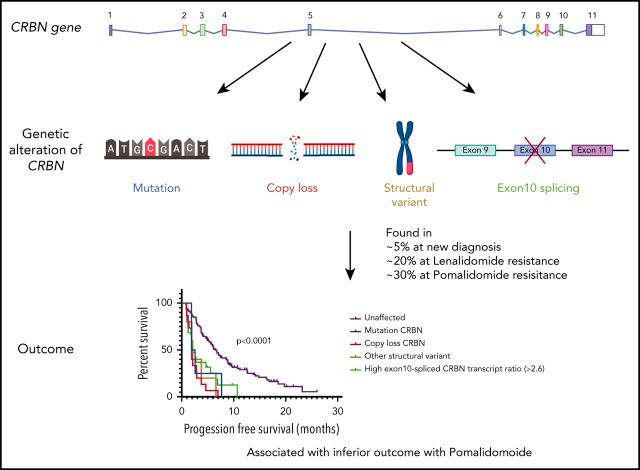
Emergence of drug resistance to all available therapies is the major challenge to improving survival in myeloma. Cereblon (CRBN) is the essential binding protein of the widely used immunomodulatory drugs (IMiDs) and novel CRBN E3 ligase modulator drugs (CELMoDs) in myeloma, as well as certain proteolysis targeting chimeras (PROTACs), in development for a range of diseases. Using whole-genome sequencing (WGS) data from 455 patients and RNA sequencing (RNASeq) data from 655 patients, including newly diagnosed (WGS, n = 198; RNASeq, n = 437), lenalidomide (LEN)-refractory (WGS, n = 203; RNASeq, n = 176), and pomalidomide (POM)-refractory cohorts (WGS, n = 54; RNASeq, n = 42), we found incremental increases in the frequency of 3 CRBN aberrations, namely point mutations, copy losses/structural variations, and a specific variant transcript (exon 10 spliced), with progressive IMiD exposure, until almost one-third of patients had CBRN alterations by the time they were POM refractory. We found all 3 CRBN aberrations were associated with inferior outcomes to POM in those already refractory to LEN, including those with gene copy losses and structural variations, a finding not previously described. This represents the first comprehensive analysis and largest data set of CBRN alterations in myeloma patients as they progress through therapy. It will help inform patient selection for sequential therapies with CRBN-targeting drugs.
现有疗法的耐药性的出现是提高骨髓瘤患者生存率的主要挑战。在骨髓瘤中, cereblon(CRBN)是广泛使用的免疫调节药物(IMiDs)和新型 CRBN E3 连接酶调节剂药物(CELMoDs)以及某些正在开发用于多种疾病的蛋白水解靶向嵌合体(PROTACs)的必需结合蛋白。我们使用了 455 名患者的全基因组测序(WGS)数据和 655 名患者的 RNA 测序(RNASeq)数据,包括新诊断患者(WGS,n=198;RNASeq,n=437)、来那度胺(LEN)耐药患者(WGS,n=203;RNASeq,n=176)和泊马度胺(POM)耐药患者(WGS,n=54;RNASeq,n=42)。我们发现,随着 IMiD 暴露的增加,CRBN 出现了 3 种异常,即点突变、拷贝缺失/结构变异和特定的外显子 10 剪接变异转录本,直到将近三分之一的患者在对 POM 耐药时发生了 CRBN 改变。我们发现,在已经对 LEN 耐药的患者中,所有 3 种 CRBN 异常都与对 POM 的预后不良相关,包括基因拷贝缺失和结构变异的患者,这是以前没有描述过的发现。这是对骨髓瘤患者在治疗过程中 CRBN 改变的首次全面分析和最大数据集,将有助于为后续使用 CRBN 靶向药物的序贯治疗选择患者。
 Zotero 插件