Department of Health Policy and Management, Tulane University School of Public Health and Tropical Medicine, 1440 Canal Street, Suite 1900, New Orleans, LA, 70112, USA.
Genentech Inc., San Francisco, CA, USA.
Orphanet J Rare Dis. 2021 Jan 20;16(1):36. doi: 10.1186/s13023-020-01667-3.
To examine patient/caregiver preference for key attributes of treatments for spinal muscular atrophy (SMA).
In the rapidly evolving SMA treatment landscape, it is critically important to understand how attributes of potential treatments may impact patient/caregiver choices.
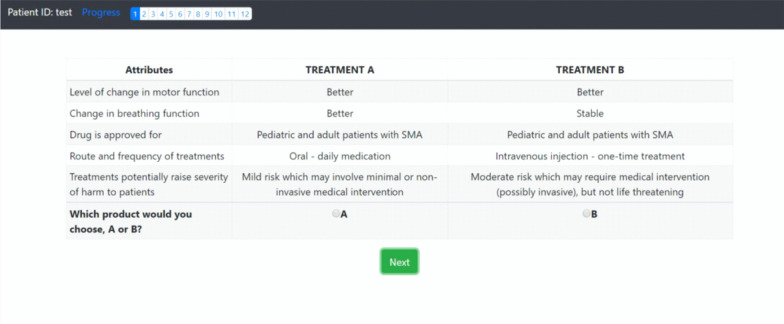
DESIGN/METHODS: A discrete choice experiment survey was developed based on qualitative interviews. Patients with SMA (≥ 18 years) and caregivers of patients were recruited through a U.S. patient organization. Respondents made choices in each of 12 sets of hypothetical treatments. The relative importance of five treatment characteristics was compared (measured by regression coefficients [RC] of conditional logit models): (1) improvement or stabilization of motor function, (2) improvement or stabilization of breathing function, (3) indication for all ages or pediatric patients only, (4) route of administration [repeated intrathecal (IT) injections, one-time intravenous (IV) infusion, daily oral delivery] and (5) potential harm (mild, moderate, serious/life threatening).
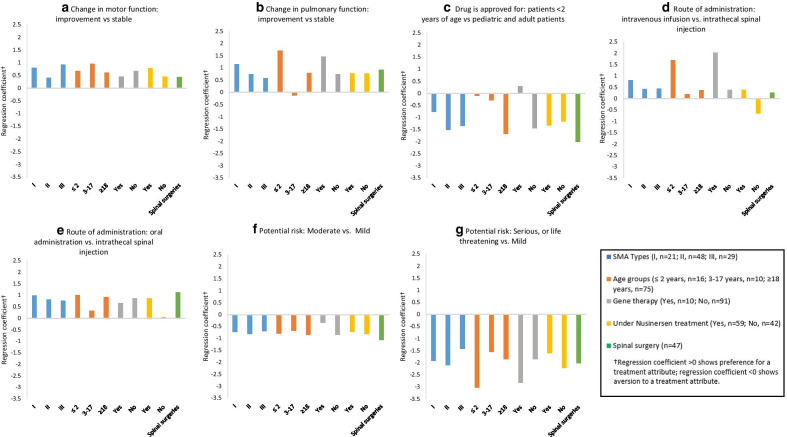
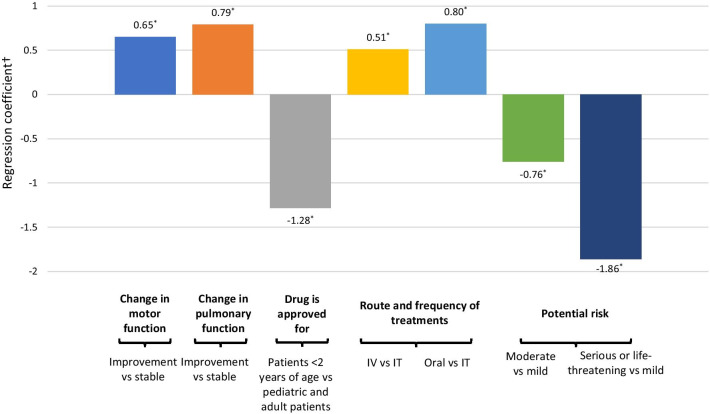
Patient ages ranged from less than 1 to 67 years (n = 101, 65 self-reported and 36 caregiver-reported) and 64 were female. Total SMA subtypes included: type 1 (n = 21), type 2 (n = 48), type 3 (n = 29), other (n = 3). Prior spinal surgery was reported in 47 patients. Nusinersen and onasemnogene abeparvovec-xioi use were reported in 59 and 10 patients, respectively. Improvement in motor and breathing function was highly valued [RC: 0.65, 95% confidence interval (CI): 0.47-0.83 and RC: 0.79, 95% CI: 0.60-0.98, respectively]. Oral medication and one-time infusion were strongly preferred over repeated IT injections (RC: 0.80, 95% CI: 0.60-0.98 and RC: 0.51, 95% CI: 0.30-0.73, respectively). Patients least preferred an age-restricted label/approved use (≤ 2 years of age) (RC: - 1.28, 95% CI: - 1.47 to - 1.09). Cross-attributes trade-off decision suggested a lower willingness for a high-risk therapy despite additional efficacy gain. For some patients, there may be willingness to trade off additional gains in efficacy for a change in route of administration from repeated intrathecal administration to oral medication.
Improvements in motor/breathing function, broad indication, oral or one-time infusion, and minimal risk were preferred treatment attributes. Treatment decisions should be made in clinical context and be tailored to patient needs.
调查脊髓性肌萎缩症(SMA)治疗关键属性的患者/照护者偏好。
在 SMA 治疗领域快速发展的背景下,了解潜在治疗方法的属性如何影响患者/照护者的选择至关重要。
设计/方法:根据定性访谈开发了一项离散选择实验调查。通过美国患者组织招募了≥18 岁的 SMA 患者和患者的照护者。受访者在 12 组假设治疗中进行了选择。通过条件逻辑回归模型的回归系数(RC)比较了五个治疗特征的相对重要性:(1)运动功能改善或稳定,(2)呼吸功能改善或稳定,(3)适用于所有年龄或仅儿科患者,(4)给药途径[重复鞘内(IT)注射、一次性静脉(IV)输注、每日口服给药]和(5)潜在危害(轻度、中度、严重/危及生命)。
患者年龄在 1 岁以下至 67 岁之间(n=101,65 例自我报告,36 例照护者报告),其中 64 例为女性。总 SMA 亚型包括:1 型(n=21)、2 型(n=48)、3 型(n=29)、其他(n=3)。47 例患者报告有脊柱手术史。59 例和 10 例患者分别报告使用nusinersen 和onasemnogene abeparvovec-xioi。运动和呼吸功能的改善受到高度重视[RC:0.65,95%置信区间(CI):0.47-0.83 和 RC:0.79,95% CI:0.60-0.98]。口服药物和一次性输注强烈优于重复 IT 注射[RC:0.80,95% CI:0.60-0.98 和 RC:0.51,95% CI:0.30-0.73]。患者最不喜欢年龄限制标签/批准用途(≤2 岁)[RC:-1.28,95% CI:-1.47 至-1.09]。交叉属性权衡决策表明,尽管疗效增加,但对高风险治疗的意愿较低。对于某些患者,可能愿意为了从重复鞘内给药改为口服药物而放弃疗效的额外提高。
运动/呼吸功能改善、广泛的适应证、口服或一次性输注、低风险是首选的治疗属性。治疗决策应在临床环境中做出,并根据患者的需求进行调整。