Department of Sociology, The University of Georgia, Athens, GA 30602, USA.
Int J Environ Res Public Health. 2021 Jan 21;18(3):898. doi: 10.3390/ijerph18030898.
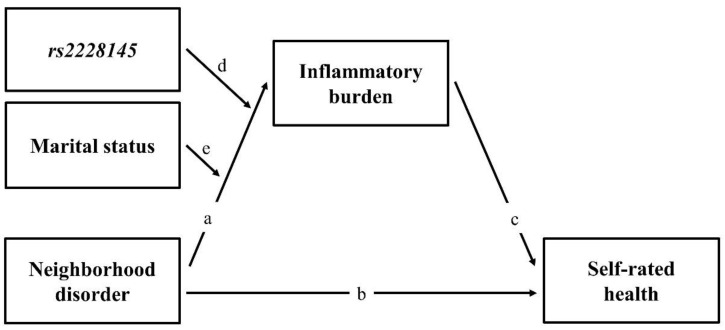
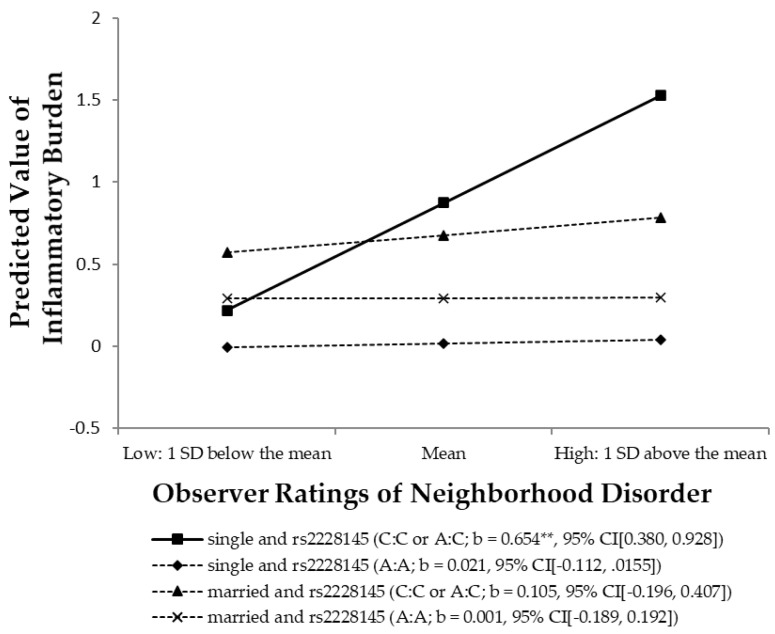
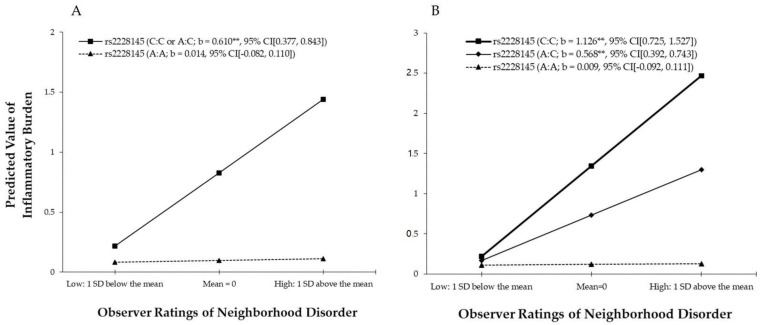
The present study extends prior research on the link between neighborhood disorder and health by testing an integrated model that combines various social and biological factors. Hypotheses were tested using a sample of 325 African American women from the Family and Community Health Study (FACHS). As expected, inflammatory burden was the biophysiological mechanism that mediated much of the association between neighborhood physical disorder and perceived physical health. This finding provided additional support for the view that global self-ratings of health are powerful predictors of morbidity because, in large measure, they are indicators of chronic, systemic inflammation. Further, both genetic variation and marital status served to moderate the association between neighborhood disorder and health. Finally, being married largely eliminated the probability that neighborhood disorder would combine with genetic vulnerability to increase inflammatory burden and perceived illness. Overall, the findings demonstrate the value of constructing integrated models that specify various biophysiological mechanisms that link social conditions to physical health.
本研究通过测试一个综合模型,将各种社会和生物因素结合起来,扩展了先前关于邻里混乱与健康之间联系的研究。该假设使用来自家庭和社区健康研究(FACHS)的 325 名非裔美国女性样本进行了检验。正如预期的那样,炎症负担是邻里物理混乱与感知身体健康之间关联的主要生物生理机制。这一发现为以下观点提供了额外的支持,即全球自我健康评估是发病率的有力预测因素,因为在很大程度上,它们是慢性、系统性炎症的指标。此外,遗传变异和婚姻状况都起到了调节邻里混乱与健康之间关联的作用。最后,婚姻在很大程度上消除了邻里混乱与遗传脆弱性相结合增加炎症负担和感知疾病的可能性。总的来说,这些发现表明构建综合模型的价值,这些模型可以明确将社会条件与身体健康联系起来的各种生物生理机制。