Applied BioMath, Concord, Massachusetts, USA.
KSQ Therapeutics, Cambridge, Massachusetts, USA.
CPT Pharmacometrics Syst Pharmacol. 2021 Mar;10(3):220-229. doi: 10.1002/psp4.12592. Epub 2021 Feb 13.
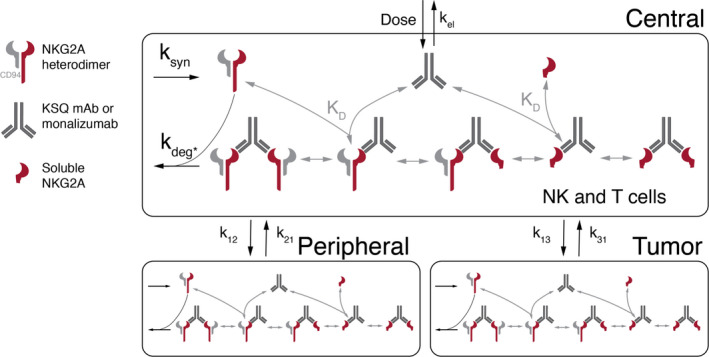
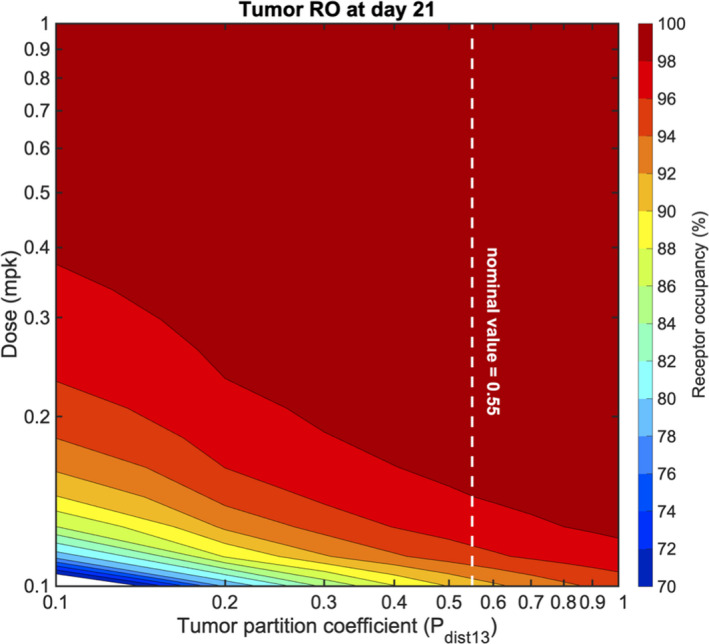
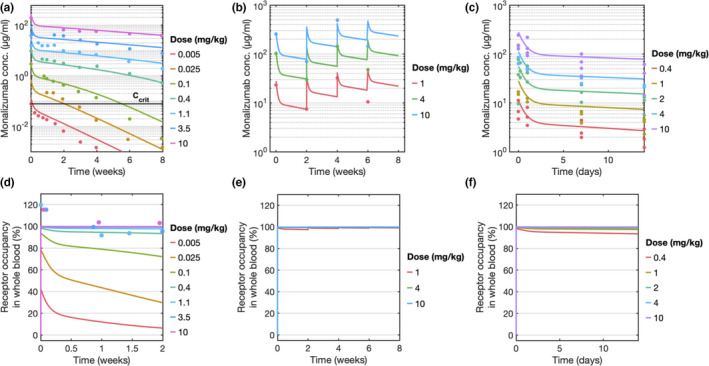
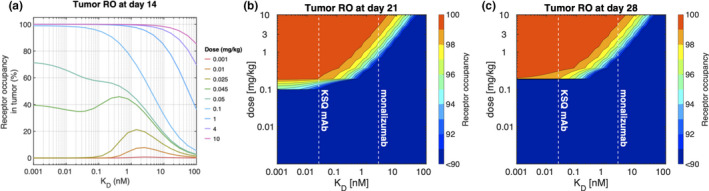
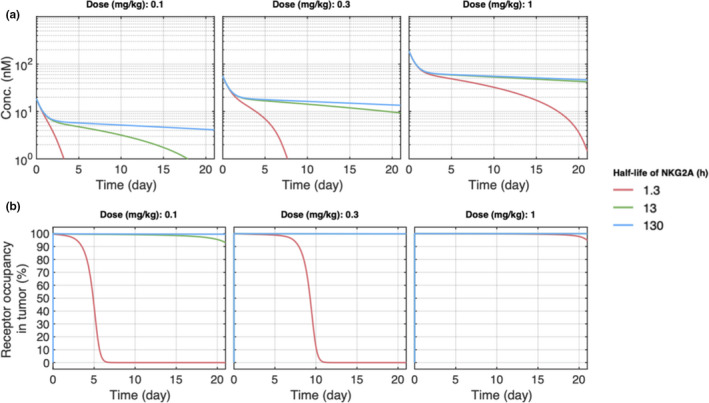
A semimechanistic pharmacokinetic (PK)/receptor occupancy (RO) model was constructed to differentiate a next generation anti-NKG2A monoclonal antibody (KSQ mAb) from monalizumab, an immune checkpoint inhibitor in multiple clinical trials for the treatment of solid tumors. A three-compartment model incorporating drug PK, biodistribution, and NKG2A receptor interactions was parameterized using monalizumab PK, in vitro affinity measurements for both monalizumab and KSQ mAb, and receptor burden estimates from the literature. Following calibration against monalizumab PK data in patients with rheumatoid arthritis, the model successfully predicted the published PK and RO observed in gynecological tumors and in patients with squamous cell carcinoma of the head and neck. Simulations predicted that the KSQ mAb requires a 10-fold lower dose than monalizumab to achieve a similar RO over a 3-week period following q3w intravenous (i.v.) infusion dosing. A global sensitivity analysis of the model indicated that the drug-target binding affinity greatly affects the tumor RO and that an optimal affinity is needed to balance RO with enhanced drug clearance due to target mediated drug disposition. The model predicted that the KSQ mAb can be dosed over a less frequent regimen or at lower dose levels than the current monalizumab clinical dosing regimen of 10 mg/kg q2w. Either dosing strategy represents a competitive advantage over the current therapy. The results of this study demonstrate a key role for mechanistic modeling in identifying optimal drug parameters to inform and accelerate progression of mAb to clinical trials.
建立了一个半机械论药代动力学(PK)/受体占有率(RO)模型,以区分下一代抗 NKG2A 单克隆抗体(KSQ mAb)与 monalizumab,后者是多种临床试验中用于治疗实体瘤的免疫检查点抑制剂。该模型采用三房室模型,纳入了药物 PK、生物分布和 NKG2A 受体相互作用,参数化使用了 monalizumab PK、monalizumab 和 KSQ mAb 的体外亲和力测量值以及文献中的受体负担估计值。在对类风湿关节炎患者的 monalizumab PK 数据进行校准后,该模型成功预测了已发表的在妇科肿瘤和头颈部鳞状细胞癌患者中观察到的 PK 和 RO。模拟预测,与 3 周 q3w 静脉(i.v.)输注给药方案相比,KSQ mAb 实现相似 RO 的剂量要求比 monalizumab 低 10 倍。该模型的全局敏感性分析表明,药物-靶标结合亲和力极大地影响肿瘤 RO,需要最佳亲和力来平衡 RO 与因靶介导药物处置而增强的药物清除率。该模型预测,KSQ mAb 的给药方案可以比当前 monalizumab 的临床给药方案(10 mg/kg,q2w)更频繁或更低的剂量水平给药。这两种给药策略都代表了相对于当前治疗的竞争优势。这项研究的结果表明,在确定最佳药物参数以告知和加速 mAb 进入临床试验方面,机制建模起着关键作用。