The University of Leicester Ulverscroft Eye Unit, Department of Neuroscience, Psychology and Behaviour, University of Leicester, RKCSB, P.O. Box 65, Leicester, LE2 7LX, UK.
NUCLEUS Genomics, Core Biotechnology Services, University of Leicester, Leicester, LE1 9HN, UK.
Sci Rep. 2021 Feb 2;11(1):2826. doi: 10.1038/s41598-021-82368-0.
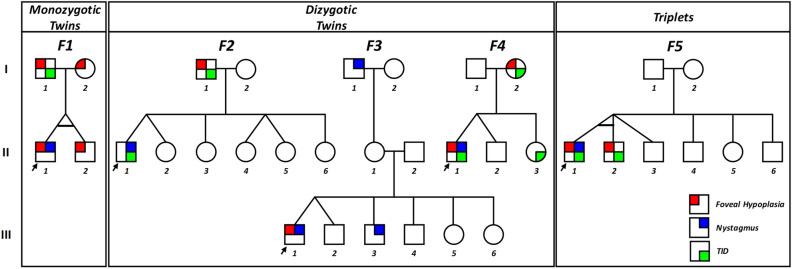
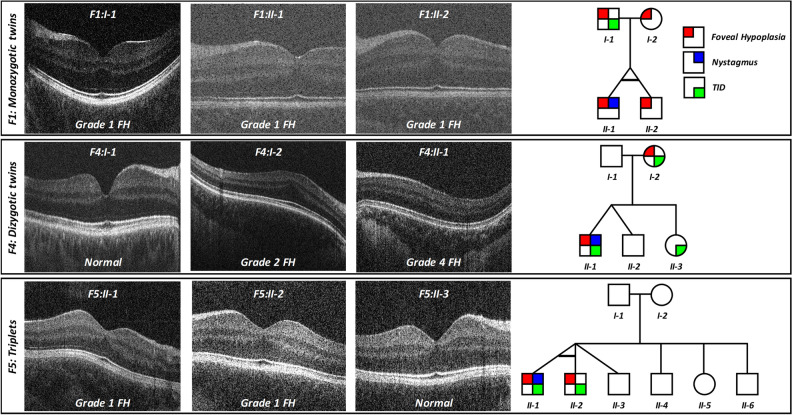
Infantile nystagmus (IN) may result from aetiologies including albinism and FRMD7 mutations. IN has low prevalence, and twins with IN are rare. Whilst discordant presentation has been previously reported for IN, we present for the first time the comprehensive assessment of diagnostically discordant monozygotic twins. From a cohort of over 2000 patients, we identified twins and triplets discordant for nystagmus. Using next-generation sequencing, high-resolution infra-red pupil tracking and optical coherence tomography, we characterised differences in genotype and phenotype. Monozygotic twins (n = 1), dizygotic twins (n = 3) and triplets (n = 1) were included. The monozygotic twins had concordant TYR variants. No causative variants were identified in the triplets. Dizygotic twins had discordant variants in TYR, OCA2 and FRMD7. One unaffected co-twin demonstrated sub-clinical nystagmus. Foveal hypoplasia (FH) was noted in four of five probands. Both co-twins of the monozygotic pair and triplets displayed FH. In three families, at least one parent had FH without nystagmus. FH alone may be insufficient to develop nystagmus. Whilst arrested optokinetic reflex pathway development is implicated in IN, discordant twins raise questions regarding where differences in development have arisen. In unaffected monozygotes therefore, genetic variants may predispose to oculomotor instability, with variable expressivity possibly responsible for the discordance observed.
婴儿型眼球震颤(IN)可能由白化病和 FRMD7 突变等病因引起。IN 的发病率较低,且患有 IN 的双胞胎较为罕见。虽然 IN 的表现存在不一致的情况已有报道,但我们首次对诊断不一致的同卵双胞胎进行了全面评估。在超过 2000 名患者的队列中,我们发现了眼球震颤不一致的双胞胎和三胞胎。通过下一代测序、高分辨率红外瞳孔跟踪和光学相干断层扫描,我们对基因型和表型的差异进行了特征描述。纳入了同卵双胞胎(n=1)、异卵双胞胎(n=3)和三胞胎(n=1)。同卵双胞胎具有一致的 TYR 变异。三胞胎未发现致病变异。异卵双胞胎在 TYR、OCA2 和 FRMD7 中有不一致的变异。一个未受影响的同胞表现出亚临床眼球震颤。五名先证者中有四人出现了黄斑发育不良(FH)。同卵双胞胎的两个同胞和三胞胎都显示出 FH。在三个家庭中,至少有一位父母有 FH 但没有眼球震颤。仅 FH 可能不足以引起眼球震颤。虽然固视性眼球运动通路发育障碍与 IN 有关,但表现不一致的双胞胎提出了这样的问题,即发育差异是从哪里产生的。因此,在未受影响的同卵双胞胎中,遗传变异可能使眼球运动不稳定易感,而不同的表达可能是导致观察到的不一致的原因。