Centre for Infectious Disease Control, National Institute for Public Health and the Environment (RIVM), Bilthoven, the Netherlands.
Department of Cell and Chemical Biology, Oncode Institute, Leiden University Medical Center (LUMC), Leiden, the Netherlands.
Epidemiol Infect. 2021 Feb 8;149:e56. doi: 10.1017/S0950268821000285.
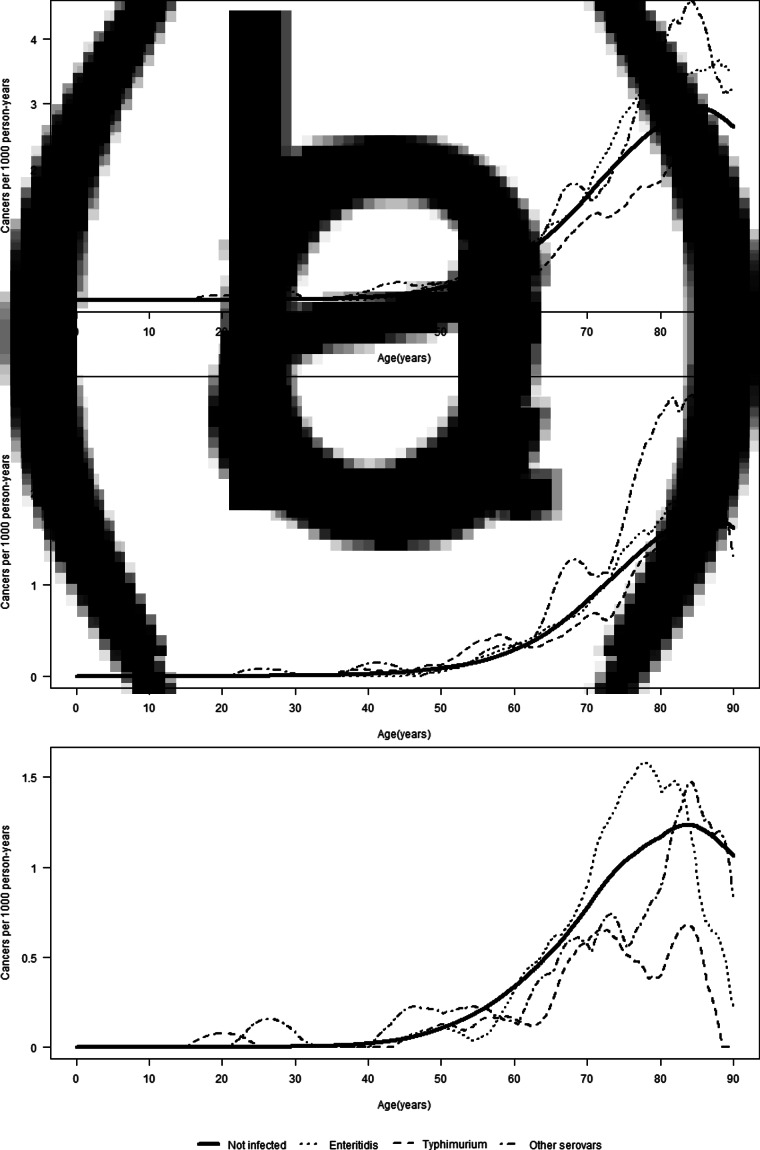
Laboratory data increasingly suggest that Salmonella infection may contribute to colon cancer (CC) development. Here, we examined epidemiologically the potential risk of CC associated with salmonellosis in the human population. We conducted a population-based cohort study using four health registries in Denmark. Person-level demographic data of all residents were linked to laboratory-confirmed non-typhoidal salmonellosis and to CC diagnoses in 1994-2016. Hazard ratios (HRs) for CC (overall/proximal/distal) associated with reported salmonellosis were estimated using Cox proportional hazard models. Potential effects of serovar, age, sex, inflammatory bowel disease and follow-up time post-infection were also assessed. We found no increased risk of CC ≥1 year post-infection (HR 0.99; 95% confidence interval (CI) 0.88-1.13). When stratifying by serovar, there was a significantly increased risk of proximal CC ≥1 year post-infection with serovars other than Enteritidis and Typhimurium (HR 1.40; 95% CI 1.03-1.90). CC risk was significantly increased in the first year post-infection (HR 2.08; 95% CI 1.48-2.93). The association between salmonellosis and CC in the first year post-infection can be explained by increased stool testing around the time of CC diagnosis. The association between proximal CC and non-Enteritidis/non-Typhimurium serovars is unclear and warrants further investigation. Overall, this study provides epidemiological evidence that notified Salmonella infections do not contribute significantly to CC risk in the studied population.
实验室数据越来越多地表明,沙门氏菌感染可能导致结肠癌(CC)的发展。在这里,我们从流行病学角度研究了人类沙门氏菌感染与 CC 相关的潜在风险。我们在丹麦的四个健康登记处进行了一项基于人群的队列研究。通过实验室确诊的非伤寒沙门氏菌感染和 1994-2016 年的 CC 诊断,将所有居民的个人水平人口统计学数据与这些数据相关联。使用 Cox 比例风险模型估计与报告的沙门氏菌感染相关的 CC(整体/近端/远端)的风险比(HR)。还评估了血清型、年龄、性别、炎症性肠病和感染后随访时间的潜在影响。我们发现感染后≥1 年 CC 的风险没有增加(HR 0.99;95%置信区间(CI)0.88-1.13)。当按血清型分层时,感染后≥1 年近端 CC 的风险显著增加,而血清型不是肠炎沙门氏菌和鼠伤寒沙门氏菌(HR 1.40;95% CI 1.03-1.90)。感染后第一年 CC 的风险显著增加(HR 2.08;95% CI 1.48-2.93)。感染后第一年沙门氏菌感染与 CC 之间的关联可以用 CC 诊断前后粪便检测增加来解释。感染后第一年近端 CC 与非肠炎沙门氏菌/非鼠伤寒沙门氏菌血清型之间的关联尚不清楚,需要进一步研究。总体而言,本研究提供了流行病学证据,表明报告的沙门氏菌感染不会显著增加研究人群的 CC 风险。