
HIV 发病率在高危人群中的妇女和男子暴露前预防启动后:肯尼亚和乌干达农村的一项基于人群的研究。
HIV incidence after pre-exposure prophylaxis initiation among women and men at elevated HIV risk: A population-based study in rural Kenya and Uganda.
机构信息
Division of HIV, Infectious Diseases, and Global Medicine, University of California, San Francisco, San Francisco, California, United States of America.
Centre for Microbiology Research, Kenya Medical Research Institute, Nairobi, Kenya.
出版信息
PLoS Med. 2021 Feb 9;18(2):e1003492. doi: 10.1371/journal.pmed.1003492. eCollection 2021 Feb.
BACKGROUND
Oral pre-exposure prophylaxis (PrEP) is highly effective for HIV prevention, but data are limited on HIV incidence among PrEP users in generalized epidemic settings, particularly outside of selected risk groups. We performed a population-based PrEP study in rural Kenya and Uganda and sought to evaluate both changes in HIV incidence and clinical and virologic outcomes following seroconversion on PrEP.
METHODS AND FINDINGS
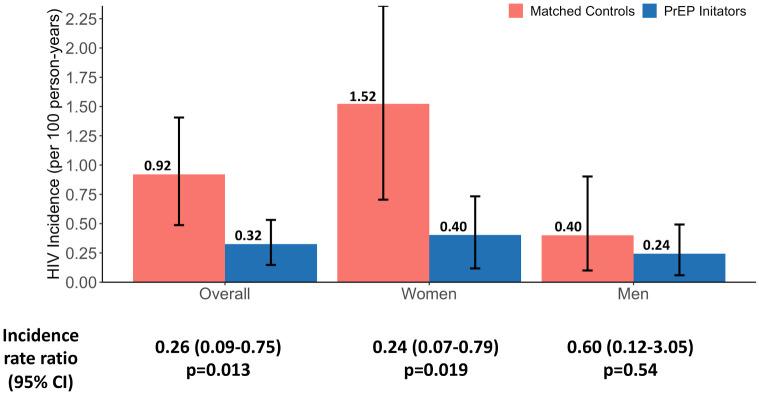
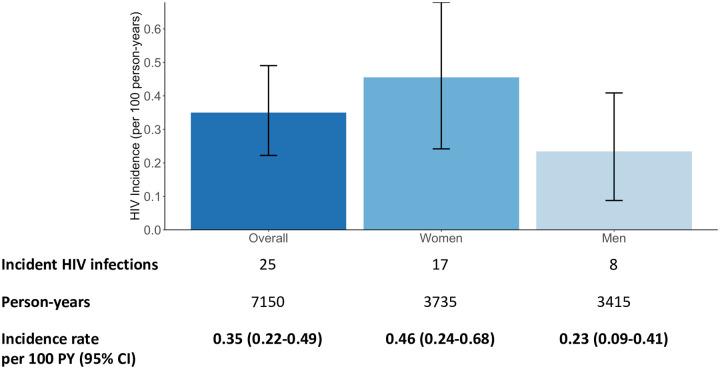
During population-level HIV testing of individuals ≥15 years in 16 communities in the Sustainable East Africa Research in Community Health (SEARCH) study (NCT01864603), we offered universal access to PrEP with enhanced counseling for persons at elevated HIV risk (based on serodifferent partnership, machine learning-based risk score, or self-identified HIV risk). We offered rapid or same-day PrEP initiation and flexible service delivery with follow-up visits at facilities or community-based sites at 4, 12, and every 12 weeks up to week 144. Among participants with incident HIV infection after PrEP initiation, we offered same-day antiretroviral therapy (ART) initiation and analyzed HIV RNA, tenofovir hair concentrations, drug resistance, and viral suppression (<1,000 c/ml based on available assays) after ART start. Using Poisson regression with cluster-robust standard errors, we compared HIV incidence among PrEP initiators to incidence among propensity score-matched recent historical controls (from the year before PrEP availability) in 8 of the 16 communities, adjusted for risk group. Among 74,541 individuals who tested negative for HIV, 15,632/74,541 (21%) were assessed to be at elevated HIV risk; 5,447/15,632 (35%) initiated PrEP (49% female; 29% 15-24 years; 19% in serodifferent partnerships), of whom 79% engaged in ≥1 follow-up visit and 61% self-reported PrEP adherence at ≥1 visit. Over 7,150 person-years of follow-up, HIV incidence was 0.35 per 100 person-years (95% confidence interval [CI] 0.22-0.49) among PrEP initiators. Among matched controls, HIV incidence was 0.92 per 100 person-years (95% CI 0.49-1.41), corresponding to 74% lower incidence among PrEP initiators compared to matched controls (adjusted incidence rate ratio [aIRR] 0.26, 95% CI 0.09-0.75; p = 0.013). Among women, HIV incidence was 76% lower among PrEP initiators versus matched controls (aIRR 0.24, 95% CI 0.07-0.79; p = 0.019); among men, HIV incidence was 40% lower, but not significantly so (aIRR 0.60, 95% CI 0.12-3.05; p = 0.54). Of 25 participants with incident HIV infection (68% women), 7/25 (28%) reported taking PrEP ≤30 days before HIV diagnosis, and 24/25 (96%) started ART. Of those with repeat HIV RNA after ART start, 18/19 (95%) had <1,000 c/ml. One participant with viral non-suppression was found to have transmitted viral resistance, as well as emtricitabine resistance possibly related to PrEP use. Limitations include the lack of contemporaneous controls to assess HIV incidence without PrEP and that plasma samples were not archived to assess for baseline acute infection.
CONCLUSIONS
Population-level offer of PrEP with rapid start and flexible service delivery was associated with 74% lower HIV incidence among PrEP initiators compared to matched recent controls prior to PrEP availability. HIV infections were significantly lower among women who started PrEP. Universal HIV testing with linkage to treatment and prevention, including PrEP, is a promising approach to accelerate reductions in new infections in generalized epidemic settings.
TRIAL REGISTRATION
ClinicalTrials.gov NCT01864603.
背景
口服暴露前预防(PrEP)对预防 HIV 非常有效,但在广泛流行环境中,尤其是在选定的风险群体之外,PrEP 使用者的 HIV 发病率数据有限。我们在肯尼亚和乌干达的农村进行了一项基于人群的 PrEP 研究,并试图评估在 PrEP 血清转换后 HIV 发病率的变化以及临床和病毒学结局。
方法和发现
在可持续东非社区健康研究(SEARCH)研究中,对 16 个社区中年龄≥15 岁的个体进行人群水平的 HIV 检测(NCT01864603),我们为处于艾滋病毒风险升高的人群(基于血清学不同的伴侣关系、基于机器学习的风险评分或自我识别的艾滋病毒风险)普遍提供增强咨询的 PrEP 服务。我们提供快速或当日开始 PrEP,并通过设施或社区站点提供灵活的服务,在第 4、12、26 和 52 周进行随访,直到第 144 周。在 PrEP 开始后发生 HIV 感染的参与者中,我们提供同日开始抗逆转录病毒治疗(ART),并在开始 ART 后分析 HIV RNA、替诺福韦头发浓度、耐药性和病毒抑制情况(根据可用检测,<1,000 c/ml)。使用具有聚类稳健标准误差的泊松回归,我们将 PrEP 启动者的 HIV 发病率与 8 个社区中 PrEP 可获得前一年的最近历史对照者的发病率进行比较(调整了风险组)。在 74,541 名 HIV 检测阴性的个体中,有 15,632/74,541(21%)被评估为处于 HIV 风险升高的状态;有 5,447/15,632(35%)开始接受 PrEP(49%为女性;29%为 15-24 岁;19%为血清学不同的伴侣关系),其中 79%的人至少进行了一次随访,61%的人在至少一次随访中报告了 PrEP 依从性。在超过 7,150 人年的随访中,PrEP 启动者的 HIV 发病率为 0.35/100 人年(95%置信区间[CI]0.22-0.49)。在匹配的对照组中,HIV 发病率为 0.92/100 人年(95%CI0.49-1.41),这意味着 PrEP 启动者的发病率比匹配的对照组低 74%(调整发病率比[aIRR]0.26,95%CI0.09-0.75;p = 0.013)。在女性中,PrEP 启动者的 HIV 发病率比匹配的对照组低 76%(aIRR 0.24,95%CI 0.07-0.79;p = 0.019);在男性中,HIV 发病率低 40%,但无统计学意义(aIRR 0.60,95%CI 0.12-3.05;p = 0.54)。在 25 名发生 HIV 感染的参与者中(68%为女性),有 7/25(28%)在 HIV 诊断前≤30 天报告服用 PrEP,有 24/25(96%)开始接受 ART。在开始 ART 后进行重复 HIV RNA 检测的 18/19 名(95%)患者中,HIV RNA 均<1,000 c/ml。一名病毒未抑制的参与者发现有传播性耐药,以及可能与 PrEP 应用有关的恩曲他滨耐药。局限性包括缺乏同时期的对照来评估没有 PrEP 情况下的 HIV 发病率,以及未存档血浆样本以评估基线急性感染。
结论
在广泛流行的环境中,与 PrEP 可用性之前的最近历史对照相比,人群层面提供快速启动和灵活服务的 PrEP 与 PrEP 启动者的 HIV 发病率降低 74%相关。开始 PrEP 的女性 HIV 感染率显著降低。普遍进行 HIV 检测并与治疗和预防(包括 PrEP)相联系是一种很有前途的方法,可以加速减少广泛流行环境中的新感染。
试验注册
ClinicalTrials.gov NCT01864603。

 Zotero 插件