Tracy R E, Velez-Duran M, Heigle T, Oalmann M C
LSUMC, Department of Pathology, New Orleans 70112.
Am J Pathol. 1988 May;131(2):270-82.
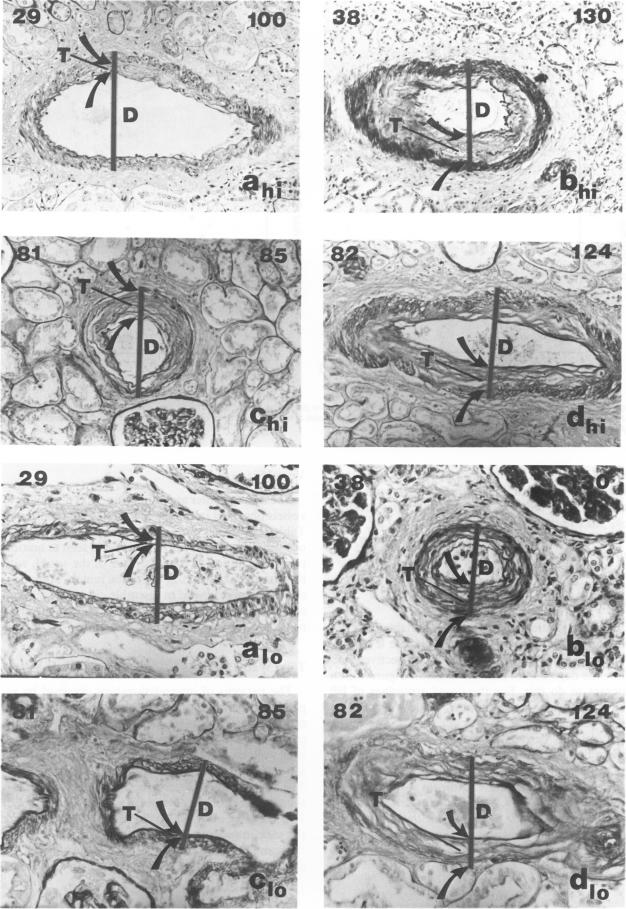
Two variants of nephrosclerosis, roughly corresponding to the arterial and the arteriolar forms, have been examined in a series of autopsy kidneys by five observers using quantitative morphometry. These two variants are both marked by fibroplastic intimal thickening and medial wastage in the arteries, but one of these affects vessels of sizes that are closer to the heart, whereas the other affects sizes that are more remote from the source of arterial pressure. Both types of nephrosclerosis were found to increase with aging in subjects without hypertension. Each year of aging added 0.15 units of intimal thickening to the close vessels and 0.11 to the remote vessels. Each millimeter of mercury of elevated blood pressure was equivalent to 1 year of aging in the close and 2 years in the remote levels of the arterial tree. The four variables, age, blood pressure, remote level intimal thickness, and close level intimal thickness, were found to hold complex curvilinear interrelationships when examined by regression analysis. A dynamic model was suggested by the following findings: The earliest changes shown by young normotensives are in the close vessels, possibly because of the aging effect of the normal pulse wave. Later, the changes extend into the remote level, perhaps because the thickened intima is rigid and propagates the pulse wave abnormally far into the smallest arteries. Hypertension could then be viewed either as a cause for an exaggeration of this normal process or as a consequence of its extension into the remote level vessels where resistance to blood flow is greater or both. The objective morphometric method showed good agreement in the findings by independent observers and is considered to be suitable for epidemiologic studies of nephrosclerosis.
通过定量形态学方法,五位观察者对一系列尸检肾脏中两种大致对应于动脉型和小动脉型的肾硬化变体进行了研究。这两种变体均以动脉内膜纤维增生性增厚和中膜变薄为特征,但其中一种影响更靠近心脏的血管大小,而另一种影响离动脉压源更远的血管大小。研究发现,在无高血压的受试者中,两种类型的肾硬化均随年龄增长而增加。年龄每增加一岁,靠近心脏的血管内膜增厚增加0.15个单位,远离心脏的血管内膜增厚增加0.11个单位。血压每升高一毫米汞柱,在靠近心脏的动脉水平相当于年龄增加一岁,在远离心脏的动脉水平相当于年龄增加两岁。通过回归分析发现,年龄、血压、远离心脏血管内膜厚度和靠近心脏血管内膜厚度这四个变量之间存在复杂的曲线相互关系。基于以下发现提出了一个动态模型:年轻血压正常者最早出现的变化发生在靠近心脏的血管,可能是由于正常脉搏波的老化效应。随后,这些变化扩展到远离心脏的血管水平,可能是因为增厚的内膜变硬,使脉搏波异常深入到最小的动脉。高血压既可以被视为这种正常过程的加剧原因,也可以被视为其扩展到血流阻力更大的远离心脏血管水平的结果,或者两者皆是。客观的形态学测量方法在独立观察者的研究结果中显示出良好的一致性,被认为适用于肾硬化的流行病学研究。