
倍半萜醇雪松醇通过破坏质膜脂筏使人类癌细胞产生化学敏感性并抑制细胞增殖。
Sesquiterpene Alcohol Cedrol Chemosensitizes Human Cancer Cells and Suppresses Cell Proliferation by Destabilizing Plasma Membrane Lipid Rafts.
作者信息
Mishra Siddhartha Kumar, Bae Yun Soo, Lee Yong-Moon, Kim Jae-Sung, Oh Seung Hyun, Kim Hwan Mook
机构信息
Gachon Institute of Pharmaceutical Sciences, Gachon University, Incheon, South Korea.
Cancer Biology Laboratory, Department of Zoology, School of Biological Sciences, Dr. Harisingh Gour Central University, Sagar, India.
出版信息
Front Cell Dev Biol. 2021 Jan 21;8:571676. doi: 10.3389/fcell.2020.571676. eCollection 2020.
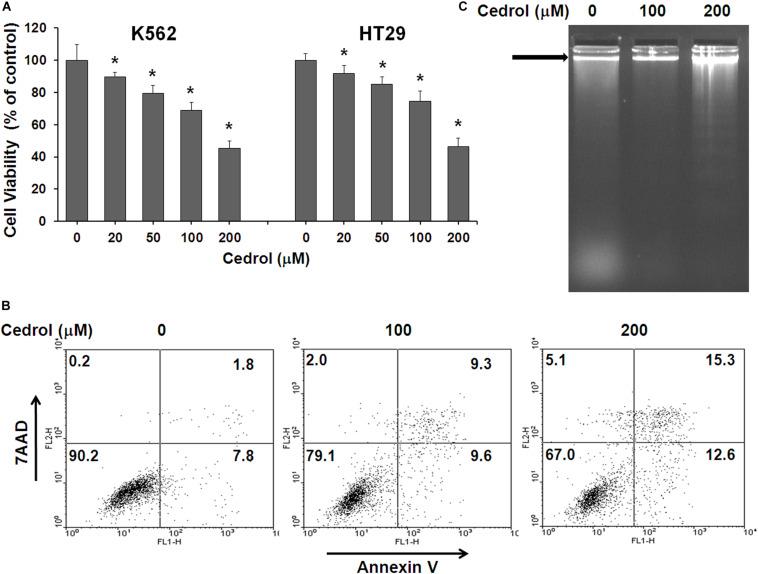
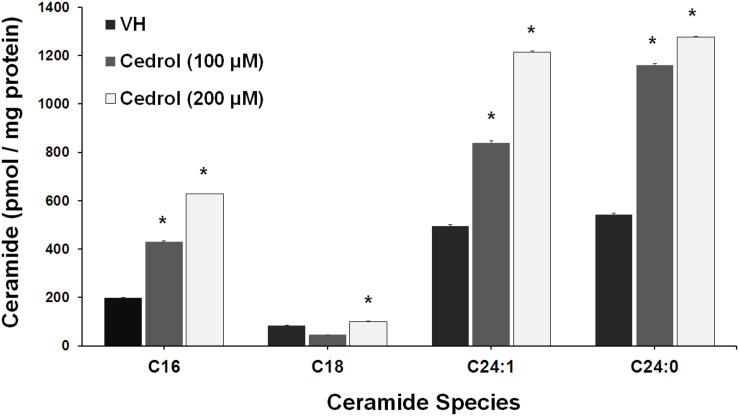
Chemosensitization of cancer cells with small molecules may improve the therapeutic index of antitumoral agents by making tumor cells sensitive to the drug regimen and thus overcome the treatment resistance and side effects of single therapy. Cell membrane lipid rafts are known to transduce various signaling events in cell proliferation. Sensitizing cancer cells may cause modulation of membrane lipid rafts which may potentially be used in improving anticancer drug response. Cedrol, a natural sesquiterpene alcohol, was used to treat human leukemia K562 and colon cancer HT-29 cell lines, and effects were observed. Cedrol decreased the cell viability by inducing apoptosis in both cell lines by activation of pro-apoptosis protein BID and inhibition of anti-apoptosis proteins Bcl-X , Bcl-2, and XIAP. Cedrol activated the caspase-9-dependent mitochondrial intrinsic pathway of apoptosis. Furthermore, cedrol inhibited the levels of pAKT, pERK, and pmTOR proteins as well as nuclear and cytoplasmic levels of the p65 subunit of NF-κB. Cedrol caused redistribution of cholesterol and sphingomyelin contents from membrane lipid raft, which was confirmed by a combined additive effect with methyl-β-cyclodextrin (lipid raft-disrupting agent). Lipid raft destabilization by cedrol led to the increased production of ceramides and inhibition of membrane-bound NADPH oxidase 2 enzyme activity. Cholesterol/sphingomyelin-redistributing abilities of cedrol appear as a novel mechanism of growth inhibition of cancer cells. Cedrol can be classified as a natural lipid raft-disrupting agent with possibilities to be used in general studies involving membrane lipid raft modifications.
小分子对癌细胞的化学增敏作用可通过使肿瘤细胞对药物治疗方案敏感来提高抗肿瘤药物的治疗指数,从而克服单一疗法的治疗抗性和副作用。已知细胞膜脂筏可转导细胞增殖中的各种信号事件。使癌细胞敏感可能会导致膜脂筏的调节,这可能潜在地用于改善抗癌药物反应。雪松醇是一种天然倍半萜醇,用于治疗人白血病K562和结肠癌细胞系HT-29,并观察其效果。雪松醇通过激活促凋亡蛋白BID和抑制抗凋亡蛋白Bcl-X 、Bcl-2和XIAP,在两种细胞系中诱导凋亡,从而降低细胞活力。雪松醇激活了caspase-9依赖性的线粒体凋亡内在途径。此外,雪松醇抑制了pAKT、pERK和pmTOR蛋白的水平以及NF-κB p65亚基的核内和胞质水平。雪松醇导致胆固醇和鞘磷脂含量从膜脂筏重新分布,这通过与甲基-β-环糊精(脂筏破坏剂)的联合加和效应得到证实。雪松醇引起的脂筏不稳定导致神经酰胺产量增加并抑制膜结合的NADPH氧化酶2酶活性。雪松醇的胆固醇/鞘磷脂重新分布能力似乎是癌细胞生长抑制的一种新机制。雪松醇可被归类为一种天然脂筏破坏剂,有可能用于涉及膜脂筏修饰的一般研究。



 Zotero 插件