Department of Hematology, Cancer Center Amsterdam, Amsterdam University Medical Center, Location VUMC, Amsterdam, Netherlands.
Genmab, Utrecht, Netherlands.
Blood Cancer J. 2021 Feb 18;11(2):38. doi: 10.1038/s41408-021-00430-6.
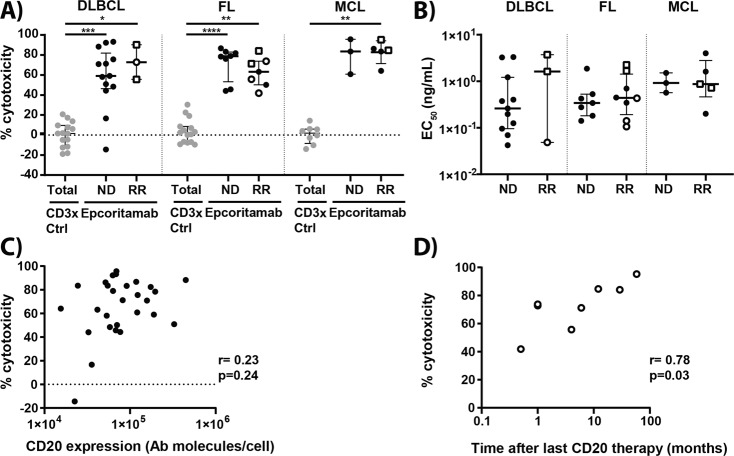
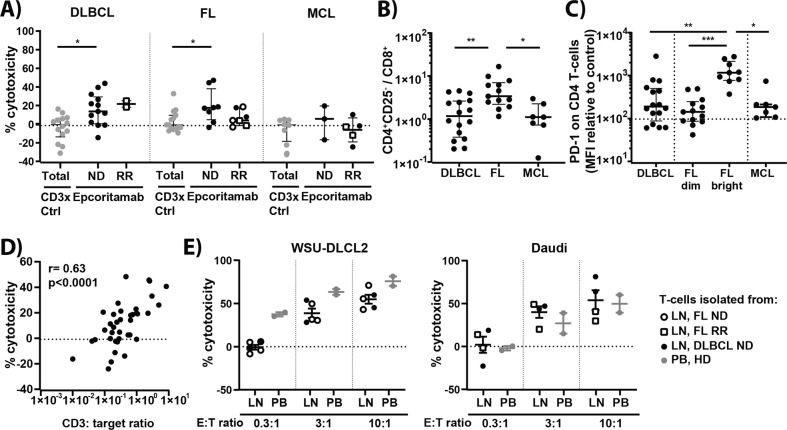
Epcoritamab (DuoBody-CD3xCD20, GEN3013) is a novel bispecific IgG1 antibody redirecting T-cells toward CD20 tumor cells. Here, we assessed the preclinical efficacy of epcoritamab against primary tumor cells present in the lymph node biopsies from newly diagnosed (ND) and relapsed/refractory (RR) B-NHL patients. In the presence of T-cells from a healthy donor, epcoritamab demonstrated potent activity against primary tumor cells, irrespective of prior treatments, including CD20 mAbs. Median lysis of 65, 74, and 84% were achieved in diffuse large B-cell lymphoma (n = 16), follicular lymphoma (n = 15), and mantle cell lymphoma (n = 8), respectively. Furthermore, in this allogeneic setting, we discovered that the capacity of B-cell tumors to activate T-cells was heterogeneous and showed an inverse association with their surface expression levels of the immune checkpoint molecule Herpesvirus Entry Mediator (HVEM). In the autologous setting, when lymph node (LN)-residing T-cells were the only source of effector cells, the epcoritamab-dependent cytotoxicity strongly correlated with local effector cell-to-target cell ratios. Further analyses revealed that LN-residing-derived or peripheral blood-derived T-cells of B-NHL patients, as well as heathy donor T-cells equally mediated epcoritamab-dependent cytotoxicity. These results show the promise of epcoritamab for treatment of newly-diagnosed or relapsed/refractory B-NHL patients, including those who became refractory to previous CD20-directed therapies.
依帕珠单抗(DuoBody-CD3xCD20,GEN3013)是一种新型的双特异性 IgG1 抗体,可将 T 细胞重新定向到 CD20 肿瘤细胞。在这里,我们评估了依帕珠单抗对新诊断(ND)和复发/难治(RR)B-NHL 患者淋巴结活检中存在的原发性肿瘤细胞的临床前疗效。在健康供体 T 细胞的存在下,依帕珠单抗对原发性肿瘤细胞表现出强大的活性,无论先前的治疗如何,包括 CD20 mAbs。弥漫性大 B 细胞淋巴瘤(n=16)、滤泡性淋巴瘤(n=15)和套细胞淋巴瘤(n=8)的中位裂解率分别达到 65%、74%和 84%。此外,在这种同种异体环境中,我们发现 B 细胞肿瘤激活 T 细胞的能力具有异质性,并且与其表面免疫检查点分子疱疹病毒进入介质(HVEM)的表达水平呈反比。在自体环境中,当淋巴结(LN)驻留的 T 细胞是唯一来源的效应细胞时,依帕珠单抗依赖性细胞毒性与局部效应细胞与靶细胞的比值密切相关。进一步的分析表明,B-NHL 患者的 LN 来源或外周血来源的 T 细胞以及健康供体 T 细胞同样介导依帕珠单抗依赖性细胞毒性。这些结果表明依帕珠单抗有望用于治疗新诊断或复发/难治性 B-NHL 患者,包括那些对先前的 CD20 靶向治疗产生耐药性的患者。