Division of Epidemiology & Biostatistics, University of California, Berkeley, Berkeley, CA, USA.
Division of Epidemiology & Biostatistics, University of California, Berkeley, Berkeley, CA, USA; Energy & Resources Group, University of California, Berkeley, Berkeley, CA, USA.
Lancet Glob Health. 2021 Mar;9(3):e301-e308. doi: 10.1016/S2214-109X(20)30523-4.
Soil-transmitted helminths and Giardia duodenalis are responsible for a large burden of disease globally. In low-resource settings, household finished floors (eg, concrete floors) might reduce transmission of soil-transmitted helminths and G duodenalis.
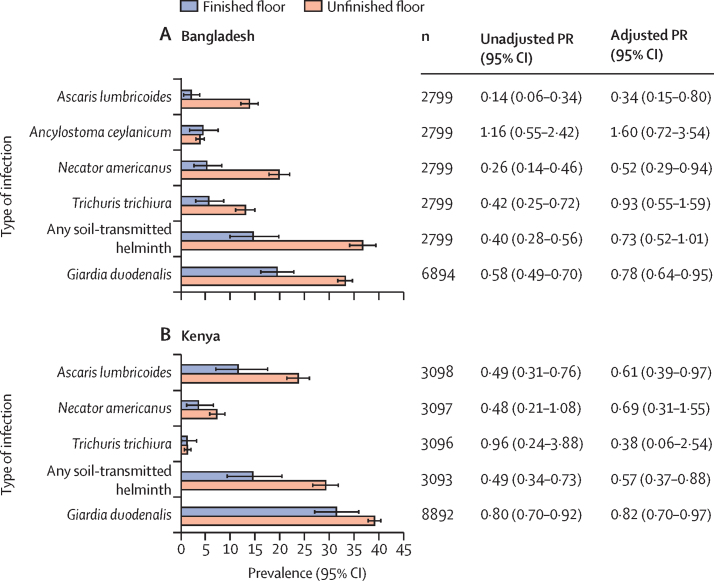
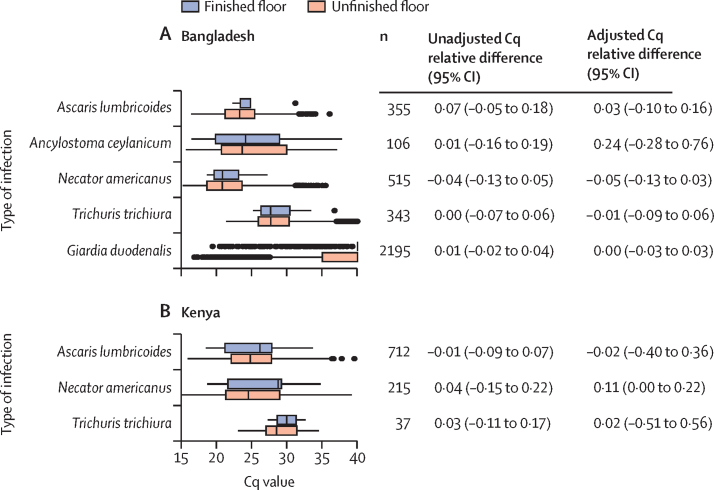
In a prospective cohort of children nested within two randomised trials in rural Bangladesh and Kenya, we estimated associations between household finished flooring and soil-transmitted helminths and G duodenalis prevalence. In 2015-16, we collected stool samples from children aged 2-16 years in rural Bangladesh and Kenya. We detected soil-transmitted helminth infection using quantitative PCR (qPCR; Bangladesh n=2800; Kenya n=3094), and G duodenalis using qPCR in Bangladesh (n=6894) and ELISA in Kenya (n=8899). We estimated adjusted prevalence ratios (aPRs) using log-linear models adjusted for potential confounders.
7187 (92·2%) of 7795 children in Bangladesh and 9077 (93·7%) of 9686 children in Kenya provided stool specimens that were analysed by qPCR. At enrolment, 691 (10%) households in Bangladesh and 471 (5%) households in Kenya had finished floors. In both countries, household finished flooring was associated with lower Ascaris lumbricoides prevalence (Bangladesh aPR 0·33, 95% CI 0·14-0·78; Kenya 0·62, 0·39-0·98) and any soil-transmitted helminths (Bangladesh 0·73, 0·52-1·01; Kenya 0·57, 0·37-0·88). Household finished floors were also associated with lower Necator americanus prevalence in Bangladesh (0·52, 0·29-0·94) and G duodenalis prevalence in both countries (Bangladesh 0·78, 0·64-0·95; Kenya 0·82, 0·70-0·97).
In low-resource settings, living in households with finished floors over a 2-year period was associated with lower prevalence of G duodenalis and some soil-transmitted helminths in children.
Bill & Melinda Gates Foundation and Task Force for Global Health.
土壤传播的蠕虫和十二指肠贾第鞭毛虫在全球范围内造成了很大的疾病负担。在资源匮乏的环境中,家庭装修的地板(例如,混凝土地板)可能会降低土壤传播的蠕虫和十二指肠贾第鞭毛虫的传播。
在孟加拉国和肯尼亚的两项随机试验嵌套的前瞻性队列中,我们估计了家庭装修地板与土壤传播的蠕虫和十二指肠贾第鞭毛虫患病率之间的关联。在 2015-2016 年期间,我们从孟加拉国和肯尼亚的农村地区 2-16 岁的儿童中收集了粪便样本。我们使用定量 PCR(qPCR;孟加拉国 n=2800;肯尼亚 n=3094)检测土壤传播的蠕虫感染,使用 qPCR 在孟加拉国(n=6894)和 ELISA 在肯尼亚(n=8899)检测十二指肠贾第鞭毛虫感染。我们使用对数线性模型调整了潜在混杂因素,估计了调整后的患病率比值(aPR)。
在孟加拉国的 7795 名儿童中有 7187 名(92.2%)和在肯尼亚的 9686 名儿童中有 9077 名(93.7%)提供了粪便样本进行 qPCR 分析。在登记时,孟加拉国的 691 个(10%)家庭和肯尼亚的 471 个(5%)家庭有装修过的地板。在这两个国家,家庭装修地板与较低的蛔虫患病率(孟加拉国 aPR 0.33,95%CI 0.14-0.78;肯尼亚 0.62,0.39-0.98)和任何土壤传播的蠕虫(孟加拉国 0.73,0.52-1.01;肯尼亚 0.57,0.37-0.88)有关。家庭装修地板也与孟加拉国的美洲钩虫患病率较低(0.52,0.29-0.94)和两个国家的十二指肠贾第鞭毛虫患病率较低有关(孟加拉国 0.78,0.64-0.95;肯尼亚 0.82,0.70-0.97)。
在资源匮乏的环境中,在有装修地板的家庭中生活两年与儿童中较低的十二指肠贾第鞭毛虫和一些土壤传播的蠕虫患病率有关。
比尔及梅琳达·盖茨基金会和全球卫生工作队。