Department of Plant Pathology and Nematology, University of São Paulo (USP), Luiz de Queiroz College of Agriculture (ESALQ), Piracicaba, São Paulo, Brazil.
Instituto Hispano-Luso de Investigaciones Agrarias (CIALE), Universidad de Salamanca, Salamanca, Spain.
Mol Plant Pathol. 2021 Apr;22(4):393-409. doi: 10.1111/mpp.13036. Epub 2021 Feb 20.
Soybean (Glycine max) is one of the most important cultivated plants worldwide as a source of protein-rich foods and animal feeds. Anthracnose, caused by different lineages of the hemibiotrophic fungus Colletotrichum, is one of the main limiting factors to soybean production. Losses due to anthracnose have been neglected, but their impact may threaten up to 50% of the grain production.
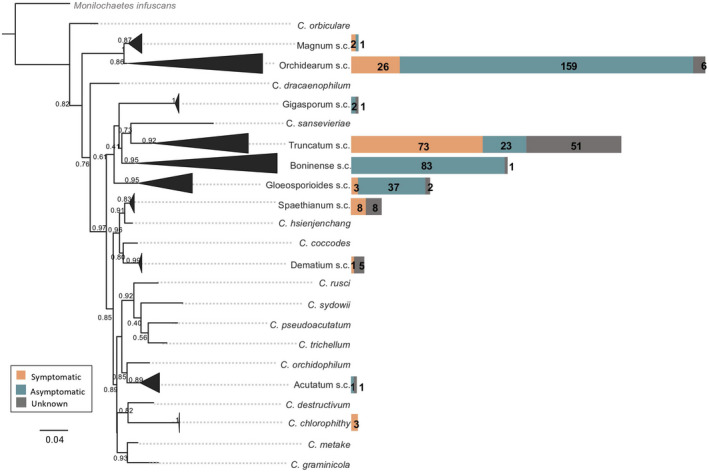
While C. truncatum is considered the main species associated with soybean anthracnose, recently other species have been reported as pathogenic on this host. Until now, it has not been clear whether the association of new Colletotrichum species with the disease is related to emerging species or whether it is due to the undergoing changes in the taxonomy of the genus.
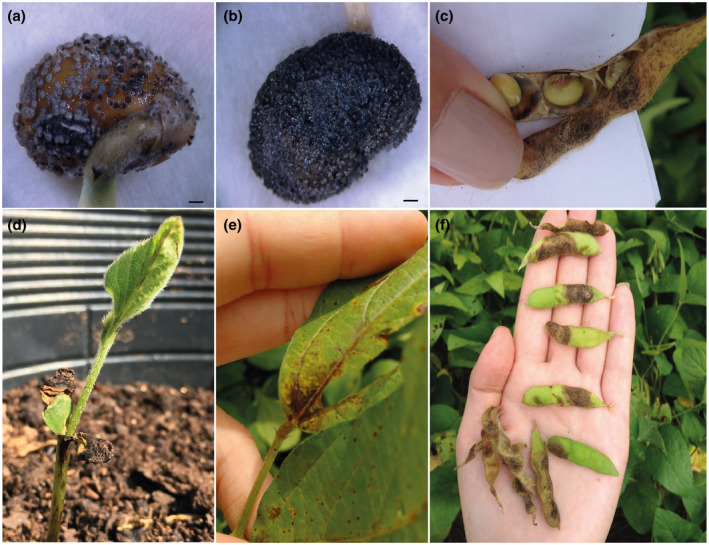
Typical anthracnose symptoms are pre- and postemergence damping-off; dark, depressed, and irregular spots on cotyledons, stems, petioles, and pods; and necrotic laminar veins on leaves that can result in premature defoliation. Symptoms may evolve to pod rot, immature opening of pods, and premature germination of grains.
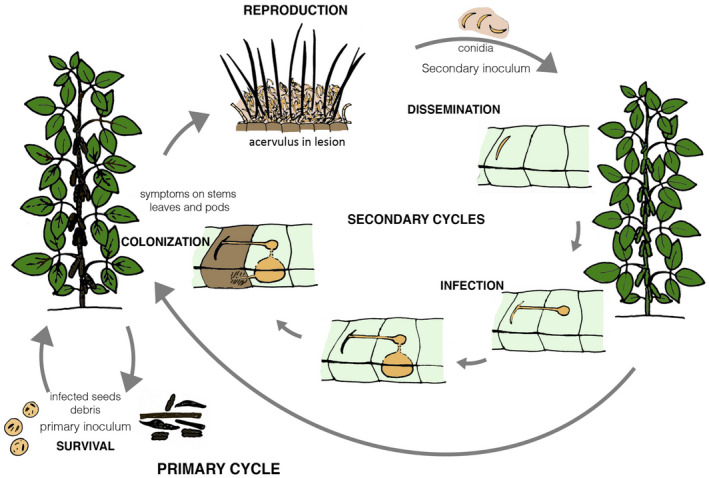
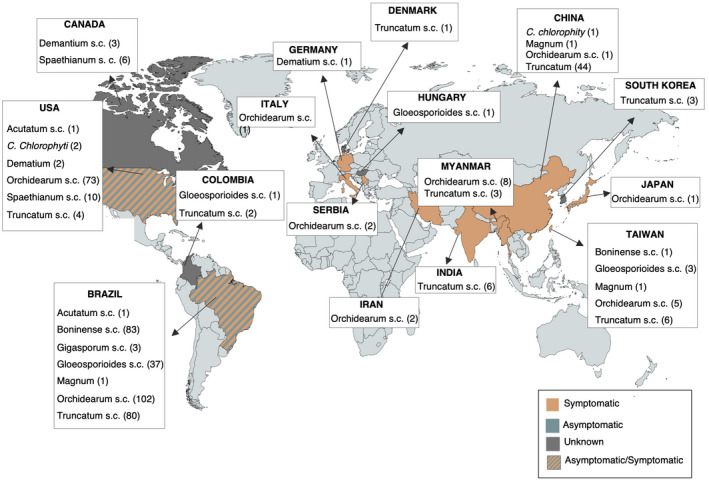
As accurate species identification of the causal agent is decisive for disease control and prevention, in this work we review the taxonomic designation of Colletotrichum isolated from soybean to understand which lineages are pathogenic on this host. We also present a comprehensive literature review of soybean anthracnose, focusing on distribution, symptomatology, epidemiology, disease management, identification, and diagnosis. We consider the knowledge emerging from population studies and comparative genomics of Colletotrichum spp. associated with soybean providing future perspectives in the identification of molecular factors involved in the pathogenicity process.
Updates on Colletotrichum can be found at http://www.colletotrichum.org/. All available Colletotrichum genomes on GenBank can be viewed at http://www.colletotrichum.org/genomics/.
大豆(Glycine max)是全球最重要的农作物之一,是富含蛋白质的食物和动物饲料的来源。炭疽病是由半活体真菌炭疽菌的不同谱系引起的,是大豆生产的主要限制因素之一。由于炭疽病造成的损失被忽视了,但它们的影响可能会威胁到高达 50%的粮食产量。
虽然 C. truncatum 被认为是与大豆炭疽病相关的主要物种,但最近其他物种也被报道对该宿主具有致病性。到目前为止,还不清楚新的炭疽菌物种与疾病的关联是与新兴物种有关,还是由于该属的分类学正在发生变化。
典型的炭疽病症状是出苗前和出苗后猝倒;子叶、茎、叶柄和豆荚上出现暗、凹陷和不规则的斑点;叶片上出现坏死的层状叶脉,导致过早落叶。症状可能发展为荚腐病、荚不成熟开裂和谷物过早发芽。
由于准确鉴定病原菌对疾病的控制和预防至关重要,因此在这项工作中,我们回顾了从大豆中分离出的炭疽菌的分类指定,以了解哪些谱系对该宿主具有致病性。我们还对大豆炭疽病进行了全面的文献综述,重点介绍了分布、症状、流行病学、疾病管理、鉴定和诊断。我们认为,从种群研究和与大豆相关的炭疽菌比较基因组学中获得的知识为鉴定与致病性过程相关的分子因素提供了未来的视角。
可以在 http://www.colletotrichum.org/ 上找到有关炭疽菌的最新信息。可以在 http://www.colletotrichum.org/genomics/ 上查看所有可在 GenBank 上获得的炭疽菌基因组。