Division of Rehabilitation Medicine, Kobe University Hospital, Kobe, Japan.
Division of Cardiovascular Medicine, Department of Internal Medicine, Kobe University Graduate School of Medicine, 7-5-2, Kusunoki-cho, Chuo-ku, Kobe, Hyogo, 650-0017, Japan.
Heart Vessels. 2021 Aug;36(8):1234-1245. doi: 10.1007/s00380-021-01793-3. Epub 2021 Feb 22.
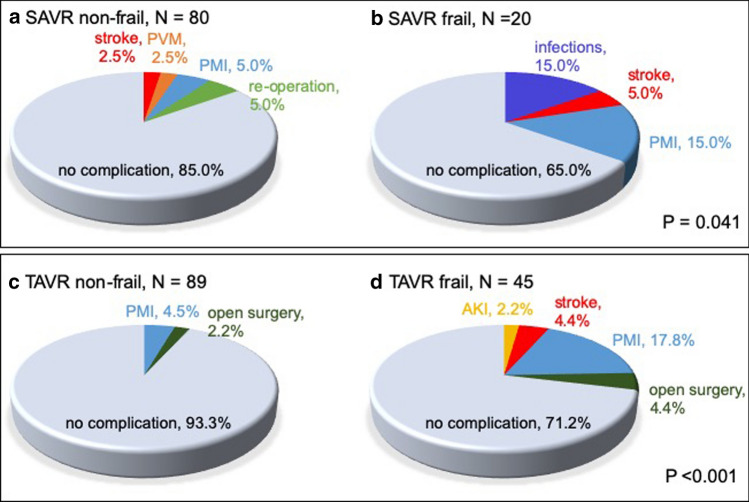
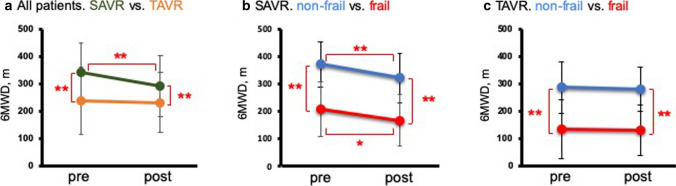
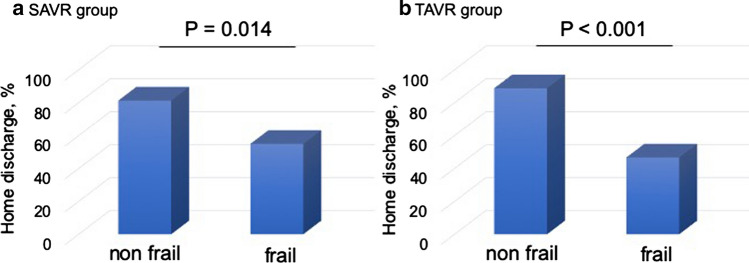
Assessment of frailty is important for risk stratification among the elderly with severe aortic stenosis (AS) when considering interventions such as surgical aortic valve replacement (SAVR) or transcatheter aortic valve replacement (TAVR). However, evidence of the impact of preoperative frailty on short-term postoperative outcomes or functional recovery is limited. This retrospective study included 234 consecutive patients with severe AS who underwent SAVR or TAVR at Kobe University Hospital between Dec 2013 and Dec 2019. Primary outcomes were postoperative complications, postoperative 6-min walking distance (6MWD), and home discharge rates. The mean age was 82 ± 6.6 years. There were 169 (SAVR: 80, TAVR: 89) and 65 (SAVR: 20, TAVR: 45) patients in the non-frail and frail groups, respectively (p = 0.02). The postoperative complication rates in the frail group were significantly higher than those in the non-frail group [30.8% (SAVR: 35.0%, TAVR: 28.9%) vs. 10.7% (SAVR: 15.0%, TAVR: 6.7%), p < 0.001]. The home discharge rate in the non-frail group was significantly higher than that in the frail group [85.2% (SAVR: 81.2%, TAVR: 88.8%) vs. 49.2% (SAVR: 55.0%, TAVR: 46.7%), p < 0.001]. The postoperative 6MWD in the non-frail group was significantly longer than that in the frail group [299.3 ± 87.8 m (SAVR: 321.9 ± 90.8 m, TAVR: 281.1 ± 81.3 m) vs. 141.9 ± 92.4 m (SAVR: 167.8 ± 92.5 m, TAVR: 131.6 ± 91.3 m), p < 0.001]. The TAVR group did not show a decrease in the 6MWD after intervention, regardless of frailty. We report for the first time that preoperative frailty was strongly associated with postoperative complications, 6MWD, and home discharge rates following both SAVR and TAVR. Preoperative frailty assessment may provide useful indications for planning better individualized therapeutic interventions and supporting comprehensive intensive care before and after interventions.
衰弱评估对于考虑介入治疗(如外科主动脉瓣置换术[SAVR]或经导管主动脉瓣置换术[TAVR])的老年严重主动脉瓣狭窄(AS)患者的风险分层很重要。然而,术前衰弱对短期术后结局或功能恢复的影响证据有限。这项回顾性研究纳入了 2013 年 12 月至 2019 年 12 月在神户大学医院接受 SAVR 或 TAVR 的 234 例连续严重 AS 患者。主要结局是术后并发症、术后 6 分钟步行距离(6MWD)和出院回家率。平均年龄为 82±6.6 岁。非虚弱组和虚弱组分别有 169 例(SAVR:80 例,TAVR:89 例)和 65 例(SAVR:20 例,TAVR:45 例)(p=0.02)。虚弱组的术后并发症发生率明显高于非虚弱组[30.8%(SAVR:35.0%,TAVR:28.9%)比 10.7%(SAVR:15.0%,TAVR:6.7%),p<0.001]。非虚弱组的出院回家率明显高于虚弱组[85.2%(SAVR:81.2%,TAVR:88.8%)比 49.2%(SAVR:55.0%,TAVR:46.7%),p<0.001]。非虚弱组的术后 6MWD 明显长于虚弱组[299.3±87.8 m(SAVR:321.9±90.8 m,TAVR:281.1±81.3 m)比 141.9±92.4 m(SAVR:167.8±92.5 m,TAVR:131.6±91.3 m),p<0.001]。无论虚弱程度如何,TAVR 组的干预后 6MWD 均未下降。我们首次报告术前衰弱与 SAVR 和 TAVR 后的术后并发症、6MWD 和出院回家率密切相关。术前衰弱评估可能为规划更好的个体化治疗干预措施以及在干预前后提供全面强化护理提供有用的指标。