Gong Fang, Zhou Quan, Gui Chunmei, Huang Shaohua, Qin Zuoan
Department of Intensive Care Unit, The First People's Hospital of Changde, Changde City, Hunan Province, 415000, People's Republic of China.
Department of Science and Education Section, The First People's Hospital of Changde, Changde City, Hunan Province, 415000, People's Republic of China.
Int J Gen Med. 2021 Feb 19;14:531-538. doi: 10.2147/IJGM.S293340. eCollection 2021.
We aimed to investigate the relationship between the serum anion gap (AG) and all-cause mortality in patients with acute pancreatitis (AP) in intensive care units (ICUs).
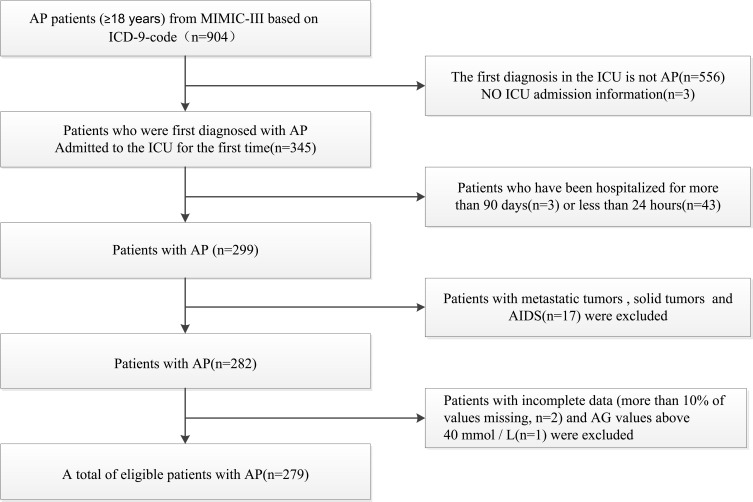
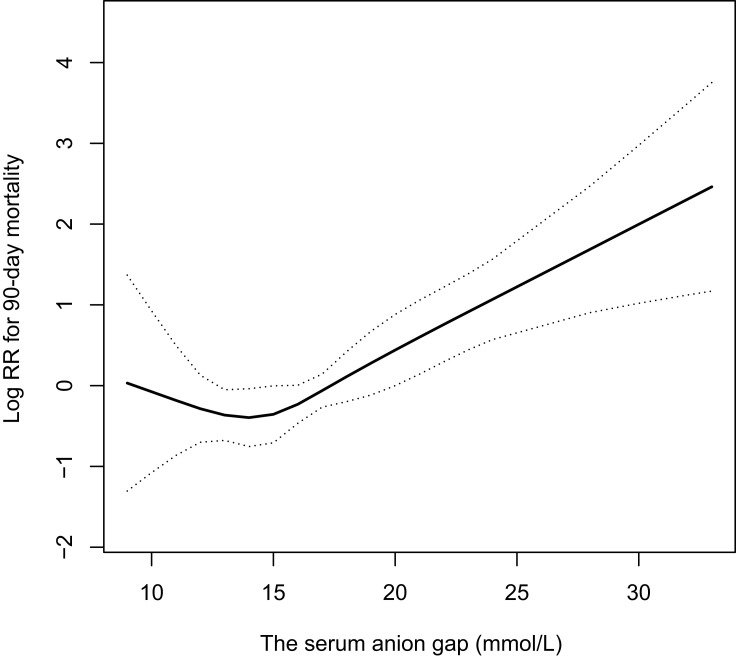
In this retrospective cohort analysis, data of patients with AP were extracted from the Medical Information Mart for Intensive Care database (version III). We collected the maximum serum AG value within the first 24 hours of ICU admission. The main outcome was 90-day all-cause mortality. A multivariate Cox proportional hazard regression model was used to examine the association between the serum AG and mortality. The restricted cubic spline curve was used to confirm a non-linear relationship between serum AG values and mortality.
Of the 279 patients included in the study, 87 (31.18%) died. The serum AG value was positively associated with 90-day all-cause mortality (hazard ratio [HR] 1.08, 95% confidence interval [CI] 1.02-1.14), after adjusting for age, sex, alcohol consumption, congestive heart failure, diabetes mellitus, hypertension, eGFR, albumin, and the SOFA score. There was a non-linear relationship between serum AG values and mortality after adjusting for potential confounders. We used a two-piecewise regression model to obtain a threshold inflection point value of 13.8 mmol/L. The HR and the 95% CI on the left inflection point were 0. 82 (0.61-1.09; p = 0.1719), and on the right inflection point were 1.15 (1.08-1.23; p < 0.0001).
The relationship between all-cause mortality in patients with acute pancreatitis and serum AG values was non-linear. All-cause mortality and serum AG values were positively correlated when the serum AG value was >13.8 mmol/L.
我们旨在研究重症监护病房(ICU)中急性胰腺炎(AP)患者的血清阴离子间隙(AG)与全因死亡率之间的关系。
在这项回顾性队列分析中,AP患者的数据从重症监护医学信息数据库(第三版)中提取。我们收集了ICU入院后24小时内的最高血清AG值。主要结局是90天全因死亡率。采用多因素Cox比例风险回归模型来检验血清AG与死亡率之间的关联。使用受限立方样条曲线来确认血清AG值与死亡率之间的非线性关系。
纳入研究的279例患者中,87例(31.18%)死亡。在调整年龄、性别、饮酒、充血性心力衰竭、糖尿病、高血压、估算肾小球滤过率(eGFR)、白蛋白和序贯器官衰竭评估(SOFA)评分后,血清AG值与90天全因死亡率呈正相关(风险比[HR] 1.08,95%置信区间[CI] 1.02 - 1.14)。在调整潜在混杂因素后血清AG值与死亡率之间存在非线性关系。我们使用两段式回归模型得出阈值拐点值为13.8 mmol/L。左拐点处的HR及95% CI为0.82(0.61 - 1.09;p = 0.1719),右拐点处为1.15(1.08 - 1.23;p < 0.0001)。结论:急性胰腺炎患者的全因死亡率与血清AG值之间的关系是非线性的。当血清AG值>13.8 mmol/L时,全因死亡率与血清AG值呈正相关。