Department of Pharmaceutical Sciences, University at Buffalo, Buffalo, NY 14214, USA.
New York State Center of Excellence in Bioinformatics and Life Sciences, Buffalo, NY 14203, USA.
Int J Mol Sci. 2021 Feb 24;22(5):2246. doi: 10.3390/ijms22052246.
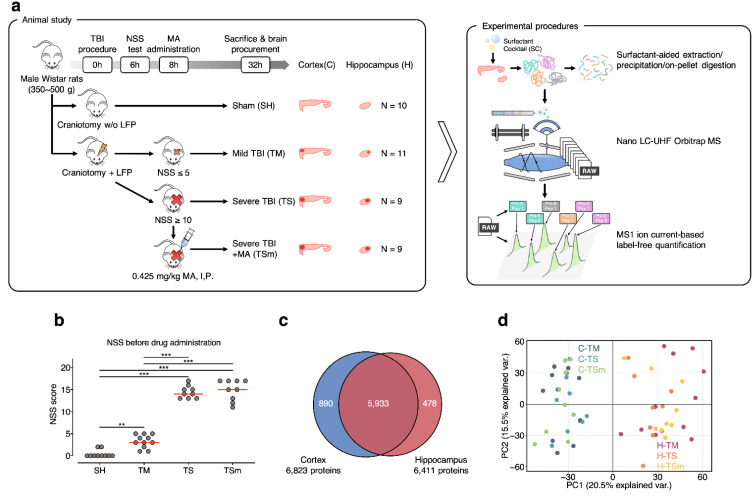
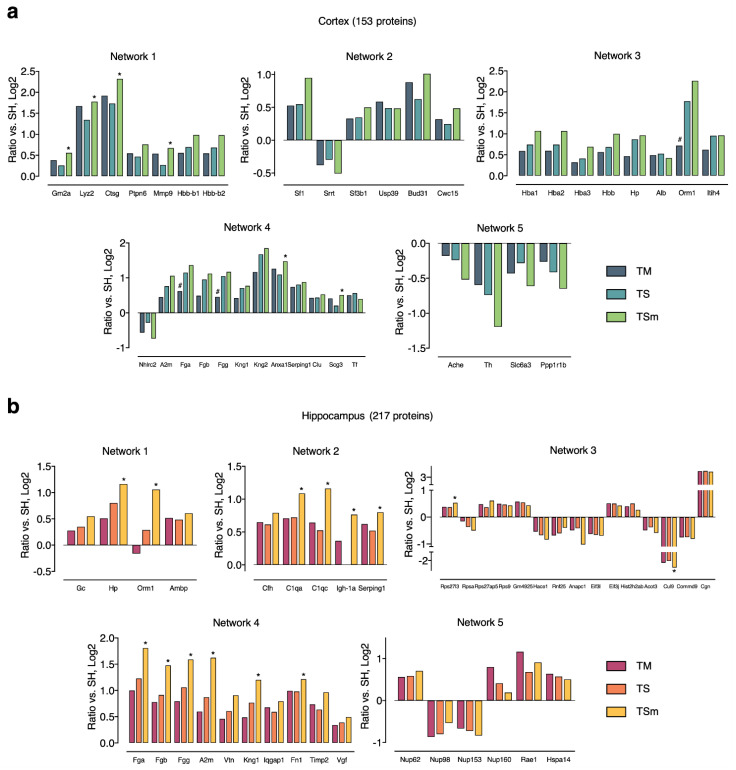
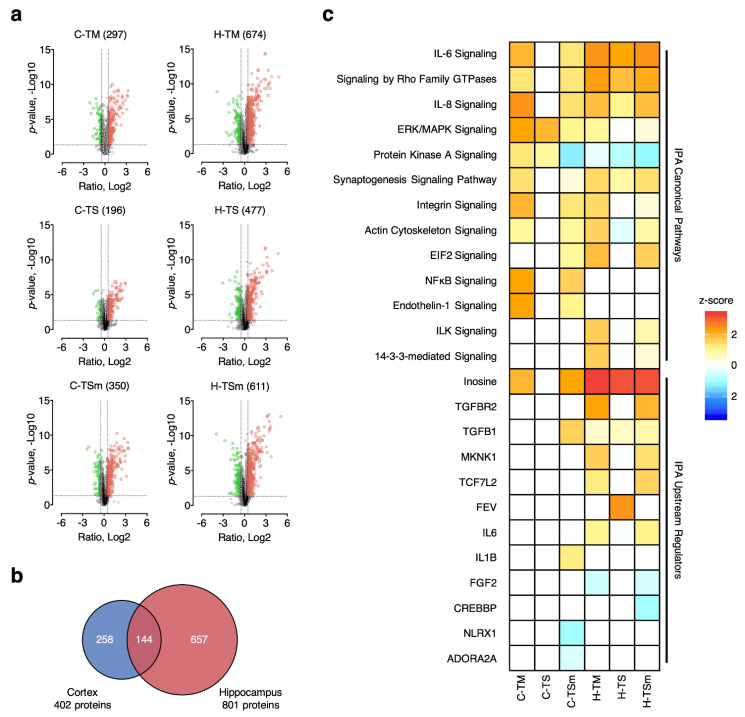
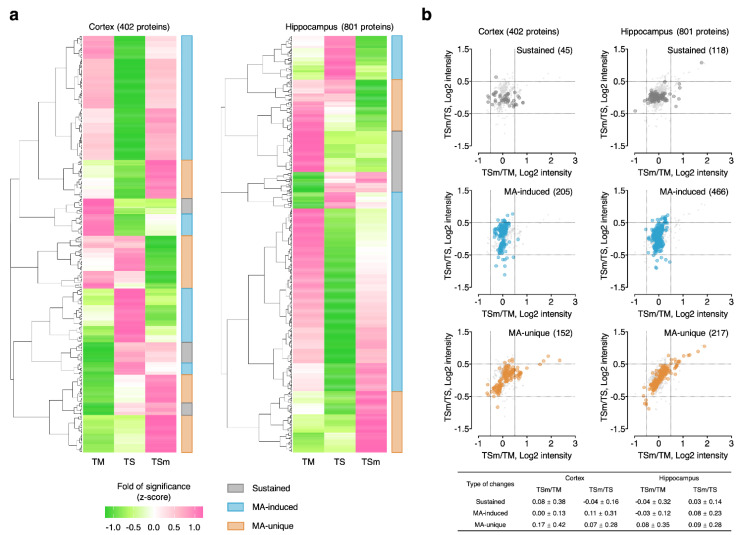
Although traumatic brain injury (TBI) causes hospitalizations and mortality worldwide, there are no approved neuroprotective treatments, partly due to a poor understanding of the molecular mechanisms underlying TBI neuropathology and neuroprotection. We previously reported that the administration of low-dose methamphetamine (MA) induced significant functional/cognitive improvements following severe TBI in rats. We further demonstrated that MA mediates neuroprotection in part, via dopamine-dependent activation of the PI3K-AKT pathway. Here, we further investigated the proteomic changes within the rat cortex and hippocampus following mild TBI (TM), severe TBI (TS), or severe TBI plus MA treatment (TSm) compared to sham operated controls. We identified 402 and 801 altered proteins (APs) with high confidence in cortical and hippocampal tissues, respectively. The overall profile of APs observed in TSm rats more closely resembled those seen in TM rather than TS rats. Pathway analysis suggested beneficial roles for acute signaling through IL-6, TGFβ, and IL-1β. Moreover, changes in fibrinogen levels observed in TSm rats suggested a potential role for these proteins in reducing/preventing TBI-induced coagulopathies. These data facilitate further investigations to identify specific pathways and proteins that may serve as key targets for the development of neuroprotective therapies.
虽然创伤性脑损伤(TBI)在全球范围内导致住院和死亡,但目前尚无批准的神经保护治疗方法,部分原因是对 TBI 神经病理学和神经保护的分子机制缺乏了解。我们之前报道过,小剂量甲基苯丙胺(MA)给药可在大鼠严重 TBI 后显著改善功能/认知。我们进一步证明,MA 通过多巴胺依赖性激活 PI3K-AKT 通路介导部分神经保护作用。在这里,我们进一步研究了与假手术对照组相比,轻度 TBI(TM)、严重 TBI(TS)或严重 TBI 加 MA 治疗(TSm)后大鼠皮质和海马中的蛋白质组变化。我们在皮质和海马组织中分别鉴定出 402 和 801 个具有高可信度的改变蛋白(AP)。TSm 大鼠中观察到的 AP 总体特征更类似于 TM 大鼠,而不是 TS 大鼠。途径分析表明,IL-6、TGFβ 和 IL-1β 的急性信号传递具有有益作用。此外,TSm 大鼠中纤维蛋白原水平的变化表明这些蛋白质在减少/预防 TBI 诱导的凝血功能障碍方面可能具有潜在作用。这些数据促进了进一步的研究,以确定可能作为神经保护治疗开发的关键靶点的特定途径和蛋白质。