Pediatric Hematology and Oncology, Hannover Medical School, Hannover, Germany.
Dr. Margarete-Fischer-Bosch Institute of Clinical Pharmacology, Stuttgart, Germany.
Leukemia. 2021 Sep;35(9):2650-2657. doi: 10.1038/s41375-021-01203-7. Epub 2021 Mar 13.
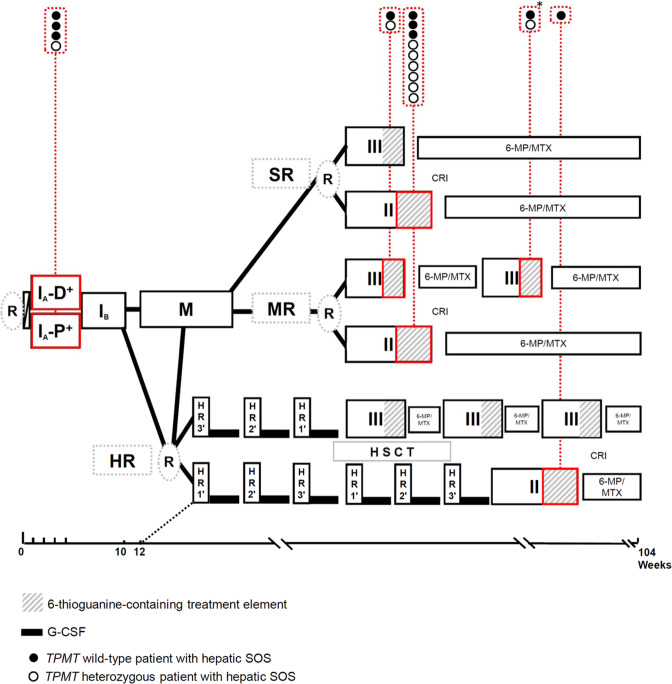
Long-term treatment with 6-thioguanine (6-TG) for pediatric acute lymphoblastic leukemia (ALL) is associated with high rates of hepatic sinusoidal obstruction syndrome (SOS). Nevertheless, current treatment continues to use short-term applications of 6-TG with only sparse information on toxicity. 6-TG is metabolized by thiopurine methyltransferase (TPMT) which underlies clinically relevant genetic polymorphism. We analyzed the association between hepatic SOS reported as a serious adverse event (SAE) and short-term 6-TG application in 3983 pediatric ALL patients treated on trial AIEOP-BFM ALL 2000 (derivation cohort) and defined the role of TPMT genotype in this relationship. We identified 17 patients (0.43%) with hepatic SOS, 13 of which with short-term exposure to 6-TG (P < 0.0001). Eight of the 13 patients were heterozygous for low-activity TPMT variants, resulting in a 22.4-fold (95% confidence interval 7.1-70.7; P ≤ 0.0001) increased risk of hepatic SOS for heterozygotes in comparison to TPMT wild-type patients. Results were supported by independent replication analysis. All patients with hepatic SOS after short-term 6-TG recovered and did not demonstrate residual symptoms. Thus, hepatic SOS is associated with short-term exposure to 6-TG during treatment of pediatric ALL and SOS risk is increased for patients with low-activity TPMT genotypes.
长期使用 6-硫鸟嘌呤(6-TG)治疗小儿急性淋巴细胞白血病(ALL)与较高的肝窦阻塞综合征(SOS)发生率相关。然而,目前的治疗方法仍在继续使用短期应用 6-TG,只有关于毒性的稀疏信息。6-TG 由硫嘌呤甲基转移酶(TPMT)代谢,该酶存在与临床相关的遗传多态性。我们分析了在 3983 例接受 AIEOP-BFM ALL 2000 试验治疗的小儿 ALL 患者(推导队列)中报告的作为严重不良事件(SAE)的肝 SOS 与短期 6-TG 应用之间的关联,并确定了 TPMT 基因型在这种关系中的作用。我们确定了 17 例(0.43%)肝 SOS 患者,其中 13 例短期接触 6-TG(P<0.0001)。在这 13 例患者中,有 8 例为低活性 TPMT 变异体的杂合子,与 TPMT 野生型患者相比,杂合子的肝 SOS 风险增加了 22.4 倍(95%置信区间 7.1-70.7;P≤0.0001)。独立的复制分析支持了这些结果。所有短期 6-TG 治疗后发生肝 SOS 的患者均已康复,且未出现残留症状。因此,肝 SOS 与小儿 ALL 治疗期间短期接触 6-TG 相关,低活性 TPMT 基因型患者的 SOS 风险增加。