Kumar Shiv, Franca Larissa Gomes, Stavrou Kleitos, Crovini Ettore, Cordes David B, Slawin Alexandra M Z, Monkman Andrew P, Zysman-Colman Eli
Organic Semiconductor Centre, EaStCHEM School of Chemistry, University of St. Andrews, St. Andrews, Fife, U.K. KY16 9ST.
Department of Physics, Durham University, Durham, U.K. DH1 3LE.
J Phys Chem Lett. 2021 Mar 25;12(11):2820-2830. doi: 10.1021/acs.jpclett.1c00265. Epub 2021 Mar 15.
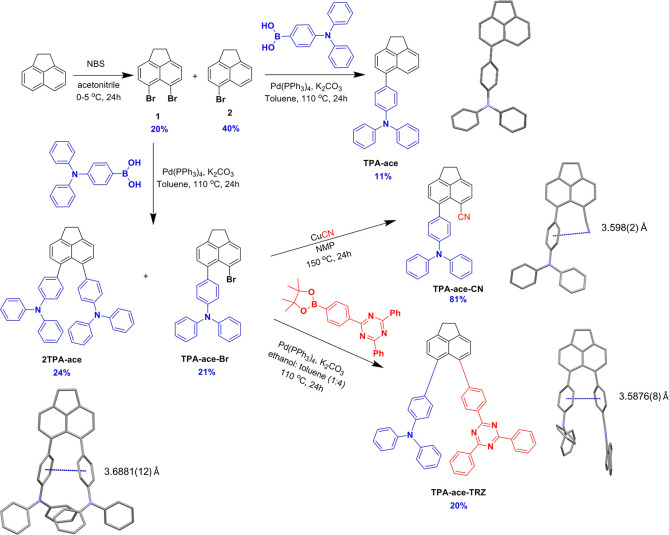
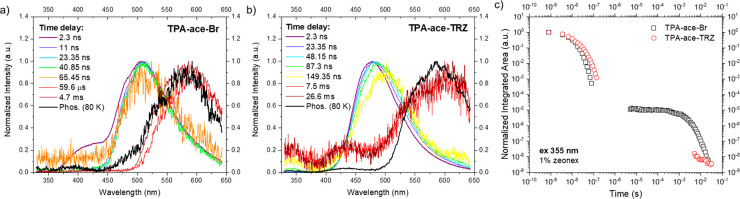
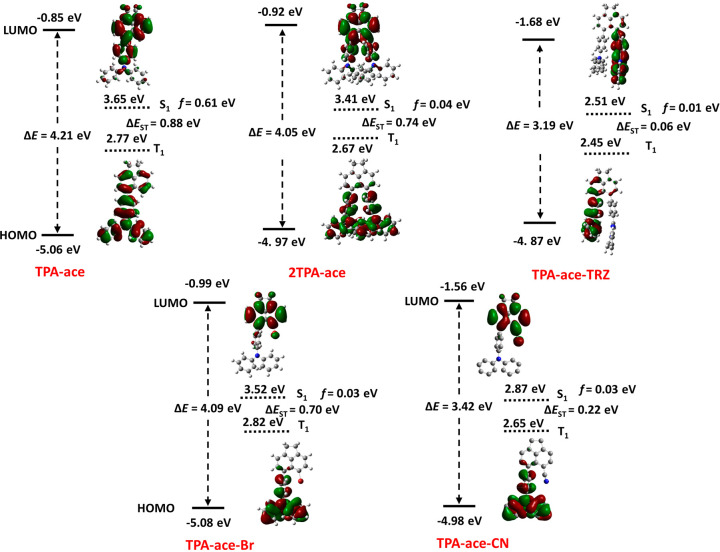
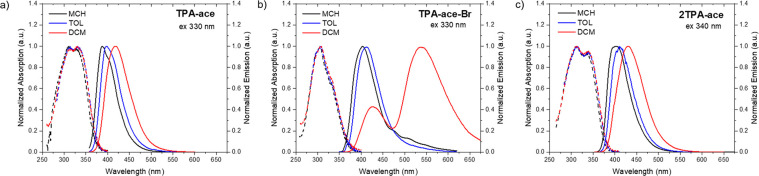
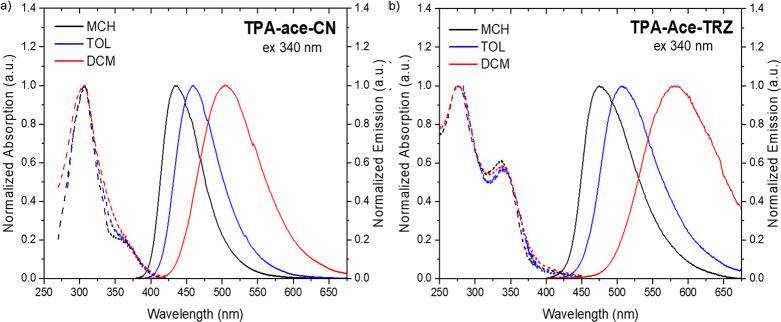
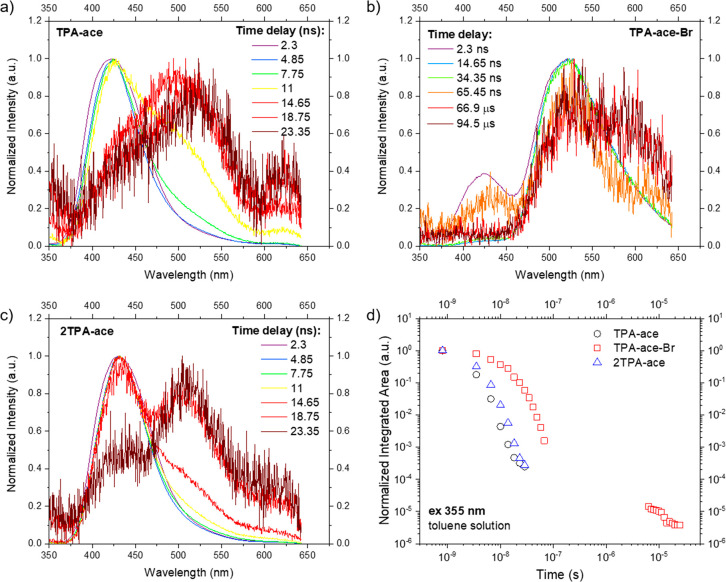
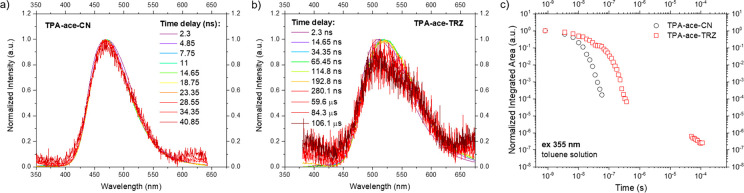
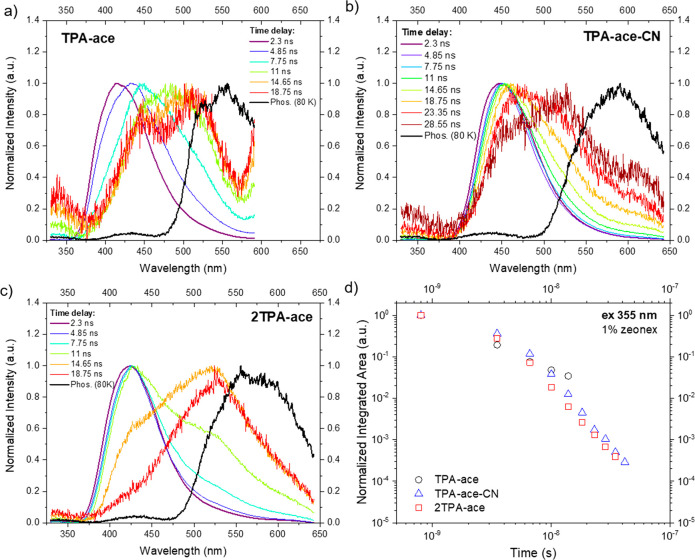
Commonly, thermally activated delayed fluorescence (TADF) emitters present a twisted donor-acceptor structure. Here, electronic communication is mediated through-bond via π-conjugation between donor and acceptor groups. A second class of TADF emitters are those where electronic communication between donor and acceptor moieties is mediated through-space. In these through-space charge-transfer (TSCT) architectures, the donor and acceptor groups are disposed in a pseudocofacial orientation and linked via a bridging group that is typically an arene (or heteroarene). In most of these systems, there is no direct evidence that the TSCT is the dominant contributor to the communication between the donor and acceptor. Herein we investigate the interplay between through-bond localized excited (LE) and charge-transfer (CT) states and the TSCT in a rationally designed emitter, , and a family of model compounds. From our photophysical studies, TSCT TADF in is unambiguously confirmed and supported by theoretical modeling.
通常,热激活延迟荧光(TADF)发光体呈现扭曲的供体-受体结构。在此,电子通信通过供体和受体基团之间的π共轭经由化学键介导。第二类TADF发光体是那些供体和受体部分之间的电子通信通过空间介导的发光体。在这些通过空间电荷转移(TSCT)结构中,供体和受体基团以假共面取向排列,并通过通常为芳烃(或杂芳烃)的桥连基团相连。在大多数这些体系中,没有直接证据表明TSCT是供体和受体之间通信的主要贡献者。在此,我们研究了在合理设计的发光体和一系列模型化合物中,经由化学键的局域激发(LE)态和电荷转移(CT)态与TSCT之间的相互作用。通过我们的光物理研究,明确证实了中的TSCT TADF,并得到了理论建模的支持。