Department of Medicine.
Division of Palliative Medicine.
Eur J Gastroenterol Hepatol. 2021 Dec 1;33(1S Suppl 1):e395-e400. doi: 10.1097/MEG.0000000000002113.
Although patients with cirrhosis often experience debilitating symptoms, few are referred for palliative care. Frailty is increasingly incorporated in liver transplantation evaluation and has been associated with symptom burden in other populations. We hypothesized that frail patients with cirrhosis are highly symptomatic and thus are likely to benefit from palliative care.
Patients with cirrhosis undergoing outpatient liver transplantation evaluation completed the Liver Frailty Index (grip strength, chair stands and balance) and a composite of validated measures including the Edmonton Symptom Assessment Scale, distress and quality of life (QOL) measures.
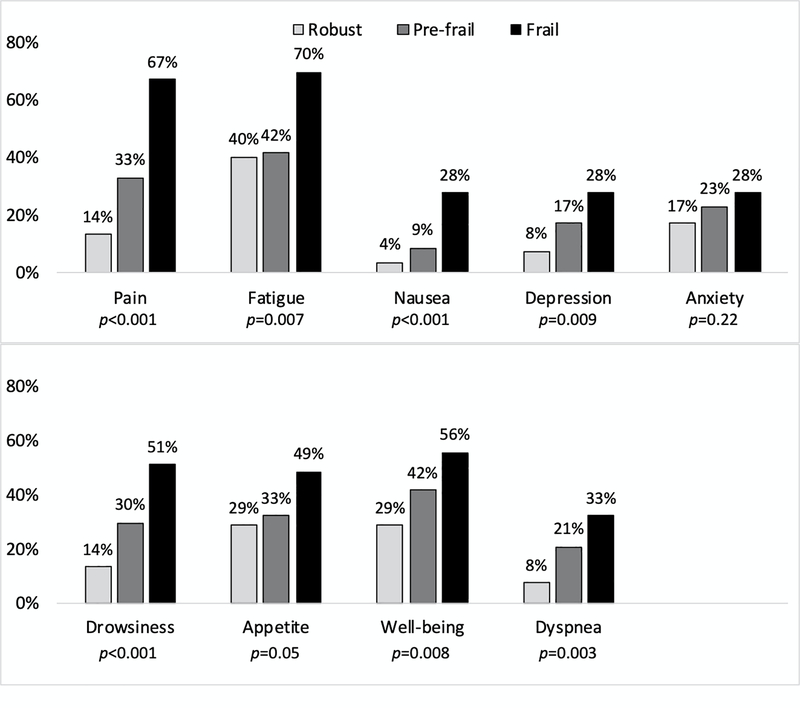
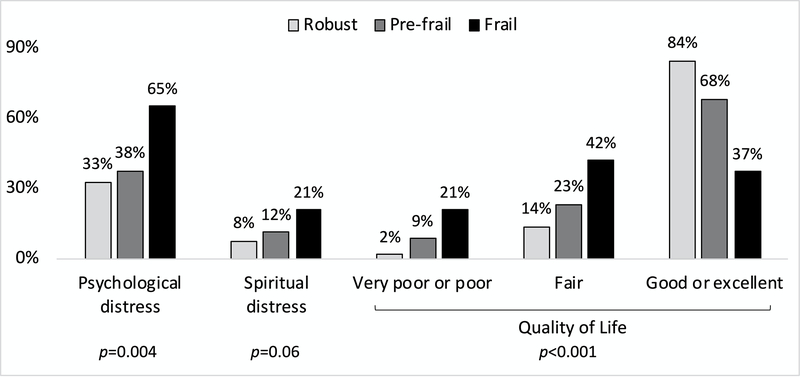
Of 233 patients (median age 61 years, 43% women), 22% were robust, 59% prefrail and 19% frail. Overall, 38% of patients reported ≥1 severe symptoms based on preestablished Edmonton Symptom Assessment Scale criteria. Higher frailty categories were associated with increased prevalence of pain, dyspnea, fatigue, nausea, poor appetite, drowsiness, depression and poor well-being (test for trend, all P < 0.05). Frail patients were also more likely to report psychological distress and poor QOL (all P < 0.01). In univariate analysis, each 0.5 increase in liver frailty index was associated with 44% increased odds of experiencing ≥1 severe symptoms [95% confidence interval (CI), 1.2-1.7, P < 0.001], which persisted (odds ratio, 1.3, 95% CI, 1.0-1.6, P = 0.004) even after adjusting for Model for End Stage Liver Disease-Sodium, ascites, hepatic encephalopathy and age.
In patients with cirrhosis, frailty is strongly associated with physical/psychological symptoms, including pain and depression and poor QOL. Frail patients with cirrhosis may benefit from palliative care co-management to address symptoms and improve QOL.
尽管肝硬化患者常出现虚弱症状,但很少有患者被转诊接受姑息治疗。衰弱越来越多地被纳入肝移植评估中,并与其他人群的症状负担相关。我们假设患有肝硬化的衰弱患者症状严重,因此可能受益于姑息治疗。
接受门诊肝移植评估的肝硬化患者完成了肝脏衰弱指数(握力、椅子站立和平衡)和包括经过验证的量表在内的综合评估,这些量表包括埃德蒙顿症状评估量表、痛苦和生活质量(QOL)量表。
在 233 名患者(中位年龄 61 岁,43%为女性)中,22%为强壮,59%为虚弱前期,19%为虚弱。总体而言,根据预先确定的埃德蒙顿症状评估量表标准,38%的患者报告存在≥1 种严重症状。较高的衰弱类别与疼痛、呼吸困难、疲劳、恶心、食欲差、嗜睡、抑郁和健康状况不佳的发生率增加相关(趋势检验,均 P < 0.05)。虚弱患者也更有可能报告心理困扰和较差的 QOL(均 P < 0.01)。在单变量分析中,肝脏衰弱指数每增加 0.5,出现≥1 种严重症状的几率增加 44%[95%置信区间(CI),1.2-1.7,P < 0.001],即使在调整了终末期肝病模型钠、腹水、肝性脑病和年龄后,这种关联仍然存在(比值比,1.3,95%CI,1.0-1.6,P = 0.004)。
在肝硬化患者中,衰弱与身体/心理症状密切相关,包括疼痛和抑郁以及较差的 QOL。患有肝硬化的衰弱患者可能受益于姑息治疗共同管理,以解决症状并改善 QOL。