
急性酒精中毒对创伤患者死亡率、凝血和纤溶的影响。
Effect of acute alcohol intoxication on mortality, coagulation, and fibrinolysis in trauma patients.
机构信息
Department of Emergency Medicine, Pusan National University Hospital, Busan, Republic of Korea.
Biomedical Research Institute, Pusan National University Hospital, Busan, Republic of Korea.
出版信息
PLoS One. 2021 Mar 23;16(3):e0248810. doi: 10.1371/journal.pone.0248810. eCollection 2021.
BACKGROUND
The effect of alcohol on the outcome and fibrinolysis phenotype in trauma patients remains unclear. Hence, we performed this study to determine whether alcohol is a risk factor for mortality and fibrinolysis shutdown in trauma patients.
MATERIALS AND METHODS
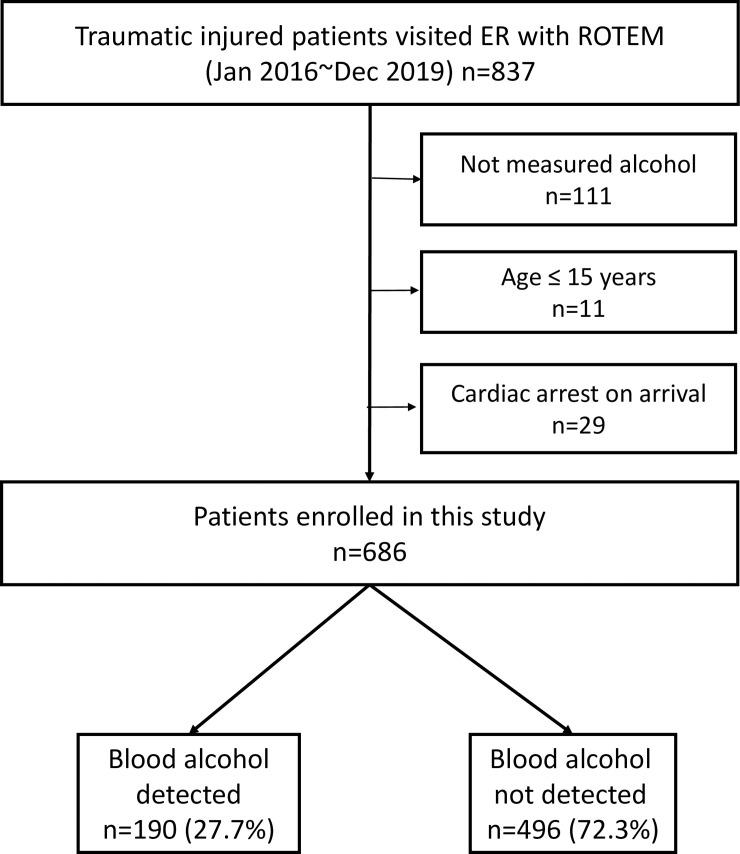
A total of 686 patients who presented to our trauma center and underwent rotational thromboelastometry were included in the study. The primary outcome was in-hospital mortality. Logistic regression analysis was performed to determine whether alcohol was an independent risk factor for in-hospital mortality and fibrinolysis shutdown.
RESULTS
The rate of in-hospital mortality was 13.8% and blood alcohol was detected in 27.7% of the patients among our study population. The patients in the alcohol-positive group had higher mortality rate, higher clotting time, and lower maximum lysis, more fibrinolysis shutdown, and hyperfibrinolysis than those in the alcohol-negative group. In logistic regression analysis, blood alcohol was independently associated with in-hospital mortality (odds ratio [OR] 2.578; 95% confidence interval [CI], 1.550-4.288) and fibrinolysis shutdown (OR 1.883 [95% CI, 1.286-2.758]). Within the fibrinolysis shutdown group, blood alcohol was an independent predictor of mortality (OR 2.168 [95% CI, 1.030-4.562]).
CONCLUSIONS
Alcohol is an independent risk factor for mortality and fibrinolysis shutdown in trauma patients. Further, alcohol is an independent risk factor for mortality among patients who experienced fibrinolysis shutdown.
背景
酒精对创伤患者结局和纤溶表型的影响仍不清楚。因此,我们进行了这项研究,以确定酒精是否是创伤患者死亡和纤溶抑制的危险因素。
材料和方法
共纳入 686 例来我院就诊并接受旋转血栓弹性测定的创伤患者。主要结局为院内死亡率。采用 logistic 回归分析确定酒精是否是院内死亡率和纤溶抑制的独立危险因素。
结果
研究人群中,院内死亡率为 13.8%,有 27.7%的患者检测到血液酒精。阳性组的死亡率更高,凝血时间更长,最大纤溶率更低,纤溶抑制更多,纤溶亢进更明显。Logistic 回归分析显示,血液酒精与院内死亡率(比值比[OR] 2.578;95%置信区间[CI],1.550-4.288)和纤溶抑制(OR 1.883[95%CI,1.286-2.758])独立相关。在纤溶抑制组中,血液酒精是死亡率的独立预测因素(OR 2.168[95%CI,1.030-4.562])。
结论
酒精是创伤患者死亡和纤溶抑制的独立危险因素。此外,酒精是纤溶抑制患者死亡的独立危险因素。
 Zotero 插件